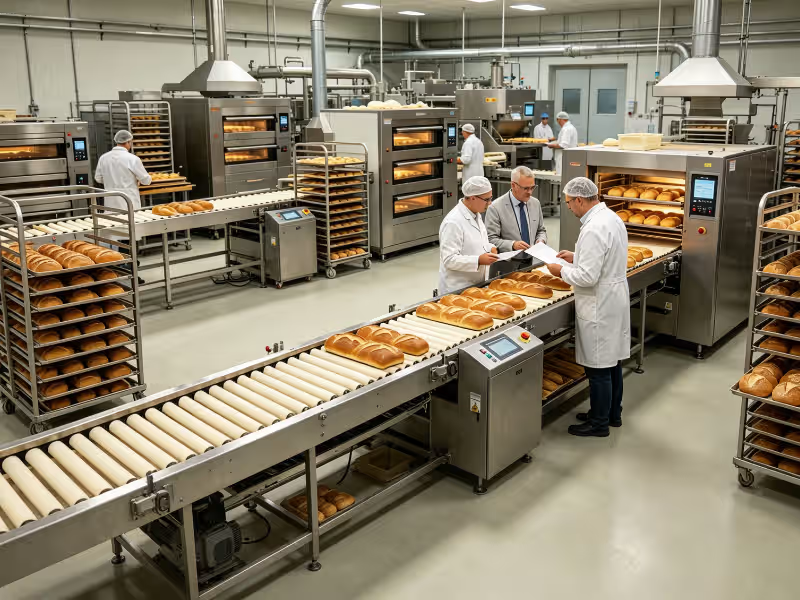
An industrial bakery still makes the same products it always has: sponge cake, sandwich bread, biscuits, Swiss rolls. The line that makes them looks very different from ten years ago. A typical plant then was a chain of standalone machines, with operators filling the gaps by hand. The plants pulling ahead today run those same process steps as one coordinated system.
The pressure is real and specific. Plants have fewer experienced operators willing to take early shifts. Retailers impose tighter specs on weight and color. Each line now handles more SKUs than it was originally designed for. Energy and ingredient costs are compressing margins. Food safety auditors expect batch-level records on request, not at the end of the week.
This article addresses three questions plant managers and production engineers actually search for:
- What “Baking 4.0” means on a working production line
- Where automation pays off first
- How to phase it in without committing the whole plant to one large-scale project
What Industrial Baking 4.0 Actually Means
Industrial Baking 4.0 is the move from automated machines to a connected, data-driven production line. Industry 3.0 automated individual stations. 4.0 connects them and uses their shared data to drive operational decisions.
It works across three layers.
1. Equipment. Machines execute their tasks with precision, without constant operator correction. A servo-driven depositor, for example, holds deposit weight within a tight tolerance across an entire shift, regardless of batter temperature or viscosity drift.
2. Connected line. Stations run in sync. The depositor’s cycle rate matches the tunnel oven belt speed, so product doesn’t pile up at the oven infeed or leave gaps on the band.
3. Data. Production data drives decisions. Oven zone temperatures are logged per batch and linked to scrap rates, so the production team can trace which bake profile produced yesterday’s rejects — before the same batch runs again.
The part most explanations skip: almost no plant is “fully 4.0.” A real factory often runs a manual mixing room alongside a PLC-controlled oven and a packing hall where staff still move product by hand. Baking 4.0 is a direction, not a switch. You move toward it one station at a time.
Why Industrial Bakeries Are Automating Now
Speed used to be the primary argument for automation. Today, the argument is different: holding consistency and protecting margin with fewer skilled people and a wider product mix.
Labor. Manual depanning, tray handling, and case packing are the hardest roles to fill. They’re repetitive, physically demanding, and concentrated in early-morning or overnight shifts. When those stations run short-handed, the whole line adjusts down to their pace.
Consistency and giveaway. Retailers reject underweight or off-color product. Overfilling to avoid rejection is direct margin loss. As an illustrative figure: 2 g of overfill on 60,000 units per shift equals 120 kg of batter given away every shift. That cost rarely appears as a line item, but it accumulates across a production year.
SKU growth and traceability. More formats per line means more changeovers, and each changeover costs output. Simultaneously, audits under BRCGS, SQF, and similar schemes require batch-level production records. Manual logs can’t support that at scale.
Automation on the Bakery Line, Step by Step
Baking 4.0 shows up station by station. For each step below: what goes wrong when run manually, what the automated version does, and what data it captures.
Mixing and Batter Aeration
The manual problem: Batch mixing varies with operator timing, ingredient temperature, and idle time before depositing. For aerated products such as sponge and chiffon cake, even small density swings change baked volume and crumb texture.
The automated solution: Continuous aerator mixers regulate air injection, mixing-head pressure, and rotor speed, keeping batter density consistent from the start of the shift to the end. Planetary mixers remain appropriate for batch work and shorter runs.
The data gained: Inline batter density and temperature — both worth correlating with final product volume and reject rates.
Depositing, Filling, and Forming
The manual problem: Mechanical depositors drift on weight as batter temperature or viscosity changes. Operators compensate by overfilling. This is where most giveaway originates.
The automated solution: Servo cake batter depositors and filling injectors maintain dose accuracy and store recipes centrally. A format changeover becomes a recipe selection on the HMI rather than a mechanical readjustment at the machine.
The data gained: Deposit weight per cycle — the number that makes the giveaway problem visible and controllable.
Baking and Oven Zone Control
The manual problem: Color and bake consistency break down when zone temperatures drift or belt speed doesn’t match the product load. The result is pale ends, dark centers, and variable moisture.
The automated solution: Multi-zone tunnel ovens with PID control and variable belt speed hold the bake profile steady across the full run. Tray tunnel ovens suit panned products; steel belt ovens suit belt-fed depositing lines; rotary rack ovens remain a solid choice for batch operations.
The data gained: Zone temperatures, belt speed, and energy consumption per zone — the foundation for tracking energy cost per kilogram of finished product.
Depanning, Cooling, and Cutting
The manual problem: Manual depanning damages product and is one of the hardest roles to staff consistently. Long cooling conveyors consume floor space. Hand cutting produces dimensional variation.
The automated solution: Pin ejector or rotary drum bakery depanning machines release product cleanly and consistently. Spiral cooling towers reduce floor footprint substantially by cooling product vertically. Ultrasonic cutters produce clean, repeatable cuts through cream-filled or layered products without smearing.
The data gained: Core temperature at the cooling exit — the number that controls condensation and mold risk inside the pack — and cut-to-size compliance.
Packaging and End-of-Line Inspection
The manual problem: Packing lines often run at a different rhythm from the oven. Product stacks up or gaps appear, and operators spend shift time manually buffering the gap.
The automated solution: Flow wrappers synchronized to upstream line speed, combined with checkweighers and metal detection or X-ray inspection, close the loop at the end of the line.
The data gained: Reject counts linked to batch, shift, and line position. This is exactly what food safety auditors request.
One honest limit: automating a single station only moves the bottleneck. A faster depositor feeding a slower packer just relocates the pile-up downstream. That’s why the data layer matters as much as the equipment.
From Connected Machines to a Connected Line
The most significant Baking 4.0 gains come when stations share data. A connected line makes losses visible, catches quality drift before it compounds, and flags equipment deterioration before it causes unplanned downtime.
The control stack, in plain terms:
- PLCs (programmable logic controllers) run individual machines.
- SCADA (supervisory control and data acquisition) displays the full line in real time.
- MES (manufacturing execution system) connects production to orders, recipes, and batch records.
- OPC UA is a widely adopted communication standard that enables machines from different vendors to exchange data on the same network.
OEE as the operational scorecard. Overall Equipment Effectiveness combines three factors: availability, performance, and quality. A line running at 90% availability, 85% performance, and 97% quality produces an OEE of roughly 74%. Without connected data, plants rarely see the micro-stops embedded in that performance number. A depositor that pauses for eight seconds, forty times an hour, generates no alarm and appears on no shift report. On a connected line, it surfaces on day one.
Inline quality control. Vision systems positioned after the oven check color and shape on every unit rather than on samples pulled at inspection intervals. Checkweigher data fed back to depositor settings allow automatic weight correction before giveaway accumulates. Closed-loop weight control is consistently among the fastest-returning 4.0 upgrades on a biscuit or cake line.
Condition-based maintenance. Vibration and temperature sensors on oven drives, conveyor chains, and cooling tower motors flag abnormal wear before it causes failure. This sits between the two costlier alternatives: fixed-schedule maintenance, which replaces serviceable components prematurely, and run-to-failure, which stops the line mid-shift without warning.
A practical note: not every plant needs a full MES from day one. A single line equipped with SCADA and consistent OEE tracking usually captures most of the early operational value at a fraction of the cost and integration complexity.
The Hard Parts: Integration, Hygiene, and People
Most Baking 4.0 projects stall on integration and skills, not on the technology itself.
Brownfield integration. Plants typically operate equipment from multiple vendors across multiple generations. Older machines often have closed controllers and no data ports. Retrofitting sensors, communication gateways, or replacement control panels is usually the first significant cost — and it’s frequently underestimated in early project budgets.
Hygiene and environment. Every sensor, cable tray, and control enclosure added to a food production line must withstand daily washdown, flour dust, oven heat, and high humidity. Equipment must also meet hygienic design requirements. A sensor mounted in a way that traps residue creates a sanitation liability, not a data asset.
People. A connected line requires controls engineers and mechatronics technicians, not only machine operators. Plants that invest in hardware but skip commissioning support and operator training routinely end up with sophisticated equipment running in semi-manual mode. A thorough supplier handover — covering system documentation, recipe management, and fault diagnosis — matters as much as the specification of the machinery itself.
Payback reality. Full-line automation returns its investment at high, sustained volume. A plant running frequent short runs across many formats may generate more measurable return by automating one or two confirmed bottleneck stations than by committing to an end-to-end automated line.
Where to Start: A Phased Roadmap
The plants that make Baking 4.0 work tend to follow the same sequence: automate the constraint first, connect the line second, optimize third.
- Measure. Establish a baseline on one line: OEE, scrap rate, giveaway per shift, changeover time, and energy per kilogram. Without these numbers, you cannot rank projects by return or confirm payback after implementation.
- Fix the constraint. Automate the station that most limits output or most depends on hard-to-fill labor. For many plants, that’s depanning, depositing, or end-of-line packing. One well-specified machine at the right station often improves the whole line’s performance.
- Connect. Synchronize line speeds and link station data. Add checkweigher feedback to the depositor and batch logging to the oven. Giveaway and scrap typically start falling at this step.
- Optimize. Use accumulated data for recipe tuning, maintenance planning, and capacity decisions. If a second line is on the roadmap, reserve floor space and utilities now. Electrical and gas infrastructure upgrades carry longer lead times than most equipment.
Plan factory acceptance testing (FAT) and site acceptance testing (SAT) at each phase. Treat any projected ROI as a target to validate, not a figure to present as fact.
Conclusion
Industrial Baking 4.0 is a line-design question before it’s a technology question. The plants pulling ahead treat mixing, depositing, baking, cooling, and packaging as one system with matched speeds and shared data. Individual stations still matter, but the operational gains come from how they work together.
Start with your most constrained station and the numbers that describe it. Whether that points toward a single equipment upgrade or a full automated baking line, the right starting point is a clear picture of where your current line loses output — and a supplier who can review that picture before proposing a solution.