The bakery industry does not have a new-product problem anymore.
For the past few years, the playbook was simple: launch more. A new viral flavor, a brand collab, a seasonal limited edition, a croissant in a shape nobody had seen before. That playbook worked when novelty was scarce. In 2026, it isn’t. Every bakery case, supermarket shelf and delivery app is crowded with “new.” Novelty has become the baseline, and a baseline is not a competitive edge.
The environment underneath the bakery case has changed. Core ingredients like cocoa, butter, eggs and matcha have gone through some of the sharpest price swings the trade has seen in decades. Customers now read portion sizes and ingredient lists as carefully as they read prices. And foot traffic that once belonged to the neighborhood bakery is being split between delivery platforms, supermarket in-store bakeries and convenience chains selling surprisingly decent pastries.
So the question for 2026 isn’t “what should we launch next?” The bakeries pulling ahead are winning on three things:
- Cost structure: can your recipes survive ingredient volatility without losing quality or customer trust?
- The new definition of health: do your products give people something, not just take something away?
- Store value: does your physical location offer something an app or a supermarket can’t?
These aren’t abstract priorities. They keep coming up on trade show floors, in conversations with ingredient suppliers, and in R&D kitchens where teams are reworking recipes they thought were finished years ago.
Below are the seven trends reshaping the industry this year, ordered from the most immediate to the least visible, and what each one means for independent bakeries, chains, supermarket bakery teams and product developers.
1. Ingredient Costs Are Rewriting Recipes
If we had to pick the single trend with the biggest practical impact on bakeries in 2026, it’s ingredient cost. It doesn’t trend on TikTok and it doesn’t get a launch event. But it has touched almost every recipe card in the industry.
Start with cocoa. Futures peaked above $12,000 per tonne in late 2024—several times the long-run average—driven by poor harvests in West Africa, where most of the world’s cocoa is grown. Prices have eased since then, but the damage to production planning was done. Chocolate stopped being a stable input and became a volatile one. Butter followed a similar path in Europe, hitting record highs in 2024. In the US, avian flu drove egg prices to painful levels in early 2025. And matcha ran into a genuine supply squeeze as global demand outpaced what Japanese growers could produce.
Here’s what that looks like at the counter. Take a pain au chocolat. The chocolate batons used to be a minor cost line—a small slice of the total compared to butter, flour and labor. When cocoa prices multiply, that small slice becomes a large one. Pair it with expensive butter, already the costliest ingredient in laminated dough, and a product that used to carry a healthy margin can slide toward break-even. Nothing about the pastry changed. Its economics did.
Bakeries and brands have responded in a few predictable ways:
- Smaller sizes at the same or a slightly lower price point
- Less chocolate per piece, or chocolate moved from the filling to a decorative drizzle
- Swapping fillings toward nuts, fruit compotes, caramel or seasonal jams
- Chocolate-flavored alternatives, including compound coatings and cocoa-free products made from roasted grains or carob
Some of these moves are smart. Others backfire.
The risk is shrinkflation. Customers notice when a croissant gets smaller or a cookie has fewer chips, and in 2026 they don’t just notice quietly. They post side-by-side photos. A quiet reformulation can become a public story about a brand cutting corners, and that reputational damage outlasts a few months of compressed margin. The fix isn’t to avoid making changes—it’s to make them openly. Rename the product, reposition it, or launch a new line instead of silently shrinking an old favorite.
Recipe Flexibility Matters More Than Locking In Prices
Most operators instinctively answer volatility through procurement: lock in forward contracts, buy in bulk, hedge where possible. That’s sensible, but it only delays the problem. Contracts expire. Bulk inventory runs out. When the next price spike hits, you’re back where you started.
The real competitive advantage in 2026 is recipe flexibility: building each core product so it can run on two or three ingredient configurations without customers noticing a meaningful drop in quality.
In practice, that means R&D teams doing the work before the price spike, not during it. For a chocolate pastry, that might mean validating a version with a lower cocoa percentage, a version with a blended filling, and a version using a high-quality compound coating—then running blind taste tests to know exactly how far each can be pushed. For laminated doughs, it means testing butter blends and knowing the threshold where flakiness and flavor visibly suffer. For egg-heavy products like brioche or custards, it means having egg-reduced formulas tested and on file before you need them.
The goal is a decision playbook: if ingredient X rises past a certain price, switch to version B. That turns a supply crisis into a planned operational move, and it protects the customer relationship because the product stays consistent rather than being reworked in a panic.
In 2026, a team that knows how to engineer a recipe is worth more than one that knows only how to negotiate a purchase order.
2. Functional Baking: Protein, Fiber, and the Small-Portion Era
What does “healthy bread” actually mean?
For a long time, the answer was subtraction: less sugar, less fat, fewer calories. That’s still part of the picture. But in 2026, the question customers are asking has flipped. They want to know what a product gives them, not just what it leaves out.
Three forces are driving this at once. First, GLP-1 medications like Ozempic and Wegovy have gone mainstream, and people taking them tend to eat significantly smaller amounts—so every bite has to earn its place. Second, the fitness audience has expanded well beyond gym regulars, and protein has become an everyday shopping filter for a much broader group. Third, more consumers now actively track blood sugar responses, driven by wearable glucose monitors and a steady stream of nutrition content online. Combined, these shifts make a pastry that’s “just a treat” a harder sell for daily purchases, while a product that delivers protein or fiber becomes an easier one.
You can already see this on shelves. High-protein bagels, sandwich breads and even croissants are now common in supermarkets and specialty cafés. Brands are working pea protein, whey, egg white powder and legume flours like chickpea and fava into doughs. It isn’t easy. Adding protein tends to tighten dough and reduce moisture retention. It affects how bread rises and how quickly it stales. And protein isolates are expensive. Teams that do this well typically accept a slightly different texture and lean into it, rather than trying to replicate a standard bagel exactly.
Fiber is the quieter half of this trend. Whole grains, oat fiber, seeds and added fibers are appearing in mainstream loaves, and “grams of fiber per serving” is migrating to the front of the pack, where it used to be buried in the nutrition panel. Fiber has a practical advantage over protein: it’s usually cheaper to incorporate and more familiar to bakers.
Then there’s portion size. When customers eat less, they buy differently. That shows up as mini croissants, bite-sized loaves, shareable boxes and individually wrapped pieces. For operators, this changes the revenue math. A smaller item means a lower unit price, so maintaining average spend requires customers to buy more than one, add a drink or choose a multi-pack. Mini formats work best when they’re built to be bundled: a box of four flavors, a “pick three” offer, or a coffee-and-pastry pairing.
Channels are adapting too. Supermarket bakery sections are beginning to carve out dedicated functional shelves, separate from the standard bread aisle. Convenience stores are placing protein breads and seeded rolls directly beside grab-and-go coffee, targeting the breakfast commuter who needs something that holds until lunch.
The lesson for product developers is clear. Stop competing only on “sugar-free.” Pick one or two nutrition claims you can actually measure, put them on the front of the pack, and build the product around them from the start.
3. Fermentation’s Return: Sourdough, Long Fermentation, and Clean Labels
Sourdough isn’t new. It’s one of the oldest ways to make bread. But in 2026, what sourdough means to customers has shifted. It used to be a flavor and craft signal in artisan bakeries. Now it’s becoming a trust signal—and mass-market brands want it just as badly as the indie shop down the street.
The driver is the growing conversation around ultra-processed food. Over the past couple of years, “ultra-processed” has moved from academic literature into everyday discourse. Industrial sliced bread, with its long list of emulsifiers, preservatives and dough conditioners, often gets pulled into that debate. The result is consumers who read ingredient lists line by line and are suspicious of anything they can’t pronounce.
Long fermentation answers that suspicion in a way that marketing alone can’t. Given sufficient time, natural fermentation builds flavor, improves texture and extends freshness without added preservatives. It lets a bakery print a short ingredient list—flour, water, salt, starter—and explain its process in a single sentence. A short list combined with a process customers can actually understand is exactly what supports a higher price point. People will pay more for bread they trust.
That’s why sourdough and “slow-fermented” lines have spread from artisan bakeries into supermarkets. Large bakery brands have launched their own versions, and in-store bakeries now feature sourdough loaves alongside their standard range.
This is where the trend gets complicated. Clean-label fermentation has real costs:
- Shorter shelf life: remove preservatives and emulsifiers, and bread stales or molds faster. That means more waste, tighter stock rotation and narrower distribution windows.
- Higher labor and time costs: long fermentation ties up space, equipment and planning. It can’t be accelerated without compromising the result.
- Concept dilution: when every brand calls a product “sourdough”—including those that rely on added acids or flavorings rather than live fermentation—the word loses its meaning. Customers who feel misled once tend to distrust the whole category.
Fermentation has been the “next big thing” in mainstream bakery conversations for years. In 2026, it has genuinely arrived. But arriving at scale is exactly when it gets stress-tested.
A clean label can earn a premium, but only when the process behind it is real and the bakery can explain it in plain language.
4. Viral Cycles Are Getting Shorter: Social Media, Global Flavors, and Limited Drops
A dessert can now go from one shop’s counter to global ubiquity to “so last year” within a few months.
The clearest case study is Dubai chocolate. It started with a single product from FIX Dessert Chocolatier in Dubai: a thick chocolate bar filled with pistachio cream and crispy kataifi pastry. A viral video in late 2023 set it off, and through 2024 it spread across TikTok and Instagram worldwide. Within months, bakeries everywhere were selling Dubai chocolate croissants, cookies, cakes and doughnuts. Major chocolate brands launched their own versions. Then pistachio supply tightened under the demand pressure. By the time some bakeries had their version properly developed and costed, the peak had already passed.
Croissant hybrids follow the same pattern, with a repeatable formula underneath: take a familiar product and give it a new shape or mash-up. The crookie—a croissant filled with cookie dough—exploded out of Paris in 2024. Before and after it came the round filled croissant, the cube croissant and the flattened, pressed croissant. None of these were technically new pastries. They were existing laminated dough in a format that photographs well and feels novel in the hand.
Flavors are moving just as fast. Matcha, ube, pandan and sweet-heat combinations like chili-honey or spicy chocolate have shifted from niche to mainstream. Global flavors spread quickly because social media erases borders. A pandan cake trending in Singapore can appear in a London bakery’s specials within weeks. There’s a catch worth naming: when a flavor goes viral, it can trigger a run on its key ingredient, as matcha buyers found in 2025.
So what’s the actual business lesson here? It isn’t to predict the next hit—almost nobody does that reliably. The money is in building a product rhythm that can respond quickly: test small, launch as a limited drop, pull it on time.
A limited drop does three things at once. It creates urgency, which brings people in and often forms a line, and a line is its own marketing. It caps the risk on specialty ingredients. And it gives you a clean exit, so the item disappears while people still want it rather than lingering in the case until it needs to be discounted.
The bakeries that get burned by viral trends tend to repeat the same mistakes. They commit to large orders of specialty ingredients—kataifi, pistachio paste, ube extract—then get stuck with inventory when demand falls. They add hit after hit to the permanent menu until the brand no longer stands for anything specific. They invest R&D time copying a trend that has already peaked.
A viral item is a traffic tool, not a product strategy. Every bakery needs a clear line between its evergreen core and its limited-time rotation—and should never let the second crowd out the first.
5. Bakeries Are Becoming Destinations, Not Just Pick-Up Points
When the same croissant is available on a delivery app and in a supermarket down the road, why would anyone make a special trip to your bakery?
That question is now shaping how successful bakeries design, staff and locate their stores. The answer is shifting. The product itself is no longer enough of a draw. What brings people in is the moment something comes out of the oven, the feeling of being somewhere real, and a space worth spending time in.
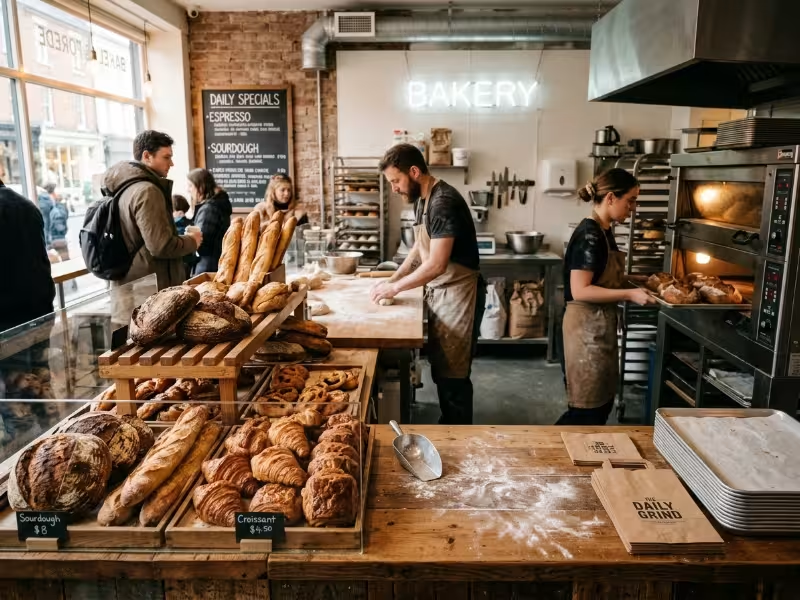
Start with the oven. Open kitchens and visible baking have moved from a design flourish to a genuine traffic strategy. People want to see dough being shaped, trays sliding out and bread cooling on racks. Some bakeries now publish bake schedules on their doors, websites and social channels: croissants at 7:30, sourdough at 11, cardamom buns at 3. That turns “fresh from the oven” from a lucky coincidence into a planned reason to visit. It also spreads foot traffic across the day instead of compressing it into the morning rush.
The second shift is format. Bakeries are blending with specialty coffee and all-day brunch, becoming places where customers sit for thirty minutes rather than grabbing a bag and walking out. In residential neighborhoods especially, the local bakery is evolving into a third place—somewhere between home and work where people meet, work on a laptop or linger on a weekend morning. That role is very difficult for a delivery app to replicate.
But the trade-off is real and shouldn’t be glossed over. Longer stays mean fewer seat turns. Seating occupies space that could hold display cases or production capacity. A high-traffic commuter location should stay lean and fast—seats there are a cost, not an asset. A neighborhood site with weekend traffic and remote workers can justify more seating and a broader food menu. There’s no universal right answer, only the right answer for each specific location.
For customers, this is the most noticeable bakery trend of 2026. They feel it every time they walk into a shop that’s actually worth the trip.
6. The Back-of-House Upgrade Nobody Sees
This is the trend customers will almost never notice. It’s also the one that may decide which bakeries are still profitable by the end of the year.
Bakeries lose money in two main ways: labor and waste. Early-morning shifts are hard to staff, and skilled bakers willing to start at 4 a.m. are in short supply in most markets. On the other end of the day, anything unsold is lost margin. Bake too little and you run out of stock by noon. Bake too much and it goes in the bin at closing time.
Demand forecasting is changing how that second problem gets handled. Tools that combine historical sales data with weather, local events, holidays and day-of-week patterns can now tell a store how many croissants to bake on a rainy Tuesday versus a sunny Saturday. This kind of forecasting used to be the exclusive domain of large industrial bakeries. In 2026, it’s reaching chains and mid-sized operators through point-of-sale integrations and more affordable software platforms.
Labor is being addressed through structural changes, not just technology. The model of central production plus in-store baking has become standard for growing chains. A central kitchen or manufacturing partner handles mixing, laminating and shaping—often producing frozen dough. Stores then proof and bake on site, preserving the fresh-from-the-oven experience without needing a skilled baker at every location before dawn. Automated dividers, sheeters and shaping equipment are filling skill gaps in central kitchens and larger production sites. For operators building or upgrading a central facility, this is where industrial cake production lines and bakery ovens with consistent, controllable bake profiles earn their keep—stable output across long runs matters far more than peak performance on a good day.
Waste is getting a second line of defense too. Apps like Too Good To Go let bakeries sell end-of-day surplus as discounted surprise bags. The real benefit is commercial, not just environmental. When a product is thrown away, you lose its full cost. When you recover even part of the sale price, that recovery goes straight to margin. For a bakery where end-of-day waste is a meaningful share of daily production, cutting it by even a few percentage points can have more impact than a small price increase—without any customer backlash.
For independent bakeries, the upfront cost of these systems can still be a hurdle. For chains and mid-sized operators, they’ve already become a basic expectation.
7. Labeling and Regulatory Pressure: The Least Visible Trend With the Deepest Impact
Regulation may be the least exciting item on this list. It’s also the one most likely to touch packaging, marketing and purchasing decisions simultaneously.
Start with marketing. In the UK, restrictions on advertising foods high in fat, sugar or salt (HFSS) became legally binding in January 2026, after the industry moved to voluntary compliance from October 2025. Many HFSS products can no longer be promoted on TV before 9 p.m. or through paid digital advertising. Pastries, cakes, biscuits and most sweet baked goods fall into that category. For brands that relied on paid social or television to build awareness around new product launches, the channel mix has to change. Expect heavier investment in in-store visibility, organic content, and reformulated or portion-controlled versions designed to fall outside the HFSS threshold.
Then there’s the supply chain. The EU Deforestation Regulation (EUDR) requires companies selling cocoa, palm oil and soy into the EU to prove those ingredients weren’t sourced from recently deforested land. The start date has been delayed more than once—verify the current implementation timeline for your business scale—but the direction is not in doubt. This compounds the cocoa cost pressure already discussed. Traceable, compliant cocoa and sustainable palm oil require additional documentation, supplier verification and, often, higher procurement costs. Any bakery buying chocolate or fats through distributors should already be asking those suppliers what their compliance plan looks like.
Labeling is tightening in parallel. Allergen rules continue to become more prescriptive. The UK’s Natasha’s Law—requiring full ingredient and allergen labeling on food prepacked for direct sale—is the reference point most bakeries already know. And the same consumer demand for transparency that’s fueling clean-label interest in ingredients also raises the standard for label accuracy, readability and format.
For most customers, all of this is invisible. For brand owners, operators and investors, it’s one of the more significant structural shifts of 2026. Compliance is quietly becoming a barrier to entry, and smaller bakery brands that find the cost of meeting it prohibitive may increasingly become acquisition targets for larger players who can absorb it.
What All of This Adds Up To in 2026
Zoom out, and these seven trends point in the same direction. Baking is no longer a contest over who launches the most new products. It’s a contest over who has the strongest underlying system: flexible recipes, genuine nutritional value, a physical location worth visiting, efficient back-of-house operations and the ability to stay compliant.
For customers, the picture is mixed. They’ll find clearer ingredient lists, more meaningful nutrition claims and more bakeries that are genuinely worth going out of their way for. They’ll also encounter smaller portions, higher prices and fewer products that seem too good to be true.
For operators, the right moves depend on who you are:
- Independent bakeries win on craft and authenticity: real fermentation, visible baking, published bake schedules and a space people want to come back to.
- Chains and supermarket bakery teams win on systems: demand forecasting, central production, supplier traceability and regulatory compliance.
- Product developers win on recipe flexibility: products engineered in advance to absorb ingredient shocks, with nutrition claims that can be measured and put on the front of the pack.
If you’re deciding where to start, don’t begin with a new product launch. Begin with an audit. Which three bestsellers are most exposed to a single volatile ingredient? Which items generate the most end-of-day waste? Which products could carry a credible protein or fiber claim with a modest reformulation? The answers typically point toward the right next step—whether that’s an ingredient supplier who can support alternative formulations, demand-planning software that connects to your point-of-sale system, a dough partner who can relieve pressure on your early-morning shift, or cake manufacturing equipment that brings more consistency and control to your production process.
This is what makes 2026 the most interesting year in baking in a long time, and why the second half of the year is worth watching closely.