It’s the early shift, and two operators are hand-filling cupcake liners on 400 × 600 mm trays. The first dozen trays look clean. By mid-morning, wrists are tired, and the scoop has started to drift. One cup sits half full, and the next is nearly at the rim. The short ones bake out pale and squat. The full ones dome, crack, or run over onto the tray. Nobody catches it until the cakes reach the packing table. By then, the batter, the oven time, and the labor are already spent.
That drift is the problem a cake batter depositor is built to solve. It takes portioning out of human hands and turns it into a mechanical cycle that delivers the same amount into every cup, mold, or tray, hour after hour. Below, we cover what the machine is, the volumetric principle behind its accuracy, how standard and servo-controlled models differ, what a real depositing run looks like, and how to match a machine to your line. We’ll start with the definition.
What Is a Cake Batter Depositor?
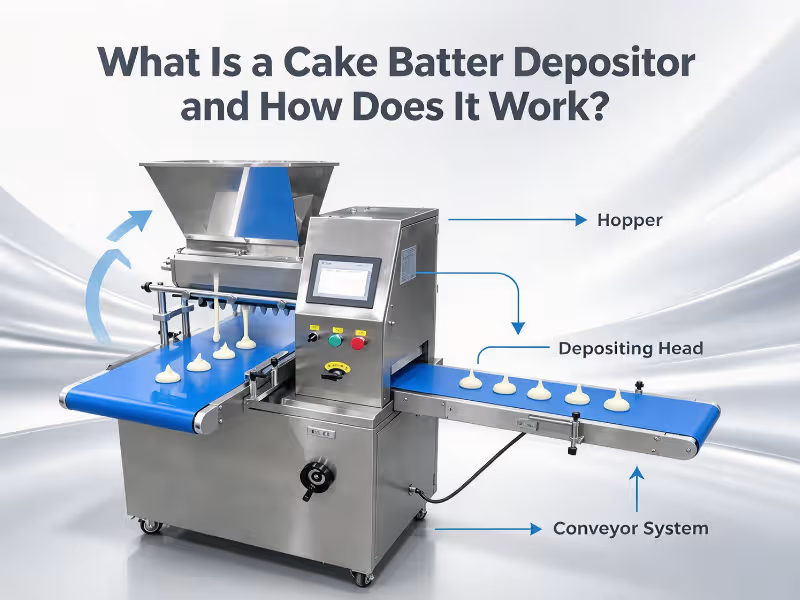
A cake batter depositor is a food processing machine that measures fixed volumes of batter or fluid mixture and dispenses them into cups, molds, or baking trays. It replaces hand scooping and piping with a repeatable mechanical cycle, so portion size stays constant at commercial production speeds.
Take the panels off almost any depositor, and you’ll find the same five working parts:
- Hopper: Holds the mixed batter and feeds it to the metering system.
- Metering system: Usually a piston and cylinder that measures each portion by volume.
- Valves: Switch the batter’s path between hopper and nozzle at set points in each cycle.
- Nozzles or depositing heads: Shape the batter as it leaves the machine and place it in each cavity.
- Control panel: Sets volume, speed, and depositing mode, and stores settings for each product.
The range of materials is wider than many buyers expect. A depositor can run sponge cake mixture, chiffon batter, cupcake and muffin batter, heavy oil cake batter, and mousse or other fluid fillings. On the line, it sits between the mixer and the oven, with trays fed underneath by a conveyor or a manual loading station. Standard machines are usually designed around the 400 × 600 mm tray found in most commercial bakeries.
How Does a Cake Batter Depositor Work?
Most cake batter depositors are volumetric. They measure batter by volume, not by weight. Think of a syringe. Pull the plunger back a set distance, and it draws in a set amount. Push it forward, and that same amount comes out. Inside a depositor, a piston travels a fixed distance in a cylinder, so every stroke moves the same volume of batter.
Each cycle runs in two phases:
- Intake stroke: The piston retracts and draws batter from the hopper into the cylinder.
- Output stroke: A valve closes off the hopper and opens the path to the nozzle, and the piston pushes the batter out.
The hardest part of the cycle is the finish. Batter keeps moving after the piston stops, leaving drips or tails trailing across the tray. Good machines handle this with tight valve timing and a short reverse movement called suck-back, which pulls batter back into the nozzle for a clean break. With thin, free-flowing chiffon and sponge batters, this one detail often decides whether trays come out neat or messy.
Operators set the deposit volume on the control panel, which adjusts the piston’s stroke length or speed. Saved recipes bring those settings back in seconds. Here is where many first-time buyers get caught out, though. A fixed volume gives you a fixed weight only when batter density stays steady. Aeration is the biggest variable. A sponge batter that has lost air in the hopper weighs more per cup than one fresh from the mixer, even at the same volume setting.
How tightly a machine controls this cycle comes down to its drive and control system. That is the clearest dividing line between depositor types.
Types of Cake Batter Depositors
Depositors separate along three lines: the drive and control system, nozzle flexibility, and the weight tolerance they can hold. Depositing mode matters too. Dot depositing places individual portions into cups and molds. Strip depositing lays continuous lines of batter for sheet cakes and full-tray formats.
Standard Volumetric Depositors
A standard volumetric depositor relies on fixed piston metering to deliver the same portion on every stroke. It suits lines running stable, repeatable products where the recipe doesn’t change every hour. Our Cake Batter Depositing Machine is a good example of this category. It runs sponge, chiffon, heavy oil cake, mousse, and similar fluid materials in both dot and strip modes, and it stores recipes for quick recall. It fits standard 400 × 600 mm trays. Its precision-machined, corrosion-resistant product-contact parts are built to handle daily washdowns without wearing out.
Servo-Controlled High-Precision Depositors
A servo depositor replaces the fixed mechanical drive with servo motors that control piston position and speed in much finer steps. A PLC coordinates timing and volume across each cycle. In practice, that means tighter weight consistency and quicker moves between products. The High Precision Cake Batter Depositor shows what this looks like on the floor. It pairs a Siemens PLC with up to 7 individually adjustable nozzles, so operators can trim a single lane without changing filling heads. Recipe changes run through an LCD touchscreen with memory programs. That combination makes it well suited to molded cakes, cupcakes, muffins, and other weight-sensitive products.
|
Standard Volumetric |
Servo High-Precision |
|
|---|---|---|
|
Control system |
Fixed volumetric metering |
Servo drive with PLC |
|
Nozzle adjustment |
Set per recipe |
Individual, per nozzle |
|
Best-fit production |
Steady, repeatable runs |
Tight tolerances, frequent changeovers |
|
Typical products |
Sponge, chiffon, heavy oil cake, mousse, full trays |
Cupcakes, muffins, molded cakes |
The machines differ in how precisely they run each cycle. The daily routine around them, however, is almost the same.
The Cake Batter Depositing Process, Step by Step
A typical depositing run, from hopper to washdown, goes like this:
- Batter preparation and loading: Freshly mixed batter goes into the hopper. Avoid over-mixing, and don’t let batter stand for long. Both change aeration, and aeration changes portion weight.
- Recipe selection: The operator calls up a saved program that sets volume, mode, and speed. With recipe memory, nobody re-keys settings at each product change.
- Tray or mold positioning: Trays or mold sets move under the nozzles by hand or by conveyor. Nozzles must line up exactly with the tray layout, or deposits land off-center.
- Metering and depositing: The piston cycle measures each portion, and the nozzles place dots into cups or strips across the tray. If one lane runs light, individual nozzle adjustment fixes it without stopping the line.
- Cut-off and indexing: A clean cut-off prevents tails. The tray then moves to the next row, or the next tray slides into place.
- Quality check and adjustment: Spot-weigh several deposits at the start of every run. If batter density has shifted, correct the volume before filling a full batch.
- Cleaning: Strip down and wash the product-contact parts between batches or at the end of the shift. Corrosion-resistant components are what make frequent washing practical.
The result is a tray of uniform deposits, ready for the oven. Bake times stay predictable, and finished weights land on target.
How to Choose the Right Cake Batter Depositor
Start with your production, not the spec sheet. Run your operation against these five criteria:
- Product range: List every batter and format you produce, including cups, molds, strips, and full trays. Confirm the machine handles each one.
- Weight tolerance: Decide how much variation you can live with. Retail-packed and labeled products usually need tighter control than loose goods.
- Changeover frequency: If you switch products several times a day, recipe memory and tool-free nozzle adjustment cut real downtime.
- Tray and mold compatibility: Check that the machine fits your 400 × 600 mm trays or custom molds before you commit.
- Hygiene and maintenance: Look for food-grade, corrosion-resistant contact parts that strip down quickly for daily cleaning.
For steady, standard-volume production, a volumetric machine such as the Cake Batter Depositing Machine usually covers the job. When weight targets are tight, molds vary, or changeovers are frequent, a servo-controlled model such as the High Precision Cake Batter Depositor earns its place.
The Future of Cake Batter Depositing
A cake batter depositor turns inconsistent hand portioning into a repeatable volumetric cycle. Standard machines carry stable, high-repeat runs. Servo models take on production that demands tighter accuracy and constant product changes.
The industry is moving in one direction. As tolerances tighten, servo drives and PLC control are becoming standard, not premium. Recipe-driven flexibility fits the shorter, more varied runs that many bakeries now handle. And every gram of batter you stop over-depositing is ingredient cost that stays on your margin. Measure your product mix and tolerance needs against both machine types, then explore our Cake Batter Depositor range to find the right fit for your line.