A cake can bake perfectly and still be ruined in the seconds after it leaves the oven. If you release it too early or too roughly, a sponge cracks, a muffin top tears from its base, or a loaf sticks and has to be scraped free. On a continuous line, each of those failures also slows every machine behind it.
This guide covers how depanning works, where it goes wrong, and how to match the release method to your product and tray.
What Is a Bakery Depanning Machine?
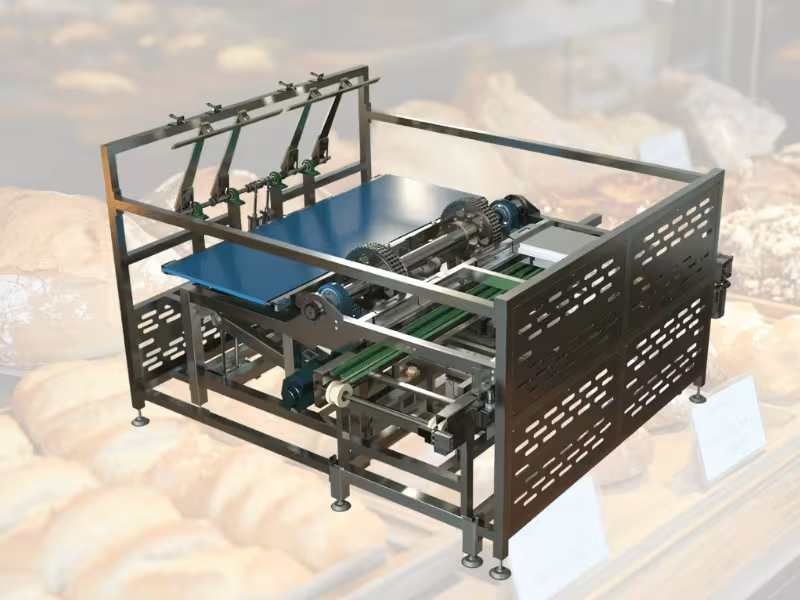
A bakery depanning machine automatically removes baked products from trays, pans, or molds. It then sends them to the next stage of production. It replaces operators who lift, knock, or turn trays by hand. The machine repeats the same motion in the same position on every tray.
The depanner sits right after the oven, where tray flow and product flow split. In most cake lines, products are depanned first and then move to a spiral cooling tower or cooling conveyor. Products that still need tray support while the crumb sets are often depanned after partial cooling instead.
Oven → depanning → cooling → slicing, filling, decorating, or packaging
That position makes depanning a control point for the whole line:
- Throughput. With manual removal, the oven runs at the pace of the slowest operator.
- Yield. Warm crumb is at its weakest, and most handling damage happens here.
- Downstream stability. A product that lands skewed or dented makes the slicer, filler, or wrapper run slower or reject more.
How Does a Bakery Depanning Machine Work?
Designs differ, but most depanners follow the same sequence:
- Infeed and alignment. Trays arrive from the oven and are squared against guides. A skewed tray releases unevenly or jams at transfer.
- Detection and timing. Sensors detect each tray, and servo or PLC control times the release cycle to the infeed rate.
- Release. The tray tilts, flips up to 180°, or stays flat while pins push products up from below.
- Separation. Products drop onto a product conveyor, and the empty tray takes its own path.
- Transfer. Products move downstream at a steady pitch.
- Tray return. Empty trays go to a return line, stacker, or cleaning station.
Where depanning actually fails
Most damage does not come from the release motion itself. It happens at the moments around it:
- Release fires before the conveyor clears. Products land on each other.
- Uneven force across a wide tray. Corners tear on one side, and products stay stuck on the other.
- Drop height is too large. Soft sponge dents and muffin tops crack on impact.
- The tray swings back too close to the product. Surfaces get scuffed or knocked out of position.
A well-set depanner is judged by one result: every product lands intact, in the same position, every cycle.
When gravity release works, and when it is too aggressive
Tilting and flipping both rely on gravity. Gravity works well when the product is firm enough to fall a short distance without changing shape. Typical examples are pound cake, sheet sponge on standard trays, and most breads.
Gravity becomes too aggressive in three cases:
- Low-density, high-air products such as chiffon and aerated sponges. These compress on impact and do not fully recover.
- Deep-cavity molds, where cupcakes and muffins grip the walls. Inverting the mold either leaves products behind or pulls the top away from the base.
- Decorated or topped products, where any inversion damages the surface.
If your product falls into one of these groups, plan around assisted release from the start rather than trying to tune a flip.
Which Depanner Fits Your Line?
Choose by product fragility first, then by tray format, then by line speed. Yucho’s range is organized around those same decisions.
|
Your situation |
Best fit |
Release method |
|---|---|---|
|
Standard trays, continuous line, needs tray return integration |
Sideways tilt |
|
|
Large trays, high output, wide-tray release problems |
Extended drum flip with long beam |
|
|
Standard trays, general automated line, firm products |
Precise 180° flip |
|
|
Fragile products or deep-cavity molds |
Pins lift from below |
Standard tray sponge and pastry lines: Side Tilt Depanner
Choose this if you run cakes, breads, or pastries on standard trays and need release, tray diversion, and empty-tray recycling in one sequence. Servo-synchronized tilting keeps the motion smooth. Independent channels connect directly to cooling and tray return lines.
Wrong fit looks like: using it for very tall or airy products that roll or fold as they slide off.
Large tray industrial bread and cake lines: Continuous Rotary Drum Depanner
Choose this when tray size and line speed both push the limits. On wide trays, compact flippers often leave products stuck along the edges. An extended drum and a long flipping beam spread the force evenly across the full tray width. A high-flow dual-channel discharge then separates product and trays fast enough to keep pace.
Wrong fit looks like: buying a standard drum for oversized trays, then fighting incomplete release and manual knock-outs every shift.
General automated lines: Rotary Drum Depanner
This is the all-round option for firm cakes and breads on standard trays. It flips each tray a precise 180° and sends products and empty trays to separate outfeeds. Modular infeed, flipping, and outfeed conveyors make it easy to fit into an existing line.
Wrong fit looks like: using it for chiffon cakes or deep cupcake molds, where inversion causes compression and broken tops.
Deep-cavity cupcake molds and aerated cakes: Pin Ejector
A pin ejector depanning machine keeps the tray flat and lifts products evenly from below with a fine pin array. Products are never dropped or inverted. That makes it the right choice for muffins, cupcakes, chiffon-style cakes, pastries, and desserts that crack or deform easily. Yucho designs it to reach removal rates of up to 99.99%. Modular pin groups allow quick changeover between tray sizes, and all contact parts are food-grade 304 stainless steel.
Wrong fit looks like: paying for gentle ejection on dense, sturdy products that a tilt or drum would release faster.
How to Choose the Right Bakery Depanning Machine for Your Line
Work through the decision in this order. Each step narrows the options for the next.
- Product fragility. Ask whether the product can survive a short drop without changing shape. If not, assisted release is your starting point.
- Tray and mold geometry. Check tray width, cavity depth, and how firmly the product grips the tray. Deep molds point to pins. Wide trays point to an extended drum.
- Peak throughput. Size for peak trays per minute, not the average. An undersized depanner wastes oven capacity.
- Integration and upkeep. Confirm infeed and outfeed heights against the oven, cooler, and tray return. Check floor space for separate product and tray paths, PLC speed linking, and easy access for crumb and release-oil cleaning.
The most expensive mistake is reversing this order. Buyers who start with speed and floor space often end up with a fast machine that damages the product it was bought to handle.
Before requesting quotes, write down these five things:
- Product type and density
- Tray or mold dimensions and cavity depth
- Peak line speed
- Acceptable damage rate
- Downstream and tray-return connections
Match the Depanner to the Product, Then the Line
Depanning decides whether good baking turns into sellable product. Get the release method right for your product, size the machine for your tray and peak output, and the rest of the line runs on stable input.
Yucho builds side tilt, rotary drum, continuous rotary drum, and pin ejector depanners. That range lets the recommendation follow your product instead of forcing a single format. Share your product details, tray dimensions, and target output, and our team will match the right depanner to your cake production line.