
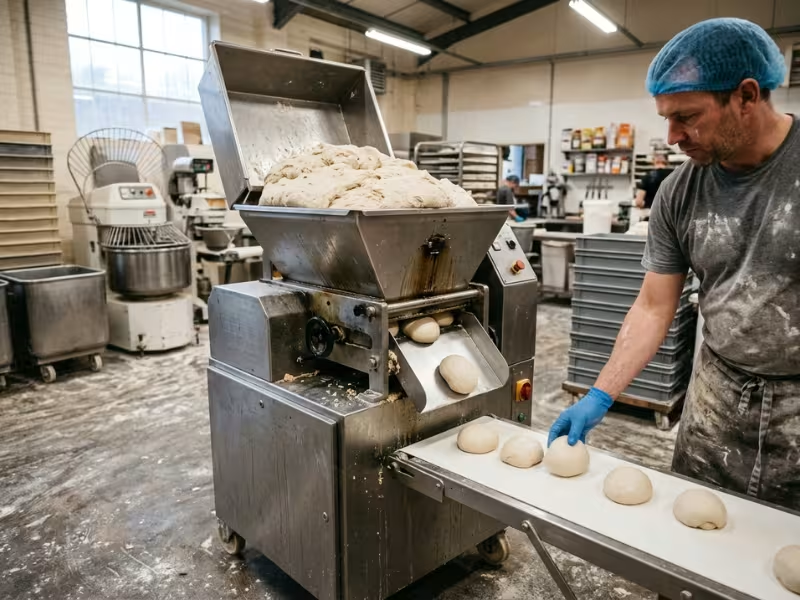
Dividing dough by hand works fine at 200 pieces a day. At 2,000, it becomes the slowest step in your bakery. Your team spends hours at the bench, and the scale still shows a different number on every piece.
Those small misses add up fast. Heavy pieces give away dough you already paid for. Light pieces bake faster and brown unevenly in the bakery oven. Mixed weights also make fair, steady pricing much harder to hold.
I have helped many bakeries find the right divider for their product mix. The gap between a machine that fits your line and one that fights it comes down to four things. Most buyers skip at least one.
This guide shows how volumetric dividers really perform on accuracy, capacity, dough range, and cost. Use it to check your options before you ask for a quote.
What a Volumetric Dough Divider Actually Does
A volumetric divider doesn’t weigh your dough. It measures space and trusts the dough to fill that space the same way every time. That one idea explains most of what the machine does well and where it struggles.
Start with what happens inside the machine.
Volume First, Weight Second
You load bulk dough into the hopper at the top. The machine then draws a portion into a dividing chamber. Piston models pull dough into a cylinder with a set stroke length. Suction models use vacuum to fill the chamber. A knife or gate cuts the piece, and the machine pushes it onto a conveyor or tray.
The chamber size sets the portion. Adjust the stroke, and the chamber holds more or less dough. The machine never checks a scale. It assumes a fixed volume equals a fixed weight.
That assumption holds only when dough density stays steady. Feed it uniform dough, and pieces land close to target. Feed it dough that changes during the run, and your weights drift with it.
Why Dough Density Matters More Than You Expect
This is where many buyers get caught out. Two pieces of the same size can weigh different amounts.
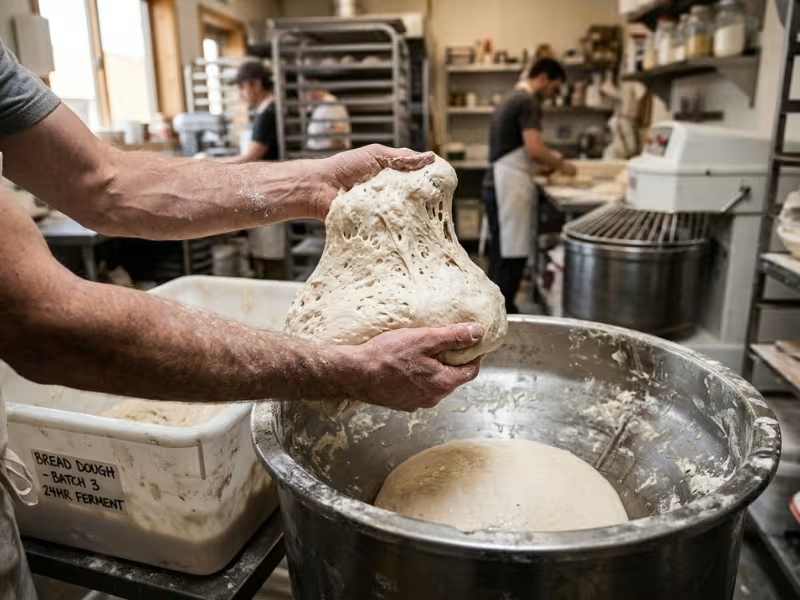
Gas causes most of it. Yeast keeps working while dough sits in the hopper. Dough that has rested 30 minutes holds more air than dough that has rested 5, so each chamber-full weighs less. Warm dough speeds this up. Hydration matters too. A slightly wetter batch packs into the chamber differently than a stiffer one, even with the same recipe.
On many lines, pieces drift a few percent lighter across a single hopper load. Operators then chase it with the adjustment knob. The machine isn’t failing. The dough is changing underneath it.
Volumetric or Weight-Based: Where Each One Fits
Weight-based dividers solve the density problem by measuring mass. Some weigh each piece on a load cell. Others use a checkweigher at the outlet that corrects the stroke automatically.
Volumetric dividers win on speed, simplicity, and price. They have fewer sensors, fewer settings, and fewer parts to fail. For bread, buns, rolls, and pizza balls, a well-run volumetric divider holds weights close enough for most bakeries.
Weight-based systems earn their cost when tolerance gets tight. If you pack retail products with a declared net weight, or supply a customer with strict specs, mass control protects you from underweight packs and costly giveaway.
I use a simple rule. If spot checks can catch and correct small variation, start with volumetric. If one light piece can trigger a rejected order or a compliance issue, budget for weight control.
|
Divider Type |
How It Portions |
Best For |
Main Limitation |
|---|---|---|---|
|
Piston volumetric |
Fills a cylinder with a set stroke |
Bread, buns, rolls |
Weight drifts as dough density changes |
|
Suction volumetric |
Vacuum draws dough into a chamber |
Soft, moderate-hydration doughs |
Harsher on very gassy or delicate dough |
|
Volumetric with checkweigher |
Divides by volume, then corrects from weight data |
Mid-to-high output lines with tighter specs |
Higher cost and more setup |
|
Weight-based |
Measures each piece by mass |
Retail-labeled goods, strict customer specs |
Slower and more expensive per piece |
Accuracy: How Precise Are Volumetric Dough Dividers Really?
Accuracy is the first question every buyer asks me, and the brochure rarely gives the full answer. A volumetric divider can hold tight weights. It only does that when you control the dough you feed it.
Here’s what to expect on a real production floor, not in a demo room.
The Numbers You’ll Actually See
Most semi-automatic piston dividers hold about ±2 to 3 percent of target weight. A good automatic volumetric divider usually holds about ±1 to 2 percent. Add a checkweigher that corrects the stroke, and many lines reach ±1 percent or better.
On a 100 g burger bun, ±2 percent means pieces land between 98 and 102 g.
Treat brochure figures as best-case results. Suppliers test with stable, well-mixed dough at steady temperatures over short runs. Your line runs for hours. The dough warms, gasses up, and changes batch to batch. In my experience, real tolerance often runs about 0.5 to 1 percent wider than the spec sheet, at least until your team learns to manage the dough.
The machine sets the limit. Your dough decides how close you get to it.
Why Weights Drift During a Run
Most weight problems trace back to a handful of causes. Fix these, and the machine starts to look far more accurate than it did.
|
Factor Affecting Accuracy |
What It Changes |
What to Do |
|---|---|---|
|
Dough temperature |
Warm dough ferments faster and gets lighter per piece |
Hold a target dough temperature, such as 76 to 78°F, every batch |
|
Hydration |
Wetter dough packs into the chamber differently |
Weigh water precisely and track flour moisture by season |
|
Gas content |
More gas means less dough in the same volume |
Divide soon after mixing, or degas where the product allows |
|
Fermentation timing |
Dough at the bottom of the hopper ages during the run |
Load smaller amounts more often |
|
Operator adjustment |
Big corrections overshoot and create a swing |
Let one person adjust, in small steps, based on logged weights |
|
Hopper feed |
A full hopper presses harder than a nearly empty one |
Keep the hopper between one-third and two-thirds full |
The last two catch many bakeries off guard. I’ve watched operators drop a 100 lb batch into the hopper, watch weights climb, then crank the stroke down. Twenty minutes later, the hopper runs low, pressure drops, and the pieces come out light. The machine never changed. The feed did.
How to Tighten Weights Without Buying New Equipment
Start with the dough. Consistent mixing time, water temperature, and dough temperature remove most of the variation before the divider sees it. A reliable commercial planetary mixer helps you repeat the same mix batch after batch. If your recipe allows it, a quick degas before loading evens out the gas content. Skip that step for open-crumb doughs like ciabatta, where you want to keep the gas.
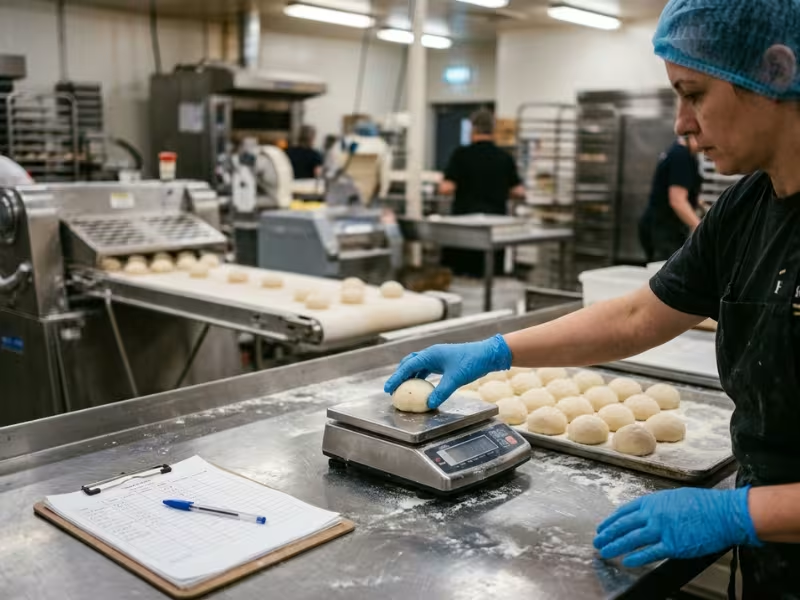
Next, calibrate at the start of every shift. Run the divider, weigh 10 pieces in a row, and adjust the stroke until the average hits target. Write it down.
Then check weights during the run. Pull 5 pieces every 15 to 20 minutes and log the average. That simple record shows you when drift starts and how big it gets. It also stops random knob-turning.
Feed the hopper in smaller, regular loads. Every 15 to 20 minutes works well on most lines, so the dough at the bottom stays close in age to the dough on top.
A checkweigher becomes worth it when manual checks can’t keep up. That usually happens above a few thousand pieces per shift, on retail packs, or when giveaway gets expensive. Many bakeries set targets 3 g heavy to avoid light pieces. At 5,000 buns a day, that’s 15 kg of free dough every day.
When Volumetric Accuracy Is Good Enough, and When It Isn’t
For bread, buns, and rolls, ±2 percent works well. Small swings barely show after proofing and baking. Pizza balls handle it easily too. A few grams rarely change the finished pie.
Retail-labeled products need more care. Most labeling rules require packages to meet the declared weight on average and limit how light any single pack can be. A volumetric divider can still work, but you’ll target a little heavy and check often.
Strict customer specs change the math. If a restaurant chain demands every bun within ±1.5 percent and rejects whole pallets that miss, weight control pays for itself fast. In that case, I steer bakeries toward a volumetric divider with a checkweigher, or a weight-based system.
Capacity: Match the Divider to Your Real Output
Speed is the second number every buyer looks at, and it misleads more people than accuracy does. A divider rated at 2,000 pieces an hour rarely delivers 2,000 pieces an hour on your floor.
Start by separating what the brochure promises from what your shift will actually see.
Brochure Speed vs. Usable Output
Rated speed assumes a full hopper, one product, and nonstop running. Real production pauses all the time.
Your operator stops to refill the hopper every 15 to 20 minutes. The machine waits while someone oils the chamber or scrapes dough off the knife. A product change can take 10 to 30 minutes for cleaning and recalibration. Weight checks and small adjustments add more stops.
Then the line around the divider takes its share. If the mixer releases a batch every 25 minutes, the divider sits idle between batches. If the rounder or proofer can’t keep up, pieces back up and the operator slows the divider on purpose.
On most lines I review, a volumetric divider delivers about 60 to 75 percent of its rated speed across a full shift. A tightly run single-product line may reach 80 percent. A busy mixed-product bakery often sits closer to 55 percent.
Plan around usable output. Treat the brochure number as a ceiling.
Typical Output by Machine Class
With that gap in mind, here’s what each class usually offers at rated speed:
- Benchtop and manual press dividers: These cut one pressed batch into 15 to 36 equal pieces per cycle. Expect roughly 500 to 1,500 pieces an hour, depending on how fast your team loads them.
- Semi-automatic piston dividers: A single-pocket unit usually runs 600 to 1,800 pieces an hour. An operator feeds the hopper and removes pieces.
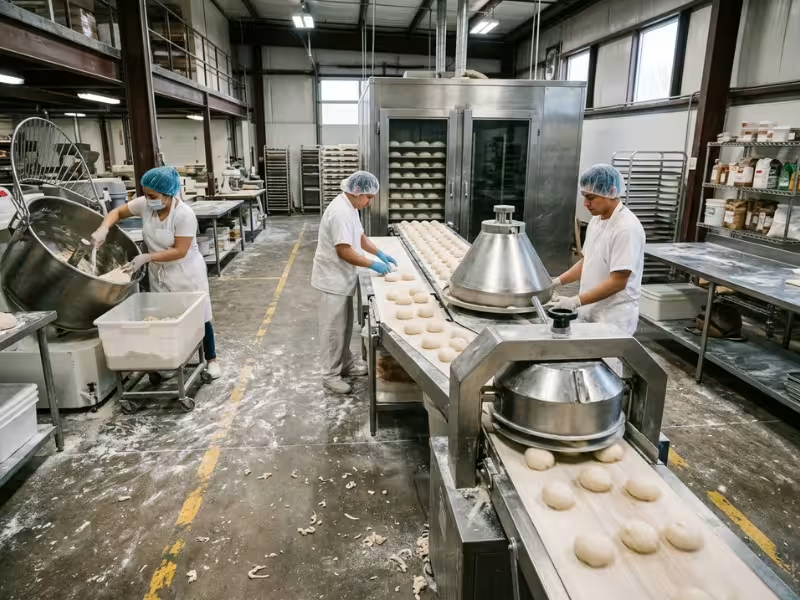
- Automatic volumetric dividers: Two to four pockets push output to about 2,000 to 6,000 pieces an hour, with a discharge conveyor.
- Line-integrated dividers: Multi-pocket units feeding a rounder and intermediate proofer can run 6,000 to 15,000 pieces an hour or more.
Check the weight range too. Each machine handles a set span, such as 30 to 300 g or 200 to 1,200 g. A divider built for buns may not cut a large loaf at all.
How to Size by Shift Demand
I size dividers with one simple formula:
Required rated speed = pieces per shift ÷ (dividing hours × utilization rate)
Count only the hours the divider actually runs, not the whole shift. Then use 0.65 as your utilization rate unless you have real data.
Say you need 4,000 pieces in a 3-hour dividing window. That’s 4,000 ÷ (3 × 0.65), or about 2,050 pieces an hour rated. A two-pocket automatic divider fits. A single-pocket semi-auto does not.
Next, list your product mix. Group items by weight range. If 80 percent of your volume sits between 60 and 120 g, size the machine for that range. Handle the odd 900 g loaf another way rather than buying a divider that does everything poorly.
Finally, add 20 to 25 percent for growth and holiday peaks. Don’t go much further. An oversized divider still needs a full-time operator and the same cleaning time every day.
Worked Examples: When Hand Dividing Breaks Down
A skilled baker scaling and cutting by hand usually manages 300 to 500 pieces an hour. That number tells you a lot.
Pizza balls. A pizzeria making 300 balls a day at 250 g spends under an hour dividing by hand. A machine adds little. A commissary making 1,500 balls a day spends 3 to 5 labor hours. A semi-automatic divider at 1,200 pieces an hour, running at 70 percent, finishes in under 2 hours with one operator.
Burger buns. A wholesale bakery making 6,000 buns a day at 90 g would need 12 to 20 labor hours by hand. That’s two or three people doing nothing else. A two-pocket automatic divider rated at 2,400 per hour delivers about 1,700 usable pieces an hour and clears the run in roughly 3.5 hours.
Pan bread. A bakery making 800 loaves a day at 680 g spends 2 to 3 hours dividing by hand, and heavy pieces tire people fast. A semi-automatic divider with a large chamber handles it in about an hour.
|
Product |
Daily Pieces |
Target Weight |
Recommended Divider Class |
|---|---|---|---|
|
Pizza balls (single pizzeria) |
300 |
250 g |
Hand dividing or benchtop press |
|
Pizza balls (commissary) |
1,500 |
250–280 g |
Semi-automatic piston |
|
Pan bread loaves |
800 |
680 g |
Semi-automatic, large-chamber model |
|
Burger buns |
6,000 |
90 g |
Automatic, two to four pockets |
|
Dinner rolls (wholesale) |
20,000 |
40 g |
Line-integrated multi-pocket |
My rule is simple. Once hand dividing takes more than two labor hours a day, every day, start pricing a machine.
Dough Range: What Doughs Work Well and What Doughs Cause Trouble
A divider can hit its rated speed and hold tight weights, and still fight you every morning if your dough doesn’t suit it. Before I talk about pocket count with any buyer, I ask for their hydration numbers. That list tells me more than any spec sheet.
Start with the doughs that run cleanly.
Doughs That Run Smoothly
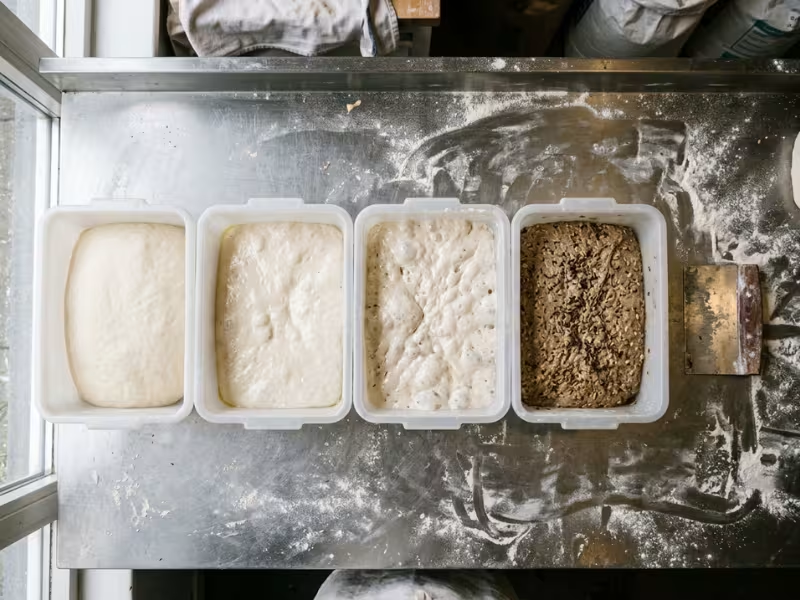
Bakers built volumetric dividers around standard bread and bun doughs. Lean and lightly enriched doughs at 58 to 68 percent hydration flow into the chamber, cut cleanly, and release without tearing. Sandwich bread, burger buns, dinner rolls, and hoagie rolls all sit in this zone.
Pizza dough runs well too. Most recipes land between 58 and 65 percent hydration, and the oil in the dough helps it release from the chamber. Divide soon after mixing, before bulk fermentation builds too much gas, then ball and cold-retard.
Moderate-hydration fermented doughs, around 65 to 72 percent, also work. Country loaves, many sourdoughs, and baguette dough fall here. Keep the dough cool and feed the hopper in smaller loads, because shifting gas content moves your weights.
Rye blends surprise many buyers. A 30 to 50 percent rye mix at modest hydration runs on a piston divider with good oiling. A 100 percent rye paste is another story. It smears and clings, and most bakeries scoop it by hand or use dedicated equipment.
Now for the doughs that cause most of the service calls I hear about.
Doughs That Push the Machine Too Far
Very high hydration. Above roughly 75 to 80 percent, dough slumps and fills the chamber unevenly. It sticks to the knife, and the piston presses out the open structure you worked hours to build. A ciabatta at 80 percent often comes out torn and dense. Most artisan bakeries cut these doughs by hand or use a low-stress strip-cutting divider instead.
Sticky or highly enriched doughs. Brioche with heavy butter warms in the hopper and smears across the chamber walls. High sugar levels add more drag. If you must run these doughs, divide them cold, around 60 to 65°F, and expect slower speeds.
Doughs with inclusions. Nuts, raisins, and whole seeds create two problems. First, the knife crushes fruit and streaks the dough. Hard pieces also slip between the piston and cylinder, which scores the metal and wears seals early. Second, inclusions spread unevenly. One bun gets three raisins, the next gets twelve, and weights swing with them. Fine seeds like flax usually run fine. Whole walnuts usually don’t.
Laminated and pastry doughs. Keep these off a volumetric divider entirely. The piston compresses the layers and wipes out lamination. Croissant and puff pastry belong on a sheeter and cutter. Shortcrust cracks and turns greasy under pressure.
Your dough list doesn’t always have to shrink to fit the machine, though.
Features That Widen Your Dough Range
The right options let one divider handle a broader mix:
- Adjustable oiling systems drip or spray a thin film onto the chamber and knife. Look for fine control, because too much oil makes greasy pieces that skid in the rounder.
- Flour dusting units help with tacky doughs where oil would change the crust.
- Adjustable pressure lets you ease off for gassy or delicate dough and protect its structure.
- Soft-touch or servo-driven pistons move more gently and reduce degassing on fermented doughs.
- Non-stick chamber coatings cut buildup on enriched and rye doughs.
- Tool-free access to the hopper, knife, and chamber turns a 30-minute cleanup into 10 minutes.
At your demo, ask the supplier to run your stickiest dough, not their easiest one. That single test shows you the machine’s real range.
|
Dough Type |
Volumetric Divider Fit |
Main Risk |
Notes |
|---|---|---|---|
|
Bread and bun dough (58–68%) |
Excellent |
Minimal |
The core use for most dividers |
|
Pizza dough |
Excellent |
Gas buildup if dough sits too long |
Divide soon after mixing |
|
Moderate-hydration sourdough (65–72%) |
Good |
Weight drift from fermentation |
Keep dough cool and load small batches |
|
Rye blends (30–50% rye) |
Good with oiling |
Sticking in the chamber |
Use an oiling system and non-stick parts |
|
100% rye |
Poor |
Smearing and clogging |
Usually needs hand portioning or dedicated equipment |
|
High hydration (75–80%+) |
Poor to fair |
Tearing and loss of open crumb |
Consider a low-stress or strip-cutting divider |
|
Rich enriched (brioche) |
Fair |
Butter smearing, slow release |
Divide cold, around 60–65°F |
|
Dough with whole inclusions |
Fair to poor |
Crushed fruit, seal wear, uneven weights |
Fine seeds run better than whole nuts |
|
Laminated and pastry dough |
Not suitable |
Destroyed layers |
Use a sheeter and cutter instead |
Cost: What You Really Pay For
The price on the quote is only the first number you’ll pay. I’ve seen bakeries buy the cheaper divider and then spend more on parts, cleaning time, and lost hours within two years than the gap they saved upfront.
Start with the purchase price, then look at what the machine costs you every day after it arrives.
Price Bands by Machine Class
These are typical new-equipment ranges. Brand, build quality, and options all move the final number.
- Benchtop and manual press dividers: about $1,500 to $8,000. Manual press models sit at the low end. Hydraulic or semi-automatic dividers that cut and round in one cycle cost more.
- Semi-automatic piston dividers: about $10,000 to $25,000 for a single-pocket unit with a stainless hopper and an adjustable stroke.
- Automatic volumetric dividers: about $25,000 to $70,000 for two to four pockets, a discharge conveyor, and an oiling system. Add $10,000 to $25,000 for a checkweigher.
- Line-integrated systems: about $100,000 to $400,000 or more once you add a rounder, intermediate proofer, and conveyors.
Options add up quickly. Servo drives, non-stick coatings, flour dusters, and extra weight ranges can raise a base price by 15 to 30 percent. Ask for an itemized quote so you can see what each one adds.
The Costs That Show Up After Delivery
Utilities rarely break the budget. Most semi-automatic dividers draw modest power, but automatic models may need three-phase power or compressed air. If your building lacks either one, the upgrade can cost more than a small divider.
Cleaning is the bigger cost. A semi-automatic divider usually takes 20 to 40 minutes of daily cleaning. A multi-pocket automatic unit can take an hour or more. Over a year, that adds up to hundreds of labor hours.
Wear parts never stop. Seals, piston rings, knives, and oil pumps all wear out, and abrasive doughs speed that up. I tell buyers to budget 2 to 5 percent of the machine price each year for parts and service. Machines that run whole-grain or seeded doughs often land at the top of that range.
Training costs time too. An operator needs a few days to learn basic setup. Learning to read weight drift and adjust calmly usually takes a few weeks. If staff turnover runs high, you pay that cost again with every new hire.
|
Cost Area |
What Buyers Often Miss |
|---|---|
|
Utilities |
Three-phase power or compressed air may need an electrical or plumbing upgrade |
|
Cleaning labor |
20 to 60+ minutes every day, plus deep cleans every week |
|
Sanitation downtime |
The machine sits idle during cleaning and product changeovers |
|
Wear parts |
Seals, knives, and piston rings wear faster on seeded and whole-grain doughs |
|
Divider oil |
A food-grade oil supply becomes a steady running cost |
|
Service visits |
Local technicians may charge travel time, and remote ones charge more |
|
Training |
Each new operator needs time to learn calibration and adjustment |
Buying New vs. Used
A used divider can save 40 to 60 percent, but only if you inspect it carefully.
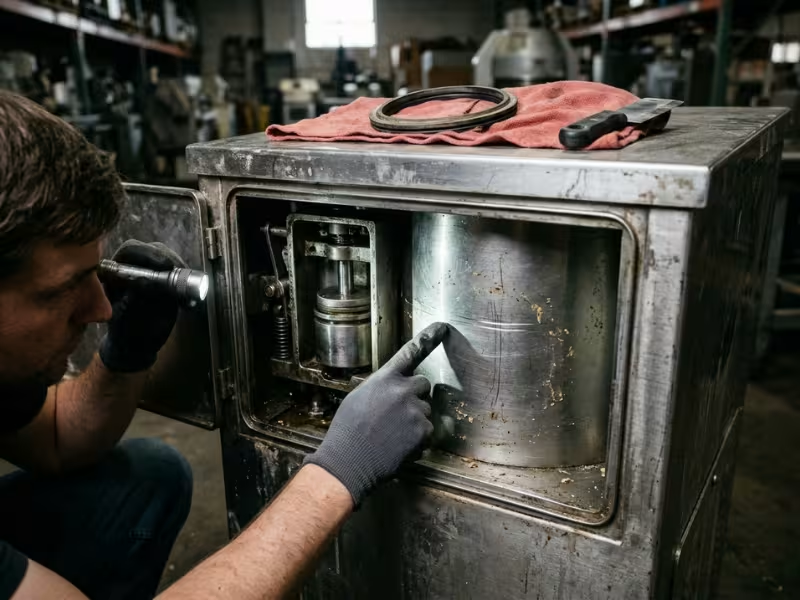
Check the piston and cylinder first. Look for scoring, grooves, or uneven wear. Scored metal leaks dough and throws off weights, and replacing a cylinder can cost thousands. Then check the seals, knife edge, and pressure parts for cracks, play, or heavy wear.
Next, look at hygiene. Old dough packed into corners, rust on food-contact surfaces, or flaking coatings tell you how the last owner treated the machine. Ask whether the seller can run it with real dough while you watch, and weigh 20 pieces in a row.
Then confirm support. Call the manufacturer with the serial number. Ask whether they still stock parts and whether a technician covers your area. A cheap divider with no parts supply turns into scrap the first time a seal fails.
Used makes the most sense for semi-automatic models from established brands with strong parts support. For automatic and line-integrated systems, I usually lean toward new or factory-refurbished equipment with a warranty.
A Simple Payback Example
You don’t need a complex ROI model. Compare the labor hours you save with what the machine costs you.
Say your bakery divides 3,000 buns a day by hand. At about 400 pieces an hour, that takes around 7.5 labor hours. A semi-automatic divider running at 840 usable pieces an hour finishes in about 3.6 hours. Add 30 minutes for cleaning, and you save roughly 3.5 hours a day.
At $22 an hour in loaded labor cost, that comes to about $77 a day. Over 300 production days, you save around $23,000 a year.
Now compare that with the cost. An $18,000 divider plus $2,000 for installation and training costs $20,000. Subtract about $2,000 a year for parts and oil. The machine pays for itself in roughly 11 to 12 months, and tighter weights cut your dough giveaway on top of that.
Which Divider Fits Your Bakery Best
Specs only matter once you match them to how your bakery actually runs. When a buyer asks me which divider to get, I ask three questions first. How many pieces do you divide per shift? What doughs do you run? How tight do your weights need to be?
Here’s how those answers usually play out.
Small Bakery or Pizzeria
If you divide fewer than 1,500 pieces a day, start small. A benchtop press divider suits shops that cut one dough into 15 to 36 equal pieces several times a morning. Pizzerias making 200 to 500 balls a day get a lot from it. It cuts a whole batch in seconds and fits on a bench.
Move to a single-pocket semi-automatic piston divider once hand dividing takes more than two labor hours a day. It runs 600 to 1,800 pieces an hour on simple utilities, and a new staff member can learn it in a few days.
Skip automatic units at this size. You’d pay for speed you never use, and you’d still clean it every day.
Mid-Size Wholesale Bakery
Between roughly 3,000 and 15,000 pieces a day, an automatic two- to four-pocket divider earns its place. Bun and roll programs with steady recipes fit it best.
The payoff comes from labor. At these volumes, hand dividing ties up two or three people. One operator can run an automatic divider and still watch the rounder. If you ship to grocery or foodservice accounts, add a checkweigher now, or choose a model that accepts one later.
At this scale, the divider also needs to keep pace with the baking side of the line. On many bun and roll programs, pieces end up in a rotary rack oven, so match usable divider output to how fast you can fill and turn those racks.
High-Output Production Line
Past about 20,000 pieces a day, the divider stops working as a standalone machine. It becomes the first step in a make-up line that feeds a rounder, intermediate proofer, and moulder.
A line-integrated system makes sense when one or two core products run for hours without a change. If you switch products six times a shift, the line loses too much time to cleaning and recalibration. In that case, two smaller automatic dividers often deliver more usable output than one large line.
When Weight-Based Dividing Wins
Volumetric dividing has a ceiling. Weight-based dividing justifies its higher price in three situations:
- You pack retail products with a declared net weight and can’t risk light packs.
- A customer contract sets tolerances near ±1 percent and rejects shipments that miss.
- Your dough density swings too much to control, as with long-fermented or high-hydration doughs.
Run the giveaway math too. If you overfill by 3 g to stay safe on 10,000 pieces a day, you give away 30 kg of dough daily. Weight control often pays for itself on that alone.
|
Bakery Situation |
Best Divider Direction |
Why |
|---|---|---|
|
Pizzeria, under 500 pieces a day |
Benchtop press divider |
Cuts full batches fast in a small space |
|
Small bakery, 500–1,500 pieces a day |
Single-pocket semi-automatic |
Saves labor without much complexity |
|
Wholesale bakery, 3,000–15,000 pieces a day |
Automatic, two to four pockets |
One operator replaces two or three people |
|
High-output plant, 20,000+ pieces a day |
Line-integrated system |
Steady long runs feed rounding and proofing |
|
Retail packs or strict customer specs |
Weight-based or volumetric with checkweigher |
Protects compliance and cuts giveaway |
Buying Mistakes That Cause Expensive Frustration
Most divider regrets don’t start with a bad machine. They start with a good machine bought for the wrong job, and five mistakes cause most of them.
Buying for brochure speed instead of your real shift. A buyer sees 2,400 pieces an hour, checks it against the daily order, and decides one machine covers everything with room to spare. Then the line starts. Hopper refills, weight checks, oiling, and a late mixer batch pull real output down to about 65 percent of rated speed. The run that looked like two hours takes three, and the rounder crew stands around waiting. Size from usable output, not peak speed. If your numbers only work at 90 percent utilization, the machine is too small.
Ignoring your dough’s hydration limits. I often meet bakers who tested a divider on a 62 percent bun dough and signed the order that afternoon. Their best seller was a 76 percent country loaf. On the first morning, it stuck to the knife, smeared across the chamber, and came out torn and lighter with every stroke. Before you shortlist any model, list the hydration of every dough you plan to run. Then ask the supplier, in writing, which ones the machine handles well. “It handles most doughs” tells you nothing.
Expecting one machine to run every dough. A mixed bakery might run buns, brioche, seeded rye, and ciabatta from the same bench. It’s tempting to push all of it through one divider. In practice, the buns run beautifully, the brioche smears, the seeds wear the seals, and the ciabatta loses its open crumb. You end up babysitting the machine for half the menu. Put your high-volume, divider-friendly doughs on the machine. Keep the difficult ones on the bench or a low-stress cutter. Buy for 80 percent of your volume, not 100 percent of your recipes.
Skipping a trial run with your own dough. Demo rooms show a divider at its best. The supplier’s dough is mixed to the minute, held at a perfect temperature, and run for ten minutes. Your dough arrives warmer, gassier, and in 100 lb batches. Bring your own dough to the trial, ideally your best seller and your stickiest product. Run it for at least 30 minutes. Weigh 20 pieces in a row at the start and again at the end. That drift tells you more than any spec sheet. If a supplier won’t arrange a trial, keep shopping.
Underestimating cleaning and changeover time. This mistake shows up on the payroll, not the invoice. A semi-automatic divider usually needs 20 to 40 minutes of cleaning every day, and a multi-pocket unit can need an hour or more. Each product change adds another 10 to 30 minutes for cleanup and recalibration. A bakery that switches doughs five times a shift can lose two hours a day while the machine sits still. Map your daily changeovers before you buy. During the demo, time a full teardown of the chamber and knife. Tool-free access pays you back every single day.
FAQs
What is a volumetric dough divider?
A volumetric dough divider portions bulk dough by filling a chamber of fixed size, then cutting each piece. It measures volume, not weight, so steady dough density keeps pieces consistent. Bakeries use it to replace hand scaling for bread, buns, rolls, and pizza balls, where speed matters more than gram-perfect precision.
How accurate is a volumetric dough divider?
Expect about ±2 to 3 percent on semi-automatic piston models and ±1 to 2 percent on good automatic units. A checkweigher can tighten that to about ±1 percent. Real results run slightly wider, because dough warms and gains gas during a run. Steady dough temperature, small hopper loads, and regular weight checks close most of that gap.
Can a volumetric divider handle high-hydration dough?
Up to a point. Most volumetric dividers handle doughs up to about 72 percent hydration with good oiling and cool dough. Above roughly 75 to 80 percent, dough sticks to the knife, fills the chamber unevenly, and loses its open crumb. For ciabatta and similar loaves, use a low-stress or strip-cutting divider, or keep dividing by hand.
How many pieces per hour can it produce?
It depends on the class. Benchtop press dividers manage roughly 500 to 1,500 pieces an hour, semi-automatic piston units 600 to 1,800, and multi-pocket automatic models 2,000 to 6,000. Line-integrated systems go well beyond that. Plan on getting only 60 to 75 percent of rated speed over a full shift once refills, cleaning, and changeovers take their share.
Is it accurate enough for retail weight requirements?
Often, yes. Labeling rules typically require packs to meet the declared weight on average and cap how light any single pack can be. A volumetric divider can meet that if you target slightly heavy and check weights every 15 to 20 minutes. If giveaway gets costly or tolerances tighten, add a checkweigher or move to weight-based dividing.
What size divider do I need?
Divide your pieces per shift by the hours the divider actually runs, then by 0.65 for realistic utilization. That’s the rated speed to shop for. Next, confirm the weight range covers most of your volume, not every outlier. Add 20 to 25 percent for growth. If hand dividing takes over two labor hours daily, start with a semi-automatic unit.
Is a used volumetric divider worth buying?
It can be, especially for semi-automatic models from established brands. Inspect the piston and cylinder for scoring, check the seals and knife, and look for packed dough or rust. Watch it run your dough and weigh 20 pieces. Then confirm the manufacturer still stocks parts. For automatic lines, a refurbished unit with a warranty is usually the safer bet.
Buy for Your Dough, Not the Brochure
Start with two facts: the doughs you run and your real daily output. Together, they rule out most machines before you open a single quote.
Next, decide how tight your weights need to be. Bread and buns run fine at ±2 percent. Retail-labeled packs need closer checks. Strict customer specs usually call for a checkweigher or weight-based dividing.
Then compare total cost of ownership. Add cleaning time, wear parts, training, and utilities to the purchase price.
This week, log your pieces per shift and the hydration of every dough you run. Then book a demo and bring your own dough, especially your stickiest one. Weigh 20 pieces at the start and end of the run before you sign anything.