In many cake lines, the oven does not set the real capacity. The cooling stage after baking often does. A hot cake cannot be sliced cleanly, filled with cream, enrobed, or wrapped until it reaches the right internal condition. Racks and long straight conveyors struggle to reach that condition consistently at full line speed.
In continuous cake production, the usual solution is a spiral cooling tower, also called a spiral cooler or spiral cooling conveyor. This guide covers how the equipment is built, how it works, and where it fits in a bakery. It also covers configuration choices and buying checks that determine whether a system suits your product and plant.
Key takeaways:
- Cooling is a process step with measurable targets, not idle waiting time.
- A spiral cooler creates cooling time from vertical belt length instead of floor length.
- The right configuration depends on cake thickness, fragility, line speed, room climate, and hygiene standards.
- Start sizing from the cake and the next process, not from tower height.
What Is a Spiral Cooling Tower in Cake Manufacturing?
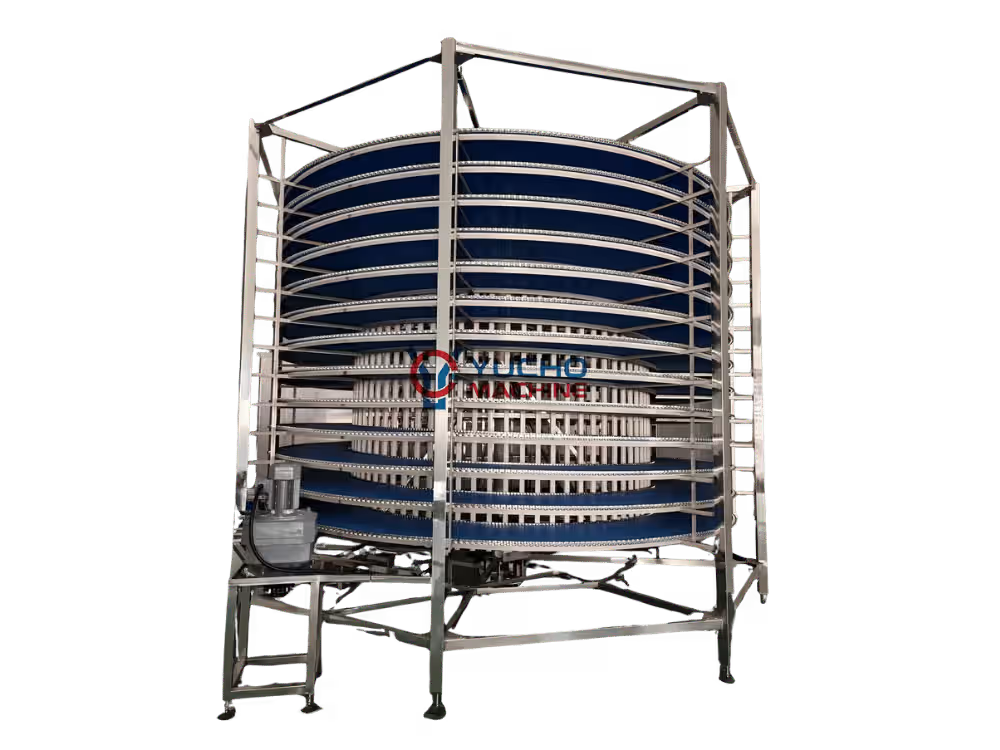
A spiral cooling tower is a conveyor that carries baked products in a continuous helix around a vertical axis. Cakes enter at the bottom or top, travel through multiple stacked tiers, and exit at the other end. Tier count varies with product, throughput, and required dwell time.
The design packs a very long belt path into a footprint of only a few square meters. That long path gives each cake a controlled cooling time without taking over the production floor.
Why cakes need a dedicated cooling stage
Cakes leave the oven in a fragile state. The crumb is still setting, starch is still firming, and moisture is moving from the hot core toward the surface.
The effects of handling too early are predictable:
- Handled too early, a sponge cake compresses or tears.
- Topped with buttercream, the cream slides or melts.
- Wrapped warm, steam condenses inside the film.
Where the spiral cooler sits in the line
In a typical industrial cake production line, the spiral cooler links these stages:
- Oven outfeed
- Depanning. This happens before or after cooling, depending on product stability, tray system, and line design.
- Spiral cooling tower
- Downstream processing, such as slicing, layering, cream injection, icing, or chocolate enrobing
- Packaging, such as flow wrapping, cartoning, or tray loading
The takeaway is that the tower is a production stage, not just a link between machines. Its job is to deliver every cake to the next operation in the same physical condition.
Why Cooling Matters in Cake Production More Than Many Buyers Expect
Many buyers treat cooling as dead time. In practice, it has its own targets, and missing them shows up later in the line.
What changes inside the cake during cooling
Four changes happen at once:
- Gelatinized starch begins to firm, which builds crumb strength.
- Fats in the crumb solidify.
- Internal moisture redistributes from core to crust.
- Surface temperature drops, which changes how coatings and fillings behave.
Each change affects how the cake responds when a blade, nozzle, coating curtain, or wrapping film meets it. If cooling is incomplete or uneven, downstream machines receive a variable product. Operators then compensate by slowing down or sorting by hand.
Quality failures caused by poor cooling
- Compression and tearing. Warm crumb has little structural strength, so transfer points, guides, and depanners can dent or rip it.
- Ragged slicing. A warm layer cake gums the blade and leaves crumbly or smeared cut faces.
- Filling instability. Cream and buttercream soften on a warm base, so layers shift or bulge.
- Enrobing defects. Heat rising from the cake can thin chocolate, slow setting, and cause streaks or poor adhesion.
- Batch drift. Cakes from the edge of an oven band may cool faster than center pieces. Uneven cooling turns that difference into visible variation.
The packaging and cost impact
A cake packed above its target temperature traps moisture inside the film. That condensation softens surfaces, encourages mold growth, and shortens practical shelf life. Proper cooling lets product enter the cake packaging machine dry and dimensionally stable, which supports clean seals and consistent pack appearance.
When cooling capacity falls short, factories add manual holding. Trolleys of cakes sit in a corridor until they are ready. This costs labor, floor space, and traceability. It also breaks the link between oven output and packing speed. The oven may be able to run faster, but the line can only move as fast as product becomes ready to handle.
Main Components of a Spiral Cooling Tower
At the core is a belt that spirals around a central structure. Each tier has enough clearance above the one below for product height plus airflow. Belt speed and total belt length set how long each cake stays inside.
|
Component |
Function |
Why it matters for cakes |
|---|---|---|
|
Spiral belt (stainless mesh or plastic modular) |
Carries product through the helix |
Mesh openness affects airflow from below. The surface pattern can mark soft sponge bases. |
|
Drive system (rotating drum or self-stacking belt) |
Moves the belt around the spiral |
Sets belt tension and smoothness, which affect how stable cakes stay in position |
|
Support structure / central drum |
Holds tiers and guides the belt |
Influences footprint, height, and cleaning access |
|
Infeed and outfeed transfers |
Move product on and off the spiral |
The most common points for cakes to tip, collide, or deform |
|
Tensioning and take-up unit |
Maintains correct belt tension |
Prevents slack, surging, or belt jumps that disturb fragile products |
|
Airflow system (fans, ducting, optional chilled coil) |
Removes heat from product surfaces |
Sets cooling rate and uniformity across tiers |
|
Enclosure (optional) |
Isolates the cooling zone |
Shields product from room temperature swings and airborne contamination |
|
Controls (PLC, VFD, sensors) |
Adjust belt speed and fans, and monitor conditions |
Let operators change dwell time for each recipe |
Product-handling details buyers often overlook
Infeed alignment decides whether cakes enter with even spacing. Uneven spacing causes uneven airflow and contact between pieces.
For delicate sponge rounds or sheet cake portions, keep transfer gaps small. The belt surface should support the base without leaving deep marks. If possible, ask to see your actual product on the proposed belt type.
Hygienic design features
Hygienic design separates bakery-grade towers from general-purpose conveyors. Look for:
- Stainless steel frames
- Sloped surfaces that shed crumbs
- Few horizontal ledges where debris can settle
- Open access to the drum and belt underside
- Removable panels and proper drainage if you plan to wet-clean
Washdown suitability depends on the specific design. Confirm it with the supplier rather than assuming it.
How a Spiral Cooling Tower Works Step by Step
A spiral cooler replaces batch waiting with continuous movement. It creates cooling time from belt length rather than floor length. A cake that needs 40 minutes to cool travels a vertical path while the next cake enters right behind it.
- Loading. Cakes arrive from the oven outfeed or depanner and move onto the spiral infeed, where spacing is set. Gaps that are too tight block airflow between pieces. Gaps that are too loose waste belt area and reduce capacity.
- Spiral travel. The belt carries product up or down through the stacked tiers. Cakes stay flat on the belt the whole way, so there is no tumbling or restacking.
- Heat removal. Air moves across and through the belt and carries heat away from cake surfaces. The core cools more slowly as heat conducts outward through the crumb. This is why thicker cakes typically need much longer dwell times than thin sheet products.
- Reaching the exit condition. Dwell time and airflow are set so each cake reaches its target condition at the exit. That target is usually a core temperature plus a crumb firm enough for the next step. A cake going to enrobing may need a cooler surface than one going straight to a flow wrapper.
- Discharge and handoff. The cooled product leaves the outfeed at a steady rate and moves to the next machine in a consistent condition.
How residence time and belt area set capacity
Belt speed mainly sets residence time, and belt area sets capacity. Here is a simple worked example:
- Line output: 100 cakes per minute
- Required cooling time: 45 minutes
- Cakes inside the tower at any moment: about 4,500
- Space per cake, including spacing: 100 × 100 mm (0.01 m²)
- Usable belt area needed: about 45 m²
This calculation drives tower diameter, belt width, and tier count. It is also why accurate product data matters before any quotation.
Key Advantages of Spiral Cooling Towers for Cake Manufacturers
Compared with rack cooling or long straight ambient conveyors, a spiral cooling conveyor improves four specific areas.
1. Floor space
In the example above, a straight conveyor 1 m wide would need roughly 45 m of run to give the same cooling time. A spiral fits that belt area into a tower only a few meters across by using ceiling height instead of floor length.
This matters most in two situations:
- Retrofits, where a new cake line must fit into an existing building
- Expansions, where a slicer or second packer needs the space a straight cooler would occupy
2. Line continuity
Rack cooling creates a batch break. Cakes are loaded, parked, and unloaded later, and someone has to decide when they are ready.
A spiral keeps first-in, first-out flow from oven to packing. Every cake gets the same dwell time, so downstream machines receive product at the oven’s rate. For a line feeding a high-speed flow wrapper, that steady feed lets the wrapper run at its rated speed instead of stopping and restarting.
3. Repeatable handoff condition
Manual transfers between racks, trolleys, and conveyors are where cakes get dented, tilted, or crushed. A spiral removes those touch points. It also delivers product at a consistent temperature, which pays off downstream:
- Before slicing: cleaner cut faces and less blade buildup
- Before cream filling: the filling holds its shape on the base
- Before enrobing: the coating sets predictably instead of thinning on warm spots
4. Controlled exposure
Cakes on open racks sit near doors, corridors, and foot traffic. An enclosed spiral keeps product in a defined zone with managed airflow. This can reduce exposure to airborne contamination and simplify hygiene zoning.
How much you gain depends on the enclosure design and the air source. Evaluate it on the actual system rather than treating it as automatic.
Common Spiral Cooling Tower Configurations and Design Options
No two cake lines have the same cooling needs. Product fragility, line speed, room climate, hygiene requirements, and building layout all shape the right configuration.
|
Design option |
When it fits |
Trade-off |
|---|---|---|
|
Open (ambient) spiral |
Stable room temperature, moderate cooling needs, easy visual access wanted |
Performance changes with season and room conditions |
|
Enclosed spiral with filtered air |
Hygiene-sensitive products, variable room climate, controlled zones |
Higher cost, and cleaning requires planned access |
|
Conditioned-air (chilled) spiral |
Hot climates, thick cakes, or short available cooling time |
Higher energy use and a risk of surface condensation if poorly managed |
|
Drum-driven (low-tension) spiral |
High capacity, wide belts, long dwell times |
Larger footprint and more mechanical parts around the drum |
|
Self-stacking spiral |
Compact layouts and enclosed airflow paths through the belt stack |
Proprietary belt design and higher belt replacement cost |
|
Ascending vs. descending flow |
Matching the infeed and outfeed heights of neighboring machines |
Affects line layout and the need for platforms or mezzanines |
|
Single-lane vs. multi-lane loading |
Multi-lane suits small cakes and cupcakes. Single wide placement suits sheet cakes. |
Multi-lane needs accurate lane alignment at the infeed |
Why the enclosure and air decision matters most
Consider an open spiral in a bakery that runs at 22 °C in winter and 32 °C in summer. At the same belt speed, it will deliver different exit temperatures across the year. Enclosed systems with controlled air hold the cooling rate steady.
Chilled air shortens dwell time, but airflow speed and humidity need careful setup. Aggressive dry air can pull moisture from the crust. On sponge products, that means weight loss and a dried-out surface.
No single design is best. The right one balances required residence time, cake fragility, sanitation standard, and available footprint and height.
Where Spiral Cooling Towers Are Used in Cake and Bakery Production
A spiral cooler earns its place when two conditions meet. Oven output is high and continuous, and the next process needs a predictable product temperature.
Cakes headed for secondary processing
This is where cooling precision matters most.
- Layer cakes must be cool and set before horizontal slicing and layering. Otherwise the blade drags and filling shifts between layers. In an automatic layer cake production line, the cooler’s exit condition directly controls slicing and layering speed.
- Sheet cakes need a firm crumb before ultrasonic or blade portioning so edges come out clean and square.
- Swiss rolls need tighter tuning. The sponge must be cool enough to accept cream without melting it, yet flexible enough to roll without cracking.
- Enrobed cakes need a cool, dry surface so chocolate or compound coating adheres and sets evenly.
Packaging-driven lines
Cupcakes, muffins, snack cakes, and individually wrapped portions often go straight from cooling to flow wrapping. The main risk is condensation. A cake packed too warm fogs the film and softens during storage.
Multi-lane spirals handle small products at high counts. Their steady discharge helps automated feeders place product accurately in front of the wrapper.
Large-scale industrial bakeries
In plants running several lines, spirals replace trolley-based buffering. They free corridor space, reduce labor at the cooling stage, and keep product traceable in strict sequence from oven to pack.
When simpler cooling may be enough
A spiral may not be justified if output is low, production runs in small batches, or products go to manual finishing without tight temperature targets. In those cases, a straight cooling conveyor or rack system can be more practical. A spiral makes sense once cooling starts limiting throughput or consistency.
How to Choose the Right Spiral Cooling Tower for Your Cake Line
Start from the product and the next process, not from machine size. The required exit condition determines dwell time. Dwell time and throughput then determine belt area, and belt area sets the physical tower. Buyers who start by asking how tall the tower can be often end up with one that fits the room but under-cools the product.
Step 1: Define the product and thermal targets
- Cake dimensions, especially thickness, which has the largest effect on cooling time
- Density, moisture level, and fragility
- Whether cakes cool in pans, on trays, or after depanning
- Target exit core temperature for the next step, verified by trials where possible
Step 2: Confirm throughput and layout
- Peak pieces per minute, not average output
- Oven band width and the spacing products need on the spiral
- Available floor area, clear ceiling height, and service clearance
- Infeed and outfeed heights and directions relative to neighboring machines
- Room for future capacity, such as extra tiers or a faster line
Step 3: Check hygiene and integration
- Cleaning method: dry cleaning, wet cleaning, or assisted belt washing
- Allergen changeover requirements between product runs
- Access to the drum, belt underside, and enclosure interior
- Compatibility with depanners, slicers, fillers, enrobers, and wrappers
- Controls integration with the line PLC for speed linking and alarms
Step 4: Evaluate the supplier, not just the machine
- How the supplier calculated residence time, and from what product data
- The airflow concept: direction, speed, and how it keeps cooling uniform across tiers
- Belt type and product support details for your specific cakes
- Reference installations running comparable products
- Commissioning, operator training, and spare parts availability
For retrofits, layout constraints usually decide the configuration. For new lines, process targets should drive it.
Operation, Hygiene, and Maintenance Considerations Before You Invest
Exit results stay predictable only when inputs stay stable. Plan for these three areas before installation, not after.
Daily operation basics
Consistent infeed spacing, belt speed linked to oven output, and steady bake conditions keep exit temperatures predictable. If the oven runs hotter or products arrive bunched together, the same belt speed delivers warmer cakes.
- Check exit temperatures at set intervals.
- Store dwell time settings by recipe in the PLC.
- Adjust from measured data, not operator feel.
Hygiene and sanitation
Crumbs collect on the drum, belt edges, and tier supports. Icing, fat, or syrup residue appears where decorated or glazed products run.
Many cake lines rely on daily dry cleaning with scheduled wet cleaning. Lines with strict allergen control may need full washdown. Settle sanitation frequency, access points, and drying time after wet cleaning during specification.
Preventive maintenance priorities
Maintenance centers on the belt and the drive.
- Belt tracking and tension: a drifting or slack belt disturbs product and speeds up wear.
- Bearings, chains or gears, and take-up units: inspect on a fixed schedule.
- Fans and filters: clogged filters reduce airflow and hurt cooling uniformity.
- Temperature sensors: calibrate them periodically so recipe settings stay accurate.
A planned preventive schedule costs far less than an unplanned stop with thousands of cakes inside the tower.
Questions to ask your supplier
- What residence time and exit temperature do you calculate for our cake, and what data is that based on?
- How is airflow distributed, and how do you keep cooling uniform from the first tier to the last?
- Which belt type do you recommend for our product, and will it mark or deform the base?
- What cleaning method does this design support, and how long does a full sanitation cycle take?
- Can we see a reference installation or run product trials before final specification?
Plan Your Cooling Stage Around the Whole Line
A spiral cooling tower is most valuable when cooling limits your throughput, your floor space, or the consistency of downstream operations. Getting it right depends on three things:
- Sizing from real product data
- Choosing the right enclosure and air concept
- Matching the cooler to the oven before it and the machines after it
At Top Cake Machine, we look at the spiral cooler as part of the complete process. Our range covers batter aeration and depositing, bakery ovens, depanners, cake cutting and filling equipment, and packaging systems. That means we can assess cooling requirements against your oven capacity, product type, and downstream speed together. This applies whether you are building a new layer cake, Swiss roll, cupcake, or center-filled cake line, or upgrading post-bake handling in an existing plant.
Contact our team with your cake dimensions, target output, and available space. We will help you work out the dwell time, layout, and configuration your line actually needs.