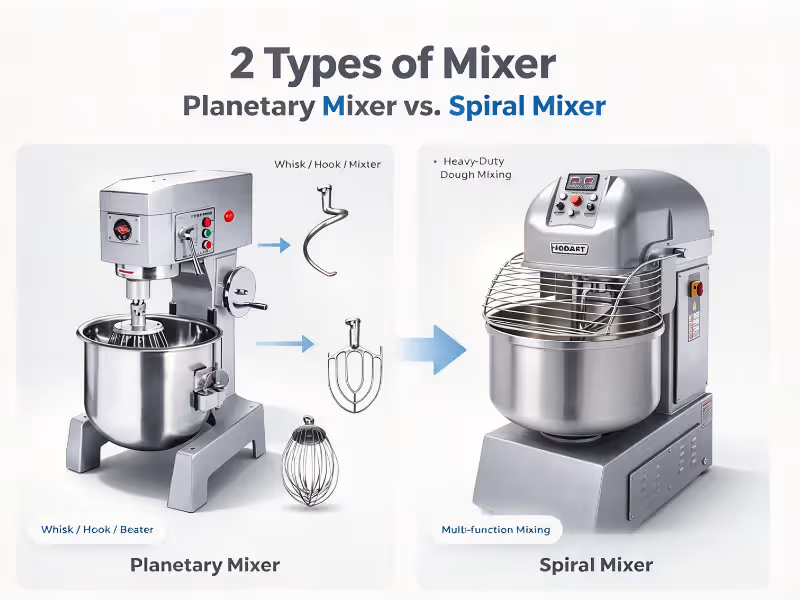
Planetary and spiral mixers often show up side by side in commercial bakery quotes, and both can mix dough. That overlap is where the confusion starts. A bread bakery adding cakes to its range, or a cake shop adding a few breads, usually asks the same thing: can one machine cover everything, and if so, which one?
Asking which mixer is better gets you nowhere. The useful question is which product mix and batch pattern you are building around. A spiral mixer is a dough specialist. A planetary mixer is a multi-product tool. Pick the wrong one, and you’ll quickly see it in strained motors, warm dough, or a machine that sits idle half the week.
Planetary Mixers Explained
A planetary mixer moves its tool, not its bowl. The attachment spins on its own axis while also orbiting inside a fixed bowl, much like a planet turning as it circles the sun. That double motion sweeps the sides, center, and bottom of the bowl on every pass, leaving no pocket of unmixed product behind. This matters most when air or fat has to spread evenly through the whole batch, as it does in whipped cream and sponge batter.
Because the tool does the moving, a commercial planetary mixer changes jobs when you swap attachments. Three standard tools cover most of a cake bakery’s prep work:
- Wire whip: Builds air into cream, egg foams, meringue, sponge batter, and mousse bases.
- Flat beater: Creams butter and sugar. It also mixes cake batter, fillings, icing, and cookie dough.
- Dough hook: Handles small to medium batches of softer dough.
One motor and one bowl can serve the cream station, the batter station, and the filling station in the same day.
A shift lead sees the operating advantage throughout the day. The bowl lowers and lifts out, so an operator can move finished product to the next station and lock in a clean bowl. A typical day might start with whipped cream, move to chocolate filling mid-morning, and finish with cake batter after lunch, all on one machine. Each switch only needs a new attachment and a clean bowl. Bowls and attachments go straight to the sink for full cleaning, which matters when dairy and egg products are in the rotation.
That said, stiff dough is where a planetary mixer struggles. With drier, low-hydration doughs, the hook tends to push the mass around the bowl instead of stretching and folding it. The motor and gearbox work harder, mixing takes longer, and friction warms the dough. Every planetary mixer carries a dough rating well below its bowl volume, and that rating drops further as the dough gets drier. Check the rating at your own hydration level. If you run high-volume bread through a planetary mixer every day, it will wear out faster than it should.
Spiral Mixers Explained
A spiral mixer works the other way around. In a planetary mixer, the tool moves around the bowl. In a spiral mixer, the bowl moves around the tool. The bowl rotates while a spiral-shaped hook turns in a fixed position, and a breaker bar stops the dough from simply riding along with the hook. The dough feeds through the hook one section at a time and gets stretched and folded on every pass. The effect is close to kneading by hand, only faster and more even.
This is why bread bakers choose it. The hook works only part of the dough at any moment, so gluten develops efficiently with less friction heat. Less heat gives you tighter control of final dough temperature, and dough temperature drives fermentation timing. When each batch leaves the mixer close to target temperature, proofing schedules hold, and the oven gets loaded on time. A spiral mixer also handles large dough batches and the stiff, low-hydration doughs that strain a planetary mixer. Most models mix small batches well relative to bowl size, which helps when daily dough volume changes.
Compared with a planetary mixer, a spiral mixer gives up range for depth. It has no whip and no flat beater. It cannot whip cream, aerate sponge batter, cream butter, or build a mousse base. This is a design choice, not a quality gap. In a bakery where cakes and fillings make up most of the output, though, a spiral mixer covers only a small part of the work and stands idle the rest of the day.
Most spiral mixers have a fixed bowl. Operators lift the dough out by hand and clean the bowl in place. Removable-bowl and tilting models make dough transfer easier at higher volumes, but they cost more.
How to Decide Between a Planetary Mixer and a Spiral Mixer
Start with your product list, not with bowl capacity. Write down what you make in a typical week and roughly how much of it is dough versus batter, cream, and fillings. That split settles most decisions before speed, bowl size, or price come into play. Buyers who start from capacity often end up with the right size of the wrong machine.
A commercial planetary mixer is the better fit when most of your output is cake batter, whipped cream, mousse, fillings, icing, or cookie dough. It is also the better choice when you change products several times per shift, or when dough is a small, soft share of the mix. Cake shops, patisseries, central kitchens that supply desserts, and cake factories that prepare creams and fillings all fall into this group. In these operations, switching between products is the daily work, so flexibility matters more than dough power.
A spiral mixer is the better fit when bread, rolls, pizza, or other yeasted dough makes up most of your volume. It is also the right choice when you mix large dough batches every day or run stiff, low-hydration recipes. If you push that work onto a planetary mixer, you shorten its service life and make it harder to hold dough temperature.
Many mixed bakeries run both: a spiral for bread dough and a planetary for everything else. That is not overspending. Each machine stays within its design limits, so both last longer. Dough and cream also stop competing for one bowl during the morning rush.
|
Production pattern |
Better fit |
|---|---|
|
Mostly cake batter, cream, mousse, and fillings |
Planetary mixer |
|
Many product changes per shift |
Planetary mixer |
|
Mostly bread, rolls, or pizza dough in large batches |
Spiral mixer |
|
Stiff, low-hydration dough |
Spiral mixer |
|
Mixed bread and cake range |
Both machines |
Batch mixing also has a ceiling. At high, continuous cake output, whipping batter one batch at a time becomes a bottleneck. Batter density also varies from one bowl to the next, and that later shows up as uneven bake volume. At that stage, factories move aeration to a continuous cake batter aeration machine and keep the planetary mixer for creams, fillings, and smaller runs.
The rule is simple. Dough-heavy production points to a spiral mixer, while cake, cream, and multi-product production points to a planetary mixer. If your range falls somewhere in between, send Yucho your product list and typical batch sizes. Our team will recommend the right mixer setup for your line.