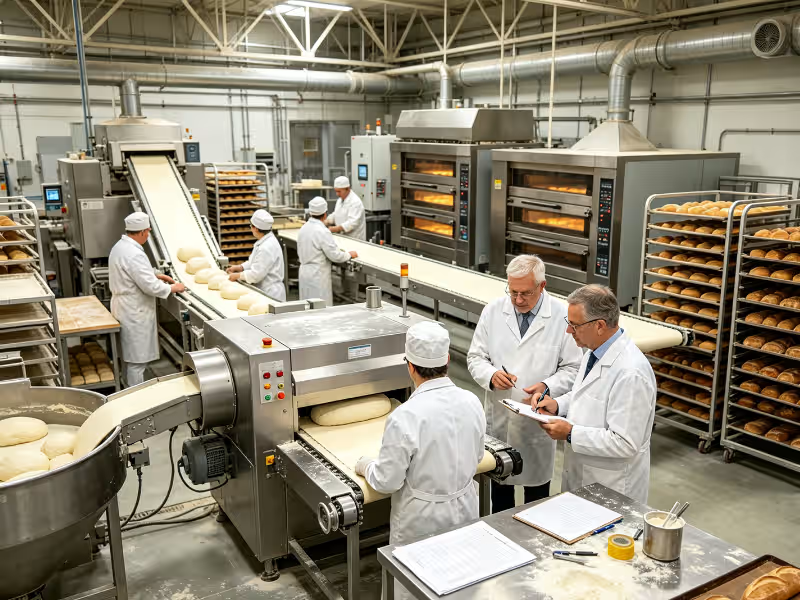
On commissioning day, the line looks right. The supplier’s technician has walked your operators through oven zone profiles, depositor weights, and the cleaning sequence. Trial runs come out on spec. Everyone signs the handover sheet. Six weeks later, cake height varies between shifts, color drifts on the night run, and an experienced operator is adjusting the depositor the same way he did on the old machine.
This is common, and it is rarely a skill problem. Training fades after commissioning because nothing in the plant is built to hold it once the technician leaves.
This guide covers what commissioning training is actually designed to do, the three themes that do the most damage when they slip, where training typically breaks down, how to turn trained behavior into stable line performance, and which signals show it is working.
What Commissioning Training Is Actually Built to Do
Commissioning training is not meant to make operators comfortable with new equipment. Its job is narrower than that. Every shift should run the line the same way, within the parameters proved during trials, and recover from common faults without improvising.
That is a behavior change, not a knowledge transfer. Operators should leave training able to load the correct recipe, check product against spec at defined intervals, clean to the validated sequence, and switch products in a fixed order.
Three design features determine whether that goal is met.
SOP handover. Written procedures are what keep the technician’s knowledge on site after the technician leaves. Without them, training lives only in memory.
Supervised trial runs on your own products. Operators learn on the cakes they will actually make, at the speed they will actually run. Demo batter teaches far less.
Operator sign-off. Each person demonstrates the critical tasks on their own. That creates a baseline you can check against later.
If any of these three is missing, the session was a machine tour, not a training.
Three Themes That Need Active Follow-Up
Not every topic covered at handover carries the same risk if it slips. The three below do the most damage when operators revert. All three can be checked on the floor within days of handover.
Settings Belong to the Recipe, Not the Operator
Oven zone temperatures, belt speed, depositor weight, and aeration density were confirmed during trials. They should be loaded from stored recipes, not adjusted by feel.
This matters because one shift’s quiet adjustment becomes the next shift’s starting point. After a few weeks, the line runs on settings nobody validated, and no one can say when they drifted. The required behavior is straightforward: report deviations rather than correcting them on the spot. If product drifts, record the reading, flag it to the shift lead, and update settings only through an approved recipe change.
Cleaning Is a Process Step, Not a Shift-End Chore
The cleaning sequence for depositor manifolds, aerator mixing heads, and oven bands or trays is part of production, not an optional extra. Residue in a depositor piston throws off fill weights. Carbon buildup on a steel band affects release and bottom color. Both problems tend to be blamed on the recipe or the machine rather than the missed clean.
Operators should follow the validated order and timing on every shift, including short ones, and record completion so the next shift knows where things stand.
Changeover Order Decides How Much You Waste
The sequence used to switch products — not machine speed — determines scrap and downtime. On a tunnel line, a new bake profile affects everything currently inside the oven. A changeover run out of sequence can waste a full oven length of product.
The required behavior is to follow the trained sequence: nozzle and piston swaps, profile loading, first-off check, in that order. Grouping products with similar bake profiles in the schedule reduces how often this sequence has to run at all.
Where Training Usually Breaks Down
Commissioning is the easy part because it is designed for learning. The production days that follow are designed for output. Under pressure, people fall back on what they already know.
Training tends to fail at four predictable points.
- No reflection. The rule stays abstract. “Use stored recipes” never becomes “I confirm the recipe number before every start-up.”
- No alignment. Trained operators return to supervisors who missed the sessions and still reward speed over procedure. The new method looks like a slowdown.
- No early repetition. A full changeover or complete band clean may not come up for days. By then, half the steps are gone.
- No reinforcement. Nobody checks. Old habits and production targets win quietly, and operators conclude the SOP was optional.
Each break point has a matching fix. Those fixes — not the original commissioning — decide whether the line holds its parameters or gradually reverts.
From Trained to Reliable: How Learning Becomes Line Performance
Reflect, Then Align
Turn each training theme into one or two specific station checks. For the depositor operator, that might be: confirm the recipe number, then check the first five fill weights after every start-up. Short lists get followed. Long ones get skipped.
Then brief supervisors and shift leads on the same procedures, even if they missed commissioning. Agree on what happens when following the SOP slows a run. If leads push operators to skip the first-off check to hit a target, the training is already lost.
Act Early, Then Repeat
Schedule the first unsupervised repetition of every critical task within days of handover — not when production happens to call for it. That includes a full changeover and a complete clean of the band or depositor. The first unassisted attempt reveals gaps the technician never saw.
Reliability comes from repetition plus feedback. Pair each operator with a trained peer for the first few weeks. Review deviations at the start of each shift. Go back to the supplier with specific questions while the relationship is still active.
Build It Into the System
Procedures that depend on memory fade in the first difficult week. Procedures built into how the plant runs survive staff changes and peak season.
Lock validated parameters behind recipe permissions so they cannot be edited at the control panel. Add cleaning and changeover checkboxes to the shift handover sheet. Turn the sign-off checklist into the standard for onboarding new operators.
Managers determine which habits survive. Operators follow what supervisors check and ask about. A production manager who walks the line, picks one station, and says “walk me through how you checked this” achieves more than a refresher session.
What Stable Training Looks Like on a Bakery Line
Training has held when you can see the evidence on the floor, not just in attendance records.
|
Horizon |
Signal to look for |
Who notices first |
|---|---|---|
|
30 days |
Operators load stored recipes and complete cleaning records every shift |
Shift leads and the operators themselves |
|
90 days |
Fill weights and bake color stay consistent across shifts without supervisor correction |
QA and production managers |
|
12 months |
New hires are trained to the same SOPs, and changeover times stay stable |
Plant management and process engineers |
Measure the right things. Attendance records show who was in the room, not what changed on the line. Compare shift-to-shift variation, scrap at changeovers, and unplanned stops before and after commissioning. A line that holds spec through a peak season and two rounds of new staff is the real proof.
Commissioning begins the process. The weeks that follow decide its value. Training becomes reliable line performance when operators translate it into station-level checks, supervisors align around the same procedures, critical tasks are repeated before they are needed, and the plant builds those habits into recipes, handover sheets, and routine walkthroughs.
Plan this follow-through before installation, not after the first quality complaint. If you are specifying a tunnel oven or a cake batter depositor, ask the supplier what parameter locks, cleaning documentation, and operator sign-off are included with commissioning. For a full cake production line, build the 30-, 90-, and 12-month checks into the project plan from day one.