
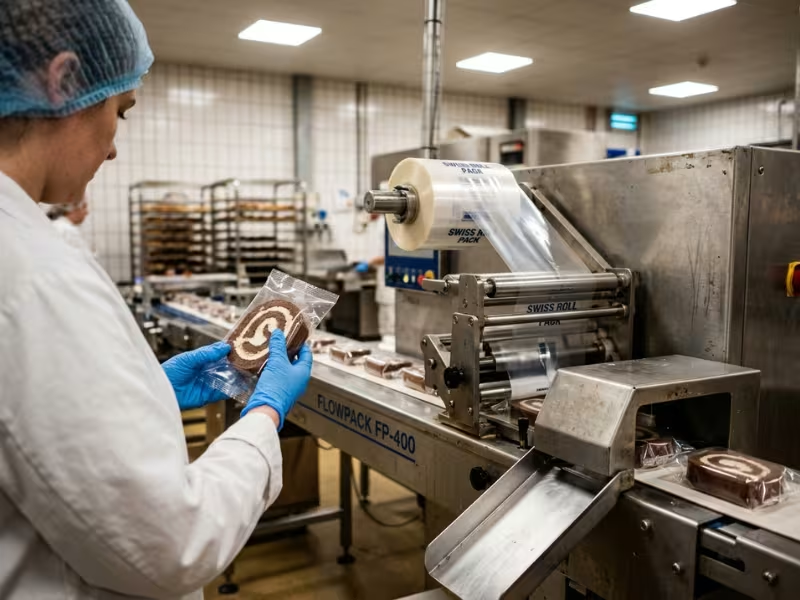
A bakery owner emails five suppliers: “We need a machine to pack our cakes. Please send a quote.” What comes back is a week of clarifying questions, three quotes that can’t be compared, and one suspiciously cheap offer that grows by 20% once the supplier finally sees the product.
This is a common pattern, and it rarely means the supplier did anything wrong. A cake packaging machine quote is only as accurate as the information behind it. When specs are missing, suppliers fill the gaps with assumptions.
The risk cuts both ways. Give too little detail and you may end up with a machine that crushes frosted tops or can’t keep pace with your oven line. Leave too much to guesswork and you may pay for servo motors, gas flushing, or speed you’ll never use. Both mistakes cost money, and both are avoidable.
This guide covers the exact specs suppliers need, grouped into six areas: product, output and format, automation, site, commercial terms, and compliance. It also shows how those requirements shift for small, mid-size, and industrial bakeries. At the end, you’ll find a copy-ready checklist you can fill in once and send to every supplier on your list.
Why Your Specs Decide the Accuracy of Your Quote
Buyers often picture a machine quote as a catalog price with shipping added. In practice, a quote is a configuration, and nearly every element of that configuration traces back to something you tell the supplier.
Your product dimensions set the film width, the forming box size, the bag length, and the pitch of the infeed conveyor. Your target speed decides the drive system—mechanical cams or independent servo motors on the sealing jaws. Your packaging format decides the machine family: a horizontal flow wrapper, a tray sealer, a thermoformer, or a cartoner. Your destination country decides the voltage, the electrical cabinet build, and the certification paperwork. Change any one of these inputs and the price changes with it.
When specs are missing, suppliers protect themselves in one of two ways. Some quote a base model at an attractive price, knowing it will need changes once your real product shows up. Those changes arrive as change orders—often after the deposit is paid or during the factory acceptance test (FAT). Other suppliers quote a padded configuration built for the worst case: extra changeover parts, more power, wider tolerances. The first approach gives you a low number that grows. The second gives you a high number that may include things you’ll never use. In neither case is the figure on the page the figure you’ll pay.
A complete inquiry changes the dynamic entirely. Engineers don’t need to chase answers, so replies come faster. The first configuration is closer to right, so there are fewer revisions. Every supplier works from the same inputs, so the quotes actually line up. And there’s a less obvious benefit: a detailed inquiry signals a serious buyer. Suppliers tend to pass those to senior application engineers rather than junior sales staff.
Product Specs: Start With the Cake Itself
If you only get one part of your inquiry right, make it the product description. Speed, format, film, and automation all depend on what the cake is, how big it is, and how much handling it can take. A supplier can work around a vague electrical spec. They cannot work around a vague product.
Cake Type and Product Range
Name the product clearly and specifically. “Cake” tells a supplier almost nothing. Swiss rolls, sponge slices, cupcakes in paper cups, muffins, mooncakes, layer cakes, brownies, and baked cheesecakes all behave differently on a conveyor. A firm brownie can be pushed by flight bars. A cream-topped slice can’t be touched from above. A cupcake with a tall swirl needs a tray or a domed pack. Each of these leads to a different infeed design and wrapping approach.
Then list every product you plan to run on the machine—not only your current best-seller. Include the smallest and largest sizes. Each additional size typically means another set of changeover parts: forming boxes, guides, and pusher settings. Some size spreads are simply too wide for a single machine. Suppliers need the full range before they quote, not after.
Send your supplier: product names, the number of SKUs, and any new products planned for the next one to two years.
Dimensions, Weight, and Shape
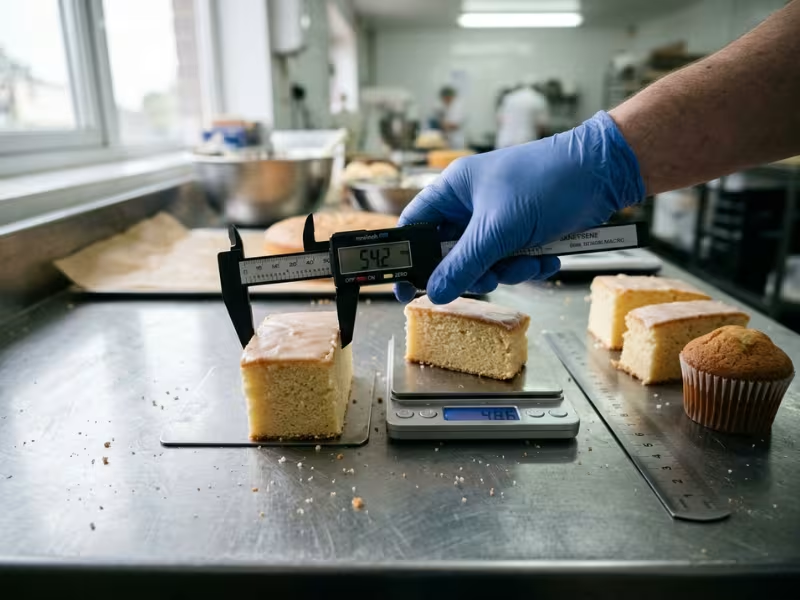
Give length × width × height in millimeters for every product, with minimum and maximum values and the real batch-to-batch variation. A sponge cake that runs at 80 mm one day and 86 mm the next needs a machine set up for that spread. Dimensions drive the film width, cut-off length, and conveyor pitch—a 5 mm error in your inquiry can mean the wrong forming box arrives with the machine.
Include the weight per piece and describe the shape honestly. Domed tops, sloped sides, uneven edges, and round versus rectangular footprints all matter. Irregular shapes often need custom infeed guides, different pusher fingers, or a tray to stabilize the product during wrapping. A supplier who doesn’t know about the dome will quote a standard setup.
Send your supplier: a dimension table, photos from the top, side, and front, and a technical drawing if you have one. Offer physical samples, especially for fragile or irregular products.
Fragility, Surface, and Temperature at Packing
Describe the surface in detail: frosting, buttercream, glaze, fruit toppings, sprinkles, sticky syrups, or a crumbly texture. These details decide whether the cake can be pushed from behind, whether anything can touch the top, and whether it needs a tray, cup, or board underneath. Frosted products often call for a film-from-below design or gentle side-belt handling—a meaningfully different configuration from a standard flow wrapper.
State the product temperature at the moment it reaches packing. Cakes packed warm release moisture inside the pack. That condensation can weaken seal integrity, fog the film, and reduce shelf life. If your line can’t fully cool products before packing, the supplier needs to know so they can factor in seal settings or recommend a spiral cooling tower buffer before the wrapper. Also note how cakes arrive at the machine: on baking trays, in paper cups, on boards, or loose.
A photo is not a spec. Two cakes that look identical on screen can need completely different machines once you factor in weight, surface, and temperature.
Output and Packaging Format Requirements
Once the product is defined, two inputs determine the machine family and most of its price: how fast you need to pack, and what the finished pack looks like.
Target Speed and Production Hours
Specify speed in packs per minute, and base it on your actual upstream output—not the highest figure in a brochure. Rated maximum speeds are typically measured with ideal products: rigid, uniform, and easy to feed. Fragile or irregular cakes often run well below that ceiling. A machine rated for 120 packs per minute may reliably handle a cream-topped slice at 60. Asking for “maximum speed” invites suppliers to quote against the rating instead of your reality.
Calculate your target this way:
Required speed (packs/min) = Upstream output per hour ÷ 60 + 15–20% headroom
For example, an oven line producing 3,000 cakes per hour needs 50 packs per minute just to keep up. Adding 15–20% headroom for restarts, film changes, and minor stoppages gives a working target of about 58–60 packs per minute. That headroom matters: a wrapper running at exactly line speed has no room to recover after a stoppage, and the backlog builds on the cooling conveyor.
Tell suppliers how many shifts you run per day and what output growth you expect. A machine running one eight-hour shift faces very different wear than one running around the clock. Continuous operation may justify heavier-duty components, and suppliers need to know that before they configure a price.
Packaging Format and Pack Style
The pack format is the single biggest fork in the road for machine selection. Here’s how the common options compare:
|
Format |
Typical Cake Types |
Impact on Machine Choice and Cost |
|---|---|---|
|
Pillow pack (flow wrap) |
Swiss rolls, muffins, brownies, mooncakes |
Horizontal flow wrapper. The most economical option at most speeds. |
|
Gusseted bag |
Taller products, multi-piece packs |
Adds gusset tooling. Slightly more complex film handling. |
|
Tray + flow wrap |
Frosted slices, cupcakes, fragile products |
Needs tray handling or a tray denester. Protects the surface and adds material cost. |
|
MAP / nitrogen flush |
Products needing extended shelf life |
Adds gas injection and tighter seals. Often requires a gas analyzer. Clearly higher cost. |
|
Clamshell or box |
Premium cakes, whole cakes |
Different machine family (lidding, cartoning, or semi-manual). |
|
Multipack or bundle |
Snack cakes sold in packs of 4–12 |
Adds collation and grouping. Primary and secondary wrapping may both be needed. |
Then specify the pack details: single or multipack, count per pack, end-seal style (serrated, flat, or easy-tear), and whether you need a euro slot or hang hole for retail display. If you have a current pack or a competitor pack you want to match, send it. A physical sample answers a dozen questions at once.
Film and Packaging Material Specs
Name the film type and structure. Common choices for cakes include OPP, CPP, PET/PE laminates, metallized films for light and oxygen barrier, and newer recyclable mono-material films. Give the thickness in microns and confirm whether the film is printed. Printed film requires a registration mark sensor (commonly called an eye-mark sensor) so the cut lands in the right spot on every pack. Without that detail, a supplier may quote a machine that can’t center your artwork.
Provide the roll specs: roll width, core inner diameter, maximum outer diameter, and maximum roll weight. These determine the film unwind setup and whether operators can lift rolls by hand. Note the sealing method—heat seal or cold seal. If you plan to switch to sustainable film, say so now. Mono-material and recyclable films often have narrower sealing windows and may need different jaw temperatures, jaw profiles, or dwell times. That’s far cheaper to plan for at the quote stage than to retrofit later.
The quickest way to cover this section: ask your film supplier for the technical data sheet and attach it to your inquiry.
Automation Level, Line Integration, and Optional Features
This is where buyers most often over-specify or under-specify. Automation and add-ons can shift a quote more than the base machine does, so decide what you genuinely need before suppliers decide for you.
Feeding Method and Line Integration
Choose your feeding method: manual loading, semi-automatic, or fully automatic infeed from a cooling conveyor. Manual loading keeps the machine price down but ties up operators, and throughput depends on how quickly people can place product. Fully automatic infeed removes that constraint but adds belts, sensors, and controls. Tell the supplier how many operators you can assign to the line—that single number helps them recommend the right balance between machine cost and labor cost.
List what connects to the machine on both sides. Upstream, that might be a depositor, oven, or cooling conveyor. Downstream, it might be a checkweigher, metal detector, cartoner, or case packer. Share the brand and model of existing equipment, plus any PLC or control system preferences. Machines need to communicate with each other: the wrapper should slow when the case packer backs up, and the oven line should know when the wrapper stops. Suppliers can only plan those signal handshakes if they know what they’re connecting to.
Special Features and Add-Ons
The common options that move a cake packaging quote include:
- Date and batch coder (thermal transfer or inkjet)
- Nitrogen flush system and gas analyzer
- Oxygen absorber dispenser
- “No product, no bag” sensing to save film
- Reject systems for faulty packs
- Label applicator
- Servo-driven sealing jaws for tighter seal control
- Quick-change parts for running multiple sizes
Don’t just list what sounds useful. Mark each feature as required now, required later, or not needed. Then ask every supplier to quote optional items as separate line items rather than bundled into one machine price. This lets you compare offers fairly when one supplier includes a coder and another doesn’t, and it shows you what can be added later instead of paid for up front.
More automation doesn’t automatically mean better value. A semi-automatic line that runs reliably at your real speed consistently outperforms a fully automated one sitting idle half the day.
Site and Utility Details
These are the most avoidable quote errors: the wrong voltage, a machine that won’t pass through the door, or no compressed air supply for the cutters. All of this information can be gathered in an afternoon.
Power, Voltage, and Utility Supply
Give your voltage (220V, 380V, 415V, or 480V), phase (single or three-phase), frequency (50 Hz or 60 Hz), and plug or socket standard. The destination country determines the electrical build—motors, drives, and cabinet components. Rewiring a machine after delivery costs time, money, and sometimes the warranty. A supplier who has to guess your power supply will typically default to their home market spec.
Note your compressed air supply: available pressure and spare capacity. Many packaging machines use air for knives, pushers, and reject units, and a weak or contaminated supply causes erratic cuts and missed rejects. If you need MAP, state whether you’ll use bottled nitrogen or an on-site nitrogen generator, since that affects how the gas system is designed and priced.
Floor Space, Layout, and Plant Environment
Give the available length and width, ceiling height, and line direction (left-to-right or right-to-left as seen from the operator side). Measure the doorways and access routes the machine must pass through on delivery day. A long flow wrapper with an infeed conveyor can fit the room but not the corridor. A simple floor sketch showing existing equipment, walls, columns, and drains is worth more than a paragraph of description.
Describe the room environment: temperature, humidity, and whether the area is washed down. Bakery packing rooms are often warm and humid, which affects how film behaves, how quickly seals set, and how electrical cabinets hold up. Washdown environments may need higher ingress protection ratings and different materials—both of which change the price.
Commercial, Delivery, and Compliance Details
Technical specs define the machine. Commercial details define the deal: what the final price includes, when you’ll have it running, and whether it’s legal to operate in your market.
Budget Range and What Drives Price
Share a budget range. Many buyers hold this back, worried it weakens their negotiating position. In practice, a range lets the supplier propose the right tier—basic mechanical, hybrid, or fully servo-driven—rather than guessing and missing. When you’re comparing several suppliers working from the same spec sheet, competition keeps prices honest, not secrecy.
Knowing what moves the number helps you read a quote intelligently. The main price drivers are speed, automation level, the number of products and sizes, add-ons, construction materials, and certifications. Each ties back to a section above. If a quote comes in higher than expected, this list tells you exactly where to look and which requirements you might adjust.
Lead Time, Delivery Terms, and After-Sales Support
State your target installation date, not just “as soon as possible.” Include your preferred Incoterms (EXW, FOB, or CIF) and the destination port or site address. Incoterms determine who pays for freight and insurance and who carries the risk in transit. Two quotes on different terms aren’t comparable until you adjust for that.
Ask every supplier to confirm what’s included beyond the machine itself:
- FAT using your product and your film—not their test samples
- Installation and commissioning on site
- Operator and maintenance training
- A starter spare parts kit
- Warranty length and coverage
- Remote support availability and response time
The FAT point matters most. A machine that runs perfectly on a supplier’s test product can struggle with your frosted slice. Testing with real product before shipment is the cheapest place to find and fix problems.
Certifications and Food Safety Requirements
Name your destination market early. CE marking is required in the EU; UL or CSA approval is typically required in North America; other regions have their own standards. Certification shapes the electrical design, the components selected, and the documentation package—it can’t be added at the last minute without added cost and delay.
Specify food-contact requirements: stainless steel grade (304 is standard; 316 suits washdown-heavy environments), food-grade lubricants, and hygienic design features such as open frames and easy-clean surfaces. Note the manual and HMI languages your team needs. If your retail customers run supplier audits, mention it—those audits often come with documentation requirements that suppliers should plan for from the start.
How Different Bakery Operations Should Prepare Their Quote Request
The checklist stays the same, but the emphasis shifts with the size and complexity of your operation. Find your situation below and focus your effort where it matters most.
Small Bakery or Growing Startup
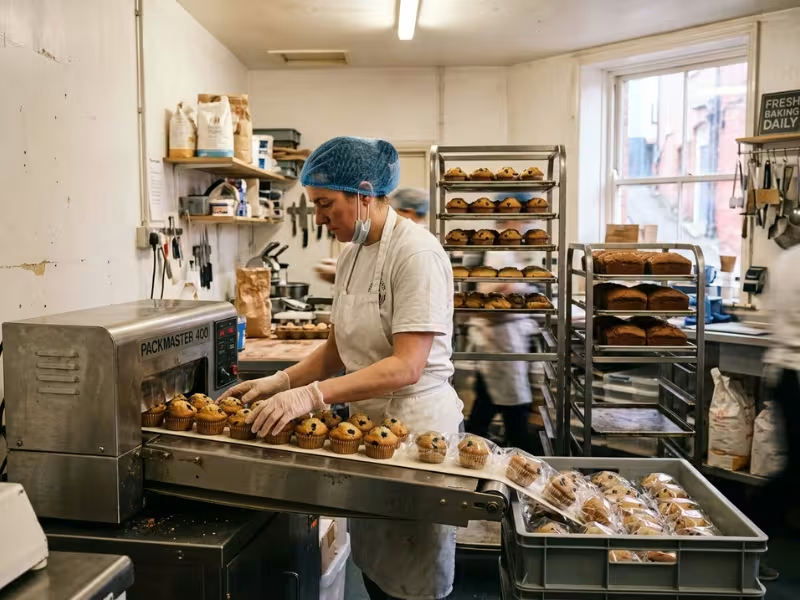
You’re likely running one or two products, loading by hand, and packing at moderate speed. Priorities are a clear product range, accurate film specs, and fast, simple changeovers—since the same operator who packs may also bake. Keep the machine configuration simple and get the basics right.
For operations at this scale, a manual feeding pillow packing machine is often the most practical starting point: lower investment, broad product flexibility, and no complex infeed system to maintain.
The most common oversight here is forgetting next year’s products. A startup that quotes only its current muffin often buys a machine that can’t handle the larger loaf cake launching eight months later. List what you plan to make, not just what you make today.
Mid-Size Producer With Multiple Products
You run several cake sizes, likely with semi-automatic or automatic infeed, and you sell to retailers who expect date codes and consistent packs. Priorities are the full size range, the changeover parts each size requires, and reliable coding.
The common oversight is quoting the best-seller’s dimensions only. Suppliers configure the machine for that one product, and every other SKU becomes an expensive add-on or an outright mismatch. Provide the full dimension table and ask how long a changeover takes between your smallest and largest product.
Industrial Line or Export-Focused Manufacturer
You need full line integration, MAP for extended shelf life, and a machine built for continuous shifts. Priorities are integration with connected upstream and downstream equipment, gas flushing performance, destination certifications, and a FAT with real product and real film.
The common oversight is not sharing details of connected equipment. A wrapper that can’t communicate with your existing case packer or metal detector turns a high-speed line into a series of manual handoffs. Send model numbers and control system details with your first inquiry. If you’re running a complete cake production line—from mixing and baking through to packaging—suppliers need to understand the full picture to quote the packaging section accurately.
Common Mistakes That Delay or Distort Your Quote
Sending only a product name or a photo. The supplier has to guess dimensions, weight, and fragility, so the quote rests entirely on assumptions. Fix: send the full product spec table and offer samples.
Asking for maximum speed instead of real output. You either pay for speed your line can’t feed, or you get a machine that underperforms on fragile products. Fix: calculate speed from upstream output plus 15–20% headroom.
Skipping film specs. The forming box, sealing temperature, and jaw design may not match your film—and that shows up at the FAT or, worse, on your production floor. Fix: attach your film supplier’s technical data sheet.
Forgetting future products or sizes. Adding changeover parts later costs more than quoting them upfront, and some size ranges simply won’t fit the machine you bought. Fix: list planned products for the next one to two years.
Overlooking destination voltage and certifications. The result is customs delays, rewiring costs, or a machine you can’t legally operate. Fix: state country, voltage, phase, frequency, and required certifications on page one of your inquiry.
Comparing quotes with different scopes. One quote includes a coder, FAT, and training. Another lists the bare machine. The cheaper number isn’t necessarily the cheaper deal. Fix: send every supplier the same spec sheet and require options to be quoted as separate line items.
Cake Packaging Machine Quote Request Checklist
Fill this in once and send the same version to every supplier you’re evaluating. Identical inputs are the only way to get quotes you can compare line by line. Adjust the example entries to match your operation.
|
Category |
What to Provide |
Example Entry |
|---|---|---|
|
Product type |
Name of each cake and number of SKUs |
Swiss roll slices, 3 SKUs |
|
Dimensions |
L × W × H in mm, min and max |
Min 90×45×30 / Max 140×60×45 mm |
|
Weight |
Grams per piece |
35–80 g |
|
Surface and fragility |
Frosting, toppings, stickiness, crumb |
Light glaze on top, no top contact |
|
Temperature at packing |
Product temperature at infeed |
22–25°C, fully cooled |
|
Target speed |
Packs per minute from real output |
60 packs/min |
|
Shifts |
Hours per day, days per week |
2 shifts, 6 days/week |
|
Packaging format |
Pack type and style |
Flow wrap on tray, serrated end seal |
|
Film specs |
Type, thickness, printed or not, roll specs |
Printed OPP, 30 µm, 76 mm core |
|
Feeding method |
Manual, semi-auto, or automatic |
Automatic from cooling conveyor |
|
Connected equipment |
Upstream and downstream brand and model |
Metal detector and checkweigher downstream |
|
Add-ons |
Required now / later / not needed |
Coder now, nitrogen flush later |
|
Power supply |
Voltage, phase, frequency |
380V, 3-phase, 50 Hz |
|
Compressed air |
Available pressure and capacity |
6 bar available |
|
Floor space |
Length, width, ceiling height, line direction |
8 m × 3 m, left-to-right |
|
Environment |
Room temperature, humidity, washdown |
24°C, 60% RH, dry clean only |
|
Budget range |
Approximate range |
Range shared confidentially |
|
Install date |
Target commissioning date |
Q3 next year |
|
Incoterms and destination |
Terms and delivery location |
CIF, destination port |
|
Certifications |
Market approvals and food-contact needs |
CE, 304 stainless contact parts |
Attach supporting files alongside the checklist: product photos from three angles, technical drawings, your film technical data sheet, a floor plan sketch, and a sample of your current or target pack. Offer to ship physical product samples for testing—especially for frosted, cream-filled, or irregular cakes.
If you don’t know an answer yet, write “to be advised” rather than leaving the field blank. A blank field looks like an oversight and the supplier will fill it with an assumption. “To be advised” signals that the item is still open, so they can either quote options or flag it as a question.
FAQ
How long does it take to get a cake packaging machine quote?
With a complete spec sheet, many suppliers return a budget quote within a few working days and a detailed quote shortly after. Incomplete inquiries often stretch to weeks of back-and-forth questions. If the supplier needs to run trials with your product and film, add time for sample shipping and testing—it’s worth it for fragile or unusual cakes.
Should I send product samples to the supplier?
Yes, whenever your cake is fragile, frosted, sticky, or irregular in shape. Photos and dimensions can’t convey how a product behaves when pushed, transferred, or wrapped. Ship samples in their real packed condition, protected against crushing and temperature swings. Include spare film rolls too so the supplier can test your actual material rather than a substitute.
Why do quotes from different suppliers vary so much?
Quotes usually differ in scope more than in honest pricing. One supplier may include a coder, spare parts, FAT, and training; another may list only the bare machine. Component brands, drive systems, and build quality also vary. To compare fairly, map each quote against your checklist and ask suppliers to fill any gaps before you decide.
Can one machine pack different cake sizes?
Yes, within a defined range. Most flow wrappers handle multiple sizes using changeover parts—forming boxes, guides, and adjusted cut-off settings. The wider the spread between your smallest and largest product, the more parts you need and the higher the cost. Very wide ranges may justify two simpler machines instead of one complex one.
What should a complete quote include?
A complete quote lists the machine model and its key specs, optional items as separate line items, FAT details, installation and commissioning, operator training, a spare parts kit, warranty terms, lead time, Incoterms, and payment terms. It should also confirm the electrical configuration and certifications. If any of these are missing, ask before comparing prices.
Can I upgrade the machine later—for example, by adding MAP or a coder?
Some features retrofit easily; others don’t. Date coders and labelers are usually straightforward bolt-on additions. Nitrogen flushing, servo jaws, or automatic infeed may require frame changes or a different base model entirely. That’s why your inquiry should flag features as “required later,” so the supplier can build in mounting points and control capacity from day one.
Conclusion
An accurate cake packaging machine quote starts with the product itself, then builds through speed, pack format, film, automation, site conditions, and commercial terms. Each spec you provide removes one assumption from the supplier’s side of the table. Fewer assumptions mean faster replies, fewer revisions, and quotes you can trust and compare side by side.
The work takes an afternoon, not a month. Fill in the checklist, gather photos and drawings, request your film data sheet, and set aside a few product samples. Then send the same package to every supplier on your shortlist. The quotes you get back will be more accurate, easier to compare, and far less likely to change after you’ve signed.
If you already have your specs together—or even half of them—send your checklist and product details to our team. We’ll review them and come back with a configuration built around your cakes and an accurate quote to match.