Request quotes for a new oven, and the list of options usually gets longer. Rotary rack, deck, tray tunnel, steel belt, mesh belt. Gas or electric. Convection, radiant, or both. Each supplier makes a strong case for the type it builds.
The situations behind these requests vary. Your rack ovens may no longer keep up with one high-volume SKU, and the night shift spends its hours pushing trolleys. Your team may be planning its first continuous cake line and need to fix a layout before the depositor is ordered. Or you run many short jobs a day, where every changeover already costs you.
Two questions remove most of the options. What carries your product through the bake? How long does each product run? Answer those honestly, and the field usually drops to one or two candidates. The rest of this guide helps you choose between them.
Batch or Continuous: The First Split
Every industrial oven belongs to one of two families, and that split shapes most of what follows.
Batch ovens bake a fixed load, then unload it. Racks or trays go in, the door closes, and the bake runs at a set time and temperature. The next load can run a completely different recipe. Rotary rack ovens and deck ovens work this way.
Continuous ovens bake product while it moves. Trays or a band carry product through heated zones, and belt speed sets the bake time. Output is steady. The catch is that every product on the line shares one rhythm. Tunnel ovens make up this family.
The practical consequence is easy to underestimate. A batch oven adapts to your schedule. A continuous oven sets the schedule. Once a tunnel oven is running, the depositor upstream must feed it at its rate, and the depanner, cooler, and packer downstream must keep up with that same rate. If any of them can’t, the oven runs half-empty or product backs up. Choosing a tunnel oven is a decision about the whole line, not just the oven. Plants that treat it as a simple swap usually discover this during commissioning.
The Four Oven Systems Industrial Bakeries Actually Shortlist
Industrial plants rarely compare more than four systems. Each is defined by what carries the product and by the run pattern it suits.
Rotary Rack Oven
How it works. Operators wheel a full rack of trays into a convection chamber. The rack rotates so every tray gets the same airflow.
Where it fits. Panned cakes, cupcakes, rolls, and mixed short runs, because bake time and temperature can change with every load.
Where it struggles. Long single-SKU runs. Loading and unloading racks takes people on every cycle, and output grows only by adding more ovens and the staff to run them.
Deck Oven
How it works. Product bakes on stacked, fixed decks and picks up strong bottom heat from the deck surface.
Where it fits. Hearth breads and products that need direct base heat, plus small specialty batches.
Where it struggles. Industrial cake production. Loading is manual, and capacity per square meter of floor is limited. In most cake plants, a deck oven fills a niche or R&D role rather than carrying core volume.
Tray Tunnel Oven
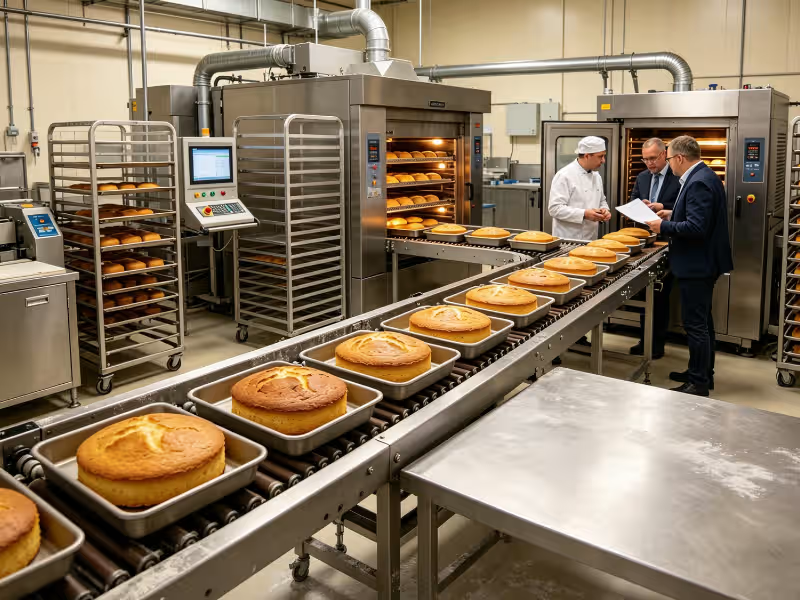
How it works. Trays or pans travel on a conveyor through a series of separately controlled heating zones.
Where it fits. Panned products at volume: sponge and layer cake, cupcakes in paper cups, loaf cakes. A tray tunnel oven is well suited to any product whose shape depends on the pan.
Where it struggles. Very frequent product changes. It also needs a pan return loop, so depanning, pan cleaning, and pan handling become permanent parts of the line.
Steel Belt Tunnel Oven
How it works. Batter or dough is deposited straight onto a continuous steel band that carries it through the heating zones.
Where it fits. Flat, sheet, and rolled products: Swiss roll sheets, sheet cakes, biscuits, and cookies. A mesh belt variant handles products that need airflow underneath. See steel belt tunnel oven for how this carrier differs from a tray line.
Where it struggles. Panned or tall products. The band also needs tracking control, a reliable release surface, and a regular cleaning routine.
Tray Tunnel vs Steel Belt Tunnel: The Decision That Shapes Your Line
Once a plant decides on a tunnel oven, the carrier choice — trays or band — matters most. It determines the depositor type, release method, cooling layout, and total floor footprint. This is where plants save or lose the most money.
A tray tunnel line runs in a loop. The depositor fills pans, the pans pass through the oven, a depanner releases the product, and empty pans return to the start. The pan defines shape and supports soft batters that would spread on an open band. That support has a cost. The pan return conveyor takes up floor space, the depanning station adds a machine to maintain, and pans wear out and need cleaning and replacing. Pan handling becomes a permanent line activity.
A steel belt line runs straight. Product is deposited onto the band, carried through the oven, and released at the band end for cutting, rolling, or cooling. With no pans, the layout is simpler. The trade-off is that product shape must come entirely from depositing accuracy. The band also needs tracking to stay centered, a release agent or surface treatment to prevent sticking, and regular cleaning built into the production schedule.
The decision rule: if the product needs a pan for shape or support, choose a tray line. If it’s flat, sheet-formed, or rolled, choose a band. Plants that choose the carrier on price rather than product fit tend to pay later in workarounds — frames bolted onto bands, or pans forced through a line built for sheets.
How Heat Is Delivered: Convection, Radiant, and Hybrid Zones
Heat delivery affects color, rise, and bake time as much as oven type does. You’ll see these terms in every quote.
Convection moves hot air across and around the product. Moving air transfers heat evenly through dense loads, which is why convection suits panned cakes and full racks. Every tray gets similar heat regardless of its position.
Radiant heat comes from burners or elements aimed at the product or the band. It delivers strong surface and base heat, building color and crust quickly. Radiant heat suits thin sheets, biscuits, and products that need a firm bottom bake.
Hybrid zoning combines both methods along the oven length. A typical cake profile might use radiant heat early to drive rise and set structure, then convection later for even bake and color. When comparing quotes, ask each supplier for a zone profile built around your specific product, not a generic setting. That request quickly shows who has actually baked a product like yours.
Heat source — gas or electric — is a separate question tied to your building’s utilities, covered in the plant checks section below.
Oven System Selection Matrix
Find the row closest to your main product and run pattern. If two rows fit, the narrowing questions in the next section break the tie.
|
Oven system |
Mode |
Best-fit products |
Run pattern |
SKU flexibility |
Labor |
Floor-space pattern |
Typical plant scenario |
|---|---|---|---|---|---|---|---|
|
Rotary rack |
Batch |
Panned cakes, cupcakes, rolls |
Short, mixed runs |
Very high |
High (rack handling) |
Compact per unit; scales by adding units |
Multi-SKU or growing plant |
|
Deck |
Batch |
Hearth bread, base-heat specialties |
Small batches |
High |
High (manual loading) |
Moderate |
Specialty or R&D capacity |
|
Tray tunnel |
Continuous |
Sponge, layer, and loaf cakes; cupcakes |
Long runs of panned product |
Moderate |
Low in baking; pan handling remains |
Long line plus pan return loop |
High-volume panned cake line |
|
Steel belt tunnel |
Continuous |
Swiss roll sheets, sheet cakes, biscuits |
Long runs of flat product |
Lower |
Low |
Long, straight line |
High-volume sheet or biscuit line |
Many plants combine rows. A tunnel line carries core volume on long campaigns while rack ovens handle short runs, seasonal SKUs, and trials. That’s deliberate design, not indecision. It keeps changeovers away from your most capital-intensive asset.
Five Questions That Narrow the Shortlist
Work through these in order. Each one removes options before you reach the next.
1. What Carries Your Product Through the Bake?
Rack, deck, pan, or band. This is the fastest filter — it rules out at least one oven family immediately. A panned sponge cake can’t run on an open steel band. A Swiss roll sheet gains nothing from a rack oven at volume. Start with the physical product, not the output target.
2. How Long Does Each Product Run?
Long, stable runs of one product family favor tunnel ovens, because the line rhythm stays fixed for hours. Many short runs favor batch ovens. On a tunnel line, every change to bake time or zone profile affects everything inside the oven at once. Product already in the oven has to finish under the old settings while the new profile stabilizes. Rack ovens absorb recipe changes one load at a time.
3. What Output Do You Need, and What Does That Mean for Oven Length?
This is where most capacity confusion starts. The logic: required baking area equals target output multiplied by bake time, divided by product loading per square meter of trays or band. Bake time carries most of the weight in that formula. A product with a longer bake needs a longer oven to hit the same hourly output. That’s why two plants with identical output targets can need very different tunnel lengths. Before comparing oven sizes, confirm your real bake time and loading density with a trial bake. Don’t rely on a catalog figure.
4. What Must the Oven Connect To?
List every station the oven touches. Upstream, that’s the depositor. Downstream, it’s depanning, cooling, cutting, and packing. A tunnel oven sets the line’s rhythm, but the slowest connected station decides real output. An oven rated well above your packing line speed doesn’t increase output — it just moves the queue further downstream.
5. Where Will Volume Be in Three to Five Years?
Batch ovens scale in steps — you add another unit when demand arrives. A tunnel oven’s length is fixed at purchase, and extending it later disrupts production and the building around it. Plan for the realistic next stage of your business, not a best-case forecast. If growth is likely but uncertain, the smarter move is to plan the building infrastructure for it, not the oven.
Plant Checks Before You Commit
The right oven on paper can still fail in your building. Run these checks before a supplier finalizes the specification.
Floor space and layout. Measure the full line, not just the oven body: infeed, outfeed, pan return, cooling, and service clearance on both sides. A tunnel line needs a straight run or a carefully planned turn. Columns, drains, and doorways often constrain the layout more than the oven does.
Utilities and heat source. Check gas supply pressure and volume, available electrical capacity, and whether switching heat source would require building upgrades. Utility work frequently takes longer than equipment lead times, so start this check early.
Exhaust and building. Plan flue routing, roof penetrations, and makeup air. A long tunnel oven also adds significant heat to the surrounding room, which affects operator comfort and nearby cooling and packing areas.
Maintenance access. Burners, elements, drive chains, and belt service points all need regular access. Leave enough side clearance to remove panels. An oven installed tight against a wall costs more to maintain across its entire working life.
Cleaning and hygiene. Confirm how crumb trays are removed, how the band or conveyor is cleaned, and how carbon and residue are cleared from inside the oven. Then verify the cleaning routine fits your production schedule without cutting into planned run hours.
What Drives Total Cost
The oven’s purchase price is rarely the largest part of the decision. Installation, connected equipment, energy, labor, and downtime usually determine what the project actually costs.
Upfront scope extends well beyond the oven itself. Installation, utility connections, exhaust work, foundations, and connected equipment all count. For a tunnel line, that includes loaders, depanners, pan return systems, and cooling. A quote that excludes these understates the project. Two quotes that look far apart on price may simply cover different scopes.
Running cost is where batch and continuous diverge most clearly. Track energy per kilogram of finished product, labor per shift, maintenance parts, and scrap. Rack ovens cost less upfront but carry ongoing labor on every load. Tunnel ovens cut baking labor and stabilize output — but only return that investment at sustained volume. A tunnel oven running short shifts or frequent changeovers carries its full cost without earning its full return.
Compare quotes on equal terms. Put scopes side by side, line by line. Ask each supplier for expected energy use at your actual product and output — not at a standard test load. Model payback against your real run hours and changeover pattern. Treat any supplier ROI figure as a target to verify, not a number to present to management.
Common Selection Mistakes
These mistakes recur in oven projects and are expensive to reverse.
Choosing by volume before product fit. High output demand doesn’t make a steel belt oven right for a panned product. Carrier fit comes first. Volume only decides between options that already match the product.
Sizing the oven to a best-case forecast. An oversized tunnel oven wastes energy and floor space every shift it runs below capacity. The smarter approach: reserve building space, gas, power, and exhaust capacity for the next stage, and size the oven itself for realistic near-term output.
Ignoring the rest of the line. A faster oven feeding a slow depanner or packer just moves the bottleneck. Check the rated speed of every connected station before you set the oven’s target output.
Underestimating changeovers. On a tunnel line, a bake-time or zone-profile change affects everything inside the oven at once. Plants that specify a tunnel oven for many short runs often lose product or leave the oven idle while profiles stabilize.
Skipping product trials. Bake your own recipe on the proposed oven type, or a directly comparable one, before you sign. A trial gives you real bake time, color, and loading density — the three numbers that determine whether the oven you’re buying actually fits your product.
Frequently Asked Questions
Is a tunnel oven always better for high-volume baking?
No. It wins on long runs of one product family. High total volume spread across many SKUs often runs better on several rack ovens, or on a mixed setup where a tunnel handles the core product and rack ovens take everything else.
When is a rotary rack oven still the right choice?
For short runs, frequent recipe changes, R&D work, and plants growing in stages. You scale by adding units as demand arrives instead of committing to a long fixed line. That lowers the cost of getting the forecast wrong.
What products suit a steel belt tunnel oven best?
Flat, sheet, or rolled products deposited directly onto the band: Swiss roll sheets, sheet cakes, biscuits, cookies. It’s a poor fit for panned or tall products, which need a pan to hold their shape through the bake.
Can a tunnel oven handle frequent product changes?
Yes, using stored zone profiles — but every bake-time change alters the rhythm of the whole line. Group products with similar profiles into campaigns to minimize how often the oven changes settings.
How much future capacity should I plan for?
Plan building infrastructure — floor space, gas, power, exhaust — for the next stage. Size the oven for realistic near-term output. That way growth doesn’t require rebuilding, and the current oven doesn’t run half-empty for years.
Is switching from gas to electric worth it when replacing an oven?
It depends on local energy prices, available electrical capacity, and any decarbonization targets your business has set. Confirm the cost of electrical upgrades before comparing oven prices — that number often changes the answer.
Can rack ovens and a tunnel oven work in the same plant?
Often, yes. The tunnel carries core volume on long campaigns. Rack ovens handle short runs, seasonal SKUs, and new product trials without interrupting the tunnel line.
Choosing an oven system follows a clear sequence. Start with the product carrier, then the run pattern. Work out output and oven length, confirm what the oven connects to upstream and downstream, and check that your building can support it. Follow that order and most plants arrive at one or two realistic candidates.
To pressure-test your shortlist, bring your product list, target output, and floor plan to a supplier review. If long runs point you toward continuous baking, compare tunnel oven options against your carrier choice and bake-time requirements. If flexibility and lower commitment matter more, a rotary rack oven configuration is likely the better fit.