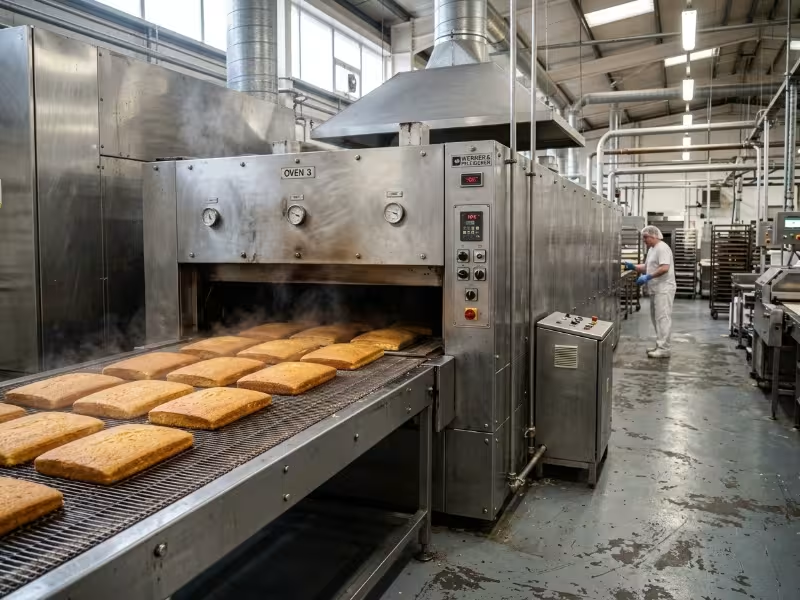
A conveyor belt oven is a continuous oven. You don’t load a tray, close a door and wait. Instead, product sits on a moving belt that carries it through a heated tunnel. It enters raw, wet or uncured at one end and leaves finished at the other, while the next piece follows right behind it. A batch oven works differently: product stays still while the oven cycles through loading, heating and unloading. The defining difference is straightforward. In a conveyor oven, belt speed sets how long the product spends in the heat—not a timer.
That one fact shapes everything else about the machine. Below, we explain how heat actually reaches the product, how belt speed controls both quality and output, which processes suit the conveyor format, and what physically limits how much an oven can handle. The stakes are practical. Choose the wrong belt speed or the wrong oven size, and the problems are predictable: pale or underdone centers, scorched surfaces, or an oven that becomes the bottleneck of an otherwise fast production line.
How a Conveyor Belt Oven Works
The Basic Layout: Belt, Chamber and Drive
Every conveyor oven shares the same core structure. An infeed section is where product is loaded onto the belt. A heated tunnel contains the heat source and airflow system. A conveyor belt carries product through that tunnel at a controlled rate. A drive motor—usually coupled to a variable frequency drive (VFD)—moves the belt at a steady, adjustable speed. An exit or cooling section receives the finished product.
The belt itself does more than move product from one end to the other. An open wire mesh lets hot air circulate underneath the product. A solid steel band conducts heat directly into flat bases, acting much like a hot plate. A PTFE-coated mesh releases sticky or delicate items without damage. When you choose a belt type, you are also choosing how heat reaches the product’s underside—which affects browning, moisture loss and texture at the bottom surface.
How Heat Reaches the Product
Heat moves into the product through three mechanisms:
- Convection: Hot air moves across the product surface. In many ovens, this air is forced through nozzles as impingement jets—high-velocity streams that break up the thin layer of cooler air clinging to the product, allowing heat to transfer significantly faster than in a still-air environment.
- Radiation: Infrared emitters or hot chamber surfaces beam energy directly onto the product without requiring air movement.
- Conduction: Heat flows from a hot belt or hearth surface into the product wherever they make direct contact.
Most ovens combine two or more of these modes, drawing on gas burners, electric elements or infrared lamps as heat sources. The combination matters because each mode affects the product differently. Impingement air dries and browns surfaces quickly. Conduction drives heat up from the base. Radiation sets color and crust without requiring air contact.
Many conveyor ovens divide the tunnel into independently controlled zones, each with its own temperature, airflow rate and top-to-bottom heat balance. A common zone structure looks like this:
- A high-heat entry zone develops the product surface.
- A moderate middle zone cooks or cures through to the core.
- A finishing zone dries the product or completes surface color.
Zoning lets one continuous pass do the work of a multi-step process. The trade-off is that each zone added increases tunnel length and introduces additional variables that operators must maintain consistently.
Conveyor Oven Speed: Belt Speed, Dwell Time and Throughput
The most important relationship in conveyor oven operation is this:
Dwell time = heated length ÷ belt speed
Dwell time is how long any single piece spends inside the heated tunnel. Take a 3 m heated tunnel running at 1 m/min. Each product receives 3 minutes of heat exposure. Slow the belt to 0.5 m/min and dwell time doubles to 6 minutes. On a conveyor oven, changing belt speed directly changes cooking or curing time. Operators who treat the speed control as a throughput dial—without accounting for its effect on dwell time—will find themselves chasing quality problems that are actually process problems.
The intuitive shortcut is to raise temperature and speed up the belt simultaneously. That approach has a physical ceiling. Heat enters at the product surface and must travel inward to the core, and that transfer takes time regardless of how hot the surrounding air is. Thicker or denser products require disproportionately more time, not just a little more. Push too aggressively and the surface browns, burns or skins over before the center reaches its target temperature. Each product’s thickness, density and moisture content sets a minimum dwell time that no combination of belt speed and temperature can bypass.
Speed and throughput are also not interchangeable terms. Throughput = usable belt width × belt speed × loading density (pieces per square meter of belt). Consider two ovens both running at 1 m/min, each loaded at 40 pieces per square meter. A 0.6 m belt yields 24 pieces per minute. A 0.9 m belt yields 36 pieces per minute—50% more output at the same belt speed and the same dwell time. Process stability matters as much as the numbers. Steady belt speed and consistent zone temperatures produce uniform results across a run. Any mid-run speed change shifts the dwell time for every piece already inside the tunnel, and that portion of the batch will come out inconsistent.
Common Uses of Conveyor Belt Ovens
Food Processing and Foodservice
Pizza, flatbreads, buns, toasted sandwiches, snack foods and cooked proteins all suit the conveyor format well. The core advantage is repeatability. Every piece receives the same dwell time and the same heat profile, so the 500th unit matches the first. The choice of heat mode shapes the result: impingement air crisps and browns pizza crusts quickly, while a solid hot belt delivers an even, conductive bake across the base of flatbreads. The conveyor format is strongest when volume is consistent and the product range is narrow. For short, varied runs with frequent product changes, a batch oven is usually a better fit.
Industrial Drying and Curing
Conveyor ovens are well established for curing paints, powder coatings and adhesives, drying washed components, and curing printed or composite materials. Cure chemistry depends on time at temperature, and belt speed controls that variable precisely. The critical requirement in most curing applications is ventilation: the oven must have enough exhaust capacity to remove solvent vapors or moisture quickly and safely. The continuous format suits high-volume runs where parts are similar in size and share the same thermal profile.
Electronics and Thermal Processing
Reflow soldering of circuit boards is the most common electronics application, with thick-film component firing and small-part annealing also carried out on conveyor systems. In these processes, tightly controlled zones create a precise temperature profile as each board travels through the tunnel: ramp, soak, peak and cool. Some processes require a controlled atmosphere—nitrogen is common—to prevent oxidation during peak temperature stages. The conveyor format is the standard choice wherever an exact thermal profile must be repeated reliably across large volumes of identical parts.
Capacity Limits: What Caps Conveyor Oven Output
Oven Dimensions and Belt Loading
Heated tunnel length sets the upper limit on belt speed at any given dwell time. The only way to run the belt faster while maintaining the same process time is to make the tunnel longer. Belt width sets how many units fit side by side per pass. Loading density also has a practical ceiling. When products are packed too tightly, they block airflow between units, shade each other from radiant heat, and bake unevenly. Adding more pieces per meter of belt only improves throughput until heat distribution breaks down—at that point, output goes up but quality goes down.
Heat Load and Airflow
Every kilogram of product entering the oven absorbs energy. Frozen, high-moisture or dense products impose a far greater heat demand than dry room-temperature items. If burner or element capacity cannot replenish heat as fast as the product absorbs it, zone temperatures drop as loading increases—a condition known as temperature pull-down. This is why an oven that performs well at light load can systematically underbake when run at full capacity. Airflow introduces a parallel constraint: uneven air distribution across the belt width creates temperature differences between the belt edges and center, and denser product loading amplifies those differences.
Product Characteristics
As noted in the speed section, product thickness directly sets minimum dwell time, which caps the belt speed ceiling. Tall products may not clear the tunnel opening. Fragile items can limit how fast the belt runs or how the product is handled at infeed and exit transfer points. High-moisture products release steam; without adequate exhaust capacity, internal humidity rises and alters browning, drying rates and cure results in ways that are difficult to compensate for through temperature alone.
Line Balance and Consistency Requirements
A conveyor oven rarely operates in isolation. Its practical capacity is constrained by the slowest step immediately before or after it—dough forming, coating, cooling or packaging. Tight specifications on color, moisture level or cure state also narrow the usable speed window, because running near the rated maximum almost always increases reject rates. When sizing an oven, the correct reference point is the product with the longest minimum dwell time, not the product that is easiest to bake.
What to Check Before You Set Speed or Size an Oven
Work backward from the process. Establish the dwell time your product requires first, then allow belt speed to follow from that—not the other way around. Match the heat mode to the specific result you need: surface browning, through-cooking, chemical cure or reflow. Size the oven around your most demanding product and its peak heat load, not around a light test run that underrepresents real operating conditions.
Confirm that upstream and downstream equipment can maintain pace with the oven’s intended throughput before finalizing the specification. For bakery production in particular, this means checking that the tunnel oven configuration—whether a steel belt tunnel oven for direct-contact belt baking or a hot air radiant tunnel oven where surface color and internal cure need to develop together—matches the product’s heat transfer requirements, not just the target output rate. The most reliable sizing data always comes from trial runs with your actual product at full load. Request them before committing to a tunnel length or belt width.