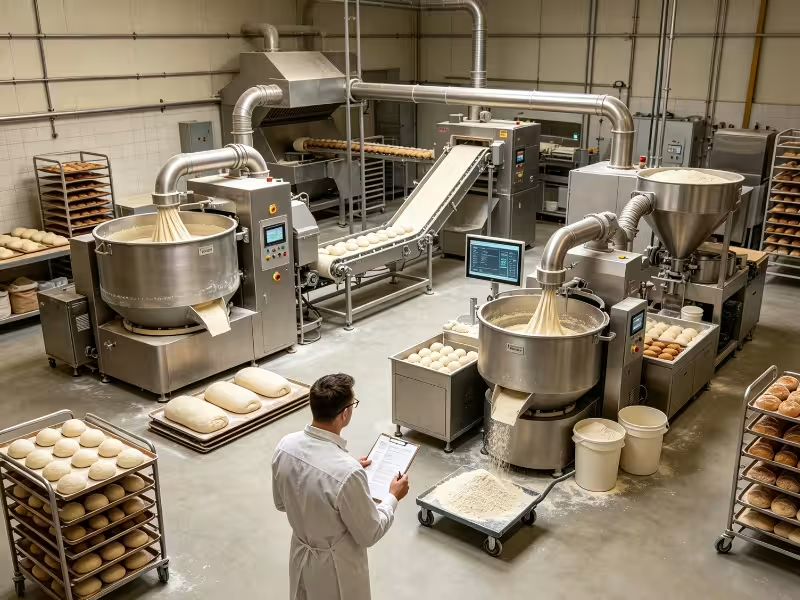
On paper, both systems produce the same batter. You can run the same sponge, chiffon, or cupcake formula through a planetary bowl or a continuous aerator, and both will bake.
On the production floor, the difference is significant. The two systems diverge in when batter is made, how stable its density stays across a shift, what a changeover actually costs in time and waste, and how batter reaches the depositor. Getting this choice right affects giveaway, labor, cleaning schedules, and how well the mixer integrates with the rest of your line.
This article defines both systems, compares them across the criteria that matter on a real production line, and gives you a clear framework for choosing.
What Is Batch Mixing?
Batch mixing prepares a fixed quantity of batter in a bowl, from start to finish. Operators or a dosing system load weighed ingredients. The mixer runs through set times and speeds, then the batch is discharged by tilting, bowl transfer, or pumping. Planetary, spiral, and horizontal mixers all operate this way.
What defines batch mixing:
- A fixed batch size, determined by bowl capacity
- A complete load, mix, and discharge cycle for every batch
- The ability to change recipes between any two batches with minimal overlap
- Results that depend on timing, accurate scaling, and operator consistency
What Is Continuous Mixing?
Continuous mixing meters premix into a mixing head at a steady rate and produces batter without stopping, matched to the downstream line speed. In industrial cake production, this usually means continuous aeration.
A feed pump pushes premix through a rotor-stator head — a fast-spinning rotor inside a toothed stator. Air is injected at a controlled flow rate. Back pressure, the resistance maintained at the outlet, keeps air finely dispersed so batter reaches a consistent target density.
What defines continuous mixing:
- A steady output rate rather than separate cycles
- Setpoints held automatically by the control system: air flow, rotor speed, back pressure
- Inline density or specific gravity monitoring
- Batter delivered on demand, matched to depositor throughput
One important clarification: “continuous” typically refers to the aeration step only. The base premix is often still prepared in batches. That distinction matters for how you plan the rest of the line — and for the hybrid setup covered later.
Where the Two Systems Actually Differ
Speed is not the core difference. Three factors determine most selection outcomes: batter timing, the source of variation, and changeover cost.
Batter Timing and Holding Time
A batch of aerated batter is made all at once and then sits in a hopper while the depositor works through it. During that hold time, it slowly loses entrained air and its viscosity shifts. The last pans of a batch often receive different batter than the first.
Continuous batter is aerated minutes before it reaches the depositor. There is no meaningful hold time, so density stays consistent from the first unit of the run to the last.
Where Variation Enters the Process
In batch mixing, variation comes from people and time: scaling errors, drift in mixing duration, and batter temperature changes between batches.
In continuous mixing, variation comes from setpoints and feed stability: a pump surge, an inconsistent premix, or a temperature shift in the feed tank.
Batch mixing is controlled by procedure. Continuous mixing is controlled by instrumentation. That distinction means a continuous line needs reliable sensors, stable feeds, and operators who understand what the readings mean.
Cleaning, Changeover, and Waste
Batch bowls are open, easy to inspect visually, and fast to swap between recipes.
Continuous systems are closed and often CIP-capable — meaning cleaning solution circulates through the system without disassembly. That supports documentation and validation, but every recipe change still requires purging the head and lines. You lose batter at start-up and shutdown. An allergen changeover adds a full clean on top of that.
Continuous vs Batch Mixing: Side-by-Side
Read each row against your own plant’s situation. The rows where your answer is clear will usually settle the decision.
|
Criterion |
Continuous mixing |
Batch mixing |
|---|---|---|
|
Production volume |
High, steady output over long runs |
Low to high, in separate cycles |
|
Recipe stability |
Best with stable, repeat recipes |
Handles frequent recipe changes |
|
SKU variety per line per day |
Few SKUs |
Many SKUs |
|
Changeover frequency |
Costly: purge, clean, reset |
Fast: empty the bowl, reload |
|
Cleaning burden |
Closed system, often CIP; full flush per change |
Open bowls, manual, easy to inspect |
|
Operator dependence |
Low once setpoints are established |
Higher: timing, scaling, temperature |
|
Density consistency |
Tight across the full shift |
Varies batch to batch and during hold |
|
Line integration |
Feeds the depositor directly at line speed |
Requires bowl transfer or pumping |
|
Flexibility |
Lower; tuned to one product family |
High; any recipe, any batch size |
|
Best-fit scenario |
Long runs of aerated cake on an automated line |
Mixed-product plants, short runs, R&D, dense batters |
Advantages of Each System — and When They Apply
Each advantage below depends on a condition. Without that condition, the benefit weakens or disappears.
Advantages of Continuous Mixing
These gains show up most clearly on long, stable runs of one product family.
- Density consistency. No hold time means the batter doesn’t lose air waiting in the hopper.
- Lower giveaway. Stable density supports stable deposit weight, which reduces the overfill operators add as a safety margin.
- Less handling labor. No bowls to lift, transfer, or tip between cycles.
- Line sync. Batter output matches depositor demand, so the mixing system doesn’t create a bottleneck.
Advantages of Batch Mixing
These gains show up most clearly when product variety is high or runs are short.
- Fast recipe changes. Empty, rinse, and reload — with minimal purge loss compared to a continuous head.
- Wider batter compatibility. Dense, inclusion-heavy, or structurally delicate formulas that don’t suit a rotor-stator head work well in a batch bowl.
- Lower capital cost and simpler maintenance. Fewer pumps, sensors, and control loops to purchase and service.
- Visual release checks. Each batch can be evaluated before it goes to the depositor.
Can One Plant Use Both?
Yes, and many already do.
The most common hybrid feeds a continuous cake batter aeration machine from a batch premix tank. Ingredient scaling stays in batches, where it’s straightforward to verify. Aeration runs continuously right before depositing, where density control matters most.
The same logic applies across a whole plant. A continuous aerator runs the high-volume core line. Batch mixers — often a commercial planetary mixer — handle short runs, product development, and batters that don’t suit the continuous head. This is not a workaround. In many industrial bakeries, it’s simply how the plant is designed.
How to Choose for Your Plant
Three questions narrow it down quickly:
- How long are your production runs?
- How many SKUs does each line run per day?
- Is the product aerated?
If you run long batches of one aerated product family, continuous aeration is worth evaluating. If you handle many SKUs, frequent allergen changeovers, or dense batters, batch mixing is likely the better fit. For high-volume lines with regular changeovers, the hybrid approach — continuous for the core product, batch for everything else — often gives the best overall outcome.
Before talking to suppliers, map your SKUs against their production volumes and count your changeovers per shift. Those two numbers will tell you more than any spec sheet about which system matches your plant.
Frequently Asked Questions
Can continuous mixing handle multiple recipes in one day?
Yes, using stored recipes. But each changeover requires a purge, and an allergen change means a full clean. Plan your run sequence to group similar products together and put allergen-containing recipes last.
Is batch mixing better for short production runs?
Usually, yes. The batter lost to start-up purging and shutdown on a continuous system makes less economic sense when spread across a small total output.
When does continuous mixing justify the higher upfront cost?
When you have long runs, products sensitive to density variation, and giveaway or labor costs large enough to offset the investment. Calculate this against your own volumes and shift patterns, not a supplier’s illustrative example.
Which system is easier to clean and validate?
Batch bowls are easier to inspect visually. Continuous systems with CIP capability offer repeatable, recordable cleaning cycles, which supports formal validation under schemes like BRCGS or SQF.
Does continuous mixing work for dense or inclusion-heavy batters?
Often not well. Large inclusions and very heavy batters generally suit batch mixing better. If inclusions are needed in an aerated product, they can often be folded in after the aeration step.