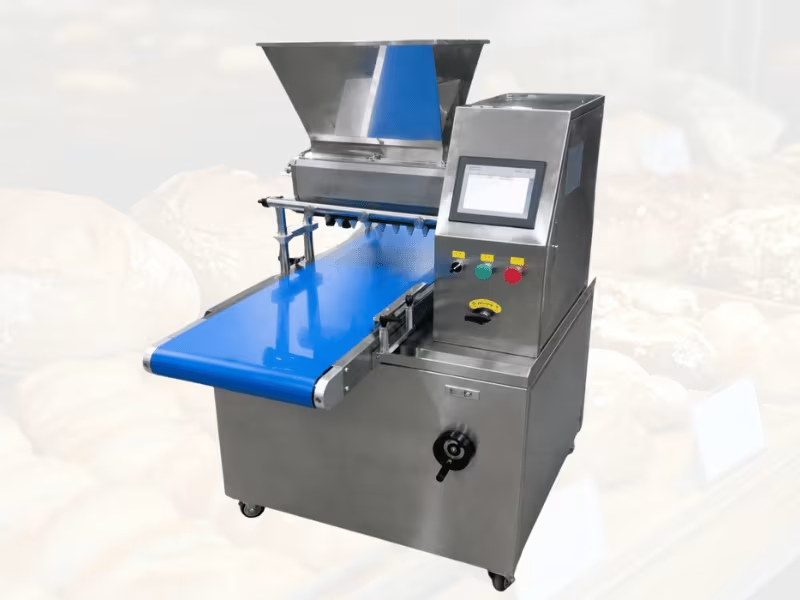
Every cupcake, muffin, and sponge sheet has its final size set before it reaches the oven. Suppose one cup gets 3 g too much batter and the next gets 3 g too little. No oven profile can fix that. The first overflows or domes unevenly, and the second bakes dry. Across thousands of pieces a shift, small fill errors become giveaways, rejects, and packs that fail weight checks.
This guide explains what a cake batter depositor is and how it meters batter. It also covers why fill weights drift even on automated lines, how to tell which problem you are dealing with, and how to decide between a standard and a high-precision machine for your products, trays, and line.
What Is a Cake Batter Depositor?
A cake batter depositor is a filling machine that measures a set portion of batter and places it in a target position. That target can be a paper cup, a mold, a cavity, or a baking tray, where the batter is laid down in dot or strip form. The machine replaces hand scooping and piping bags with a mechanical stroke. The operator sets the portion once, and the machine repeats it row after row.
Most depositors meter by volume, not weight. A piston or similar volumetric unit draws in a fixed volume of batter and pushes it out. This detail drives almost every accuracy issue covered later. If batter density stays stable, equal volume means equal weight. If density shifts, the machine keeps delivering the same volume while the weight changes underneath it.
On a cake line, the depositor sits between batter preparation and baking. Upstream, batter comes from a planetary mixer or a continuous cake batter aeration machine. Downstream, filled trays go into a rack or tunnel oven, then on to cooling, depanning, filling, and packaging. The depositor is the last point in the line where portion size can still be controlled. After that, every error is baked in.
Mixing / aeration → depositing → baking → cooling → depanning → finishing → packaging
Why Depositing Accuracy Matters in Cake Production
Fill variation shows up in the oven first. An underfilled cupcake bakes faster than its neighbors, so its edges dry before the center sets. An overfilled cup spills over the paper, forms a mushroom top, or merges with the next cup on a tightly spaced tray. Sheet sponge fails the same way on a larger scale. An uneven spread bakes into uneven thickness. That unevenness then shows up as mismatched layers after horizontal slicing.
The cost side is less visible and often larger. When operators cannot trust their fill weights, they overfill on purpose so no piece drops below the minimum.
Illustrative example: a line deposits 20,000 cupcakes a day. Operators overfill by an average of 2 g to stay safe. That adds up to 40 kg of extra batter per day, or about 12 tonnes a year on a 300-day schedule. All of it is given away inside products sold by count.
Manual depositing makes this worse. Piping bags and scoops depend on hand pressure, and that pressure changes as the operator tires and the bag empties. Hand work is also slower, so aerated batter waits longer and loses air before it reaches the tray. Squeezing the bag knocks out still more air. A depositor removes the human variable by repeating the same stroke volume every cycle.
Buying a machine does not settle the question, though. Two depositors with similar spec sheets can produce very different results on the same batter. The difference lies in a handful of specific parts.
Key Components of a Cake Batter Depositor
Every part of a depositor holds, measures, cuts, or places batter. The parts that measure and cut affect fill consistency most, so inspect them first when you assess a machine.
- Hopper. Holds batter above the metering unit. Its shape and fill level affect how evenly batter feeds into each chamber. Its size also sets how long aerated batter waits before depositing, which matters for sponge and chiffon.
- Metering unit. The volumetric core of the machine, usually one cylinder and piston per lane. Stroke length sets portion size. A rigid, precision-machined chamber keeps that volume the same from the first tray of a shift to the last.
- Valve and cut-off. The valve opens to fill the chamber from the hopper, then switches to discharge. A clean cut-off at the end of the stroke stops tails and drips from landing on cup rims or tray edges.
- Nozzles and manifold. Split batter into lanes. Nozzle count and spacing must match the cup or mold layout on the tray. Small differences between lanes are one of the most common causes of uneven weights across a row.
- Drive and controls. Set stroke speed, timing, and stored recipes. Servo drives with PLC control allow finer, more repeatable stroke adjustment than fixed mechanical settings.
- Tray conveyor and indexing. Move trays under the nozzles and stop each row in position. Accurate indexing keeps batter centered in every cup instead of striking the paper wall.
- Product-contact parts. Corrosion-resistant, precision-machined parts hold their tolerances through daily washdown. Worn or pitted surfaces slowly change chamber volume and valve sealing.
When a supplier demonstrates a machine, watch three things: the metering unit, the cut-off, and the nozzles. Those three decide most accuracy problems.
How a Cake Batter Depositor Works
Designs vary, but most volumetric depositors repeat the same short cycle many times a minute. Here is one cycle from hopper to filled tray:
- Loading. Batter is transferred from the mixer or aerator into the hopper. A short wait protects the air structure in sponge and chiffon batter.
- Chamber fill. The valve opens toward the hopper, and the piston draws a set volume of batter into each chamber.
- Discharge. The valve switches toward the nozzles, and the piston pushes batter into cups, molds, or onto the tray.
- Cut-off. At the end of the stroke, flow stops cleanly. Some systems pull batter back slightly so nothing drips between rows.
- Indexing. The conveyor moves the tray forward to the next row and stops it under the nozzles.
- Repeat. The cycle continues until the tray is full. The next tray follows without a gap.
Load → fill chamber → discharge → cut-off → index → repeat
Dot mode and strip mode. The same machine handles very different formats by changing how the stroke and the conveyor work together. In dot mode, the tray stops and each nozzle deposits a single portion. This suits cupcakes, muffins, and molded cakes. In strip mode, the machine deposits while the tray keeps moving, laying continuous lines for bar-shaped products or full-tray sheet formats. Dot mode separates stroke and travel. Strip mode synchronizes them.
Recipes. Stored recipes save stroke volume, speed, and mode for each product. After a changeover, the operator recalls a setting instead of re-tuning by trial and error. That also removes the scrap trays that trial-and-error setup usually produces.
What Affects Depositing Accuracy and Consistency
A volumetric depositor repeats volume. The bakery cares about weight and finished shape. Anything that changes how batter behaves between strokes, or between nozzles, shows up as variation in the oven. Most fill problems on automated lines trace back to one of six causes.
- Batter density drift. Aerated sponge and chiffon batter loses air as it sits in the hopper. The machine still pushes the same volume, but each portion now weighs more and bakes shorter and denser. The fix is short hopper residence time and a steady, matched supply from the aerator instead of large batches dumped in at once.
- Viscosity and temperature. Heavy oil cake batter thickens as it cools. Thicker batter fills the chamber less completely on the intake stroke, so portions lose weight over the run. Keep batter temperature stable and give thick batters a slower intake so the chamber fills fully.
- Shear on aerated batter. A fast, aggressive valve or piston motion knocks air out of delicate batter on its way through. Weight looks correct, but baked volume comes up short. The fix is a gentler stroke profile, with slower acceleration at the start and end of each stroke. Servo control makes this adjustable.
- Lane-to-lane variation. Batter does not always flow evenly through a manifold. Outer nozzles can deposit slightly more or less than center ones, producing a tray with a repeatable pattern of heavy and light pieces. The fix is individual nozzle adjustment, so each lane can be trimmed to match.
- Cut-off and tailing. Poor cut-off leaves strings or drips on cup rims. On paper cups, those drips burn or glue the paper to the cake. The fix is clean valve closure, a small suck-back where available, and correct nozzle height above the cup.
- Tray positioning. If indexing stops a row slightly off-center, batter hits the cup wall and spreads unevenly. Weight stays correct, but shape does not. Check indexing accuracy and tray guide condition on a regular schedule.
How to read the pattern
The way weights vary tells you where to look. Check-weigh a full tray, then a tray from an hour later, and compare.
|
What you see |
Most likely cause |
Where to fix it |
|---|---|---|
|
Weights creep up or down over the run |
Density drift or batter temperature |
Batter supply and hopper management |
|
Same lanes always heavy or light |
Manifold imbalance |
Per-nozzle adjustment |
|
Weight on target, baked volume low |
Shear on aerated batter |
Stroke profile |
|
Weight on target, shape off-center |
Indexing or tray guides |
Conveyor and tray handling |
|
Burnt rims or stuck paper |
Tailing at cut-off |
Valve closure and nozzle height |
The first two causes belong to batter control and line discipline. A more expensive machine will not rescue batter that sits too long or cools too much. Stroke gentleness and lane balance, however, are machine capabilities. That is where standard and high-precision depositors part ways.
Advantages of Using a Cake Batter Depositor
Each advantage below traces back to a specific machine function. If a supplier cannot explain how a claimed benefit works, discount it.
- Tighter portion control. A fixed stroke volume replaces hand pressure, so operators stop overfilling as a safety margin. On high-volume cupcake and muffin runs, this is where most giveaway savings come from.
- Steadier oven loading. Multi-nozzle rows fill a full tray in a few strokes. The oven receives trays at an even pace instead of in bursts, which keeps bake results consistent from tray to tray.
- Several formats on one unit. Dot and strip modes, combined with nozzle changes, cover paper cups, shaped molds, and full sheet trays. A mid-sized bakery can run cupcakes in the morning and sponge sheets in the afternoon.
- Faster changeovers. Stored recipes replace trial-and-error setup. The gain grows with every extra SKU per shift.
- Stable accuracy over years. Corrosion-resistant contact parts survive daily washdown without pitting, so chamber volume and valve sealing hold their tolerances.
How much of each gain you actually get depends on which configuration you choose.
Standard vs. High-Precision Cake Batter Depositors
Both machine types meter by volume. The split is not good versus better. It comes down to how finely you need to control the stroke and each nozzle, and how often you switch products and molds. Yucho builds one machine for each path.
Standard path: Cake Batter Depositing Machine
The Cake Batter Depositing Machine is a practical volumetric depositor for cupcake batter, sponge mixture, muffin batter, and full-tray cake formulations. It works with standard 400 × 600 mm baking trays. It handles sponge, chiffon, heavy oil cake, mousse, and related fluid materials. Dot and strip modes cover both cup and sheet formats. Recipe storage speeds up changeovers, and precision-machined, corrosion-resistant contact parts keep volume repeatable.
Picture a regional bakery running sponge sheets for layer cakes four days a week and one or two cupcake sizes on the other days, all on standard trays. Products are sold by count, and a small weight spread is acceptable. That is the standard machine’s home ground.
Wrong fit looks like: a line that rotates through many mold formats and must hit tight declared weights on every pack. That workload pushes the standard machine past its sweet spot.
Precision path: High Precision Cake Batter Depositor
The High Precision Cake Batter Depositor is servo-controlled, with a Siemens PLC managing the process. Its main strength is tighter weight consistency across long, demanding runs. Up to 7 nozzles can each be adjusted individually without changing filling heads, which directly targets lane-to-lane variation. An LCD touchscreen with memory programs stores settings for each recipe. The machine also adjusts flexibly to different molds, product formats, and batter types.
Picture a factory supplying retail chains with molded cakes and muffins in three cup sizes, each sold by declared weight. It changes products several times per shift, and every underweight pack is a compliance problem. Here, per-nozzle trimming and recipe memory earn their cost quickly.
Wrong fit looks like: a bakery running a single full-tray sponge product all day. Paying for per-nozzle precision there rarely pays back.
|
Factor |
Cake Batter Depositing Machine |
High Precision Cake Batter Depositor |
|---|---|---|
|
Control |
Volumetric, with recipe storage |
Servo drive, Siemens PLC |
|
Nozzle adjustment |
Set by head configuration |
Up to 7 nozzles, individually adjustable |
|
Best for |
Standard 400 × 600 mm trays, stable product range |
Multiple molds, frequent changeovers, tight weight targets |
|
Formats |
Dot and strip |
Wide mold and format flexibility |
|
Typical products |
Sponge sheets, cupcakes, muffins, heavy oil cake, mousse |
Cupcakes, muffins, chiffon, molded cakes |
Two questions settle most decisions. How many formats do you run each week? How much weight variation can each piece or pack tolerate? Few formats and loose tolerance point to the standard path. Many formats or tight tolerance point to precision.
Cake Batter Depositor Applications by Product
Each batter behaves differently under a piston and a nozzle. The right setup depends on viscosity, aeration level, and the container the batter lands in.
- Cupcakes and muffins. Paper cups need a centered deposit with no drips on the rim, and high piece counts make every gram of overfill expensive. A single-product cupcake run on standard trays works well on either Yucho machine. Once you rotate through several cup sizes and recipes in one shift, the high-precision model becomes the better choice. For full-line planning, see the automatic cupcake production line.
- Full-tray sponge. Sheet sponge for layer cakes or Swiss rolls needs an even spread across the whole tray, or thickness varies after baking. The standard machine in strip or full-tray mode handles this well. Keep hopper time short so the batter does not lose volume before it is spread.
- Chiffon in individual molds. Chiffon is the least forgiving batter. It is light, highly aerated, and easily damaged by harsh strokes. If you deposit chiffon into individual molds, choose the high-precision model so you can tune stroke profiles and protect baked height.
- Heavy oil cake. Thick batter needs complete chamber filling and steady temperature. On standard trays, the standard volumetric machine handles it well, provided stroke speed gives the chamber time to fill. Watch for weights dropping as batter cools late in a batch.
- Molded cakes. Shaped cavities need an exact volume per cavity. Underfill shows up as incomplete edges, and overfill shows up as flash around the rim. This is where individual nozzle adjustment matters most, so it points clearly to the high-precision model.
- Mousse and fluid materials. Low viscosity makes cut-off and dripping the first risk, not weight. Before buying, run your own product and check that nozzles close cleanly and nozzle height can be set low enough to prevent splashing.
|
Production scenario |
Main risk |
Better fit |
|---|---|---|
|
Single cupcake size, sold by count |
Giveaway from overfill |
Either model |
|
Several cup sizes, frequent changeovers |
Setup scrap and lane variation |
High precision |
|
Sheet sponge for layer cakes or Swiss rolls |
Uneven thickness |
Standard |
|
Chiffon in individual molds |
Air loss from shear |
High precision |
|
Heavy oil cake on standard trays |
Incomplete chamber fill |
Standard |
|
Molded cakes sold by declared weight |
Underfill and flash |
High precision |
How to Choose the Right Cake Batter Depositor
Work through the decision in this order. Each step narrows the options for the next.
- Product and weight tolerance. How much variation can each piece or pack accept? Products sold by declared weight need tighter control than products sold by count.
- Batter types. List the full viscosity range and aeration level you run, from light chiffon to heavy oil cake. A wide range calls for flexible stroke control.
- Trays and molds. Do you run standard 400 × 600 mm trays only, or several molds and cavity layouts? More layouts favor per-nozzle adjustment.
- Changeover frequency. Several SKUs per shift favor memory programs and individual nozzle trimming. One or two long runs per day do not.
- Line integration. Match depositor output to oven capacity, whether you load a rack oven or a tunnel oven. Also check how batter arrives from the mixer or aerator, because an uneven supply rhythm causes density drift.
Use these rules to turn the answers into a decision:
- Choose the standard machine if you run standard trays, a stable product range, and products sold by count.
- Choose the high-precision machine if any product is sold by declared weight, or if you run molded cakes.
- Choose the high-precision machine if you change products several times per shift, even with loose tolerances, because setup scrap adds up.
- Fix batter supply before upgrading if your check-weighs show weights creeping over time. That is a batter problem, not a machine problem.
The most common mistake is reversing this order. Buyers often choose by nozzle count and speed first. Later they find that weight variation and slow changeovers cost more than the extra speed ever saved. Choose by tolerance and format range first, then by output.
Before you request quotes, prepare this information:
- Product list with target weights
- Batter types and densities
- Tray or mold dimensions and cavity layouts
- Target trays per minute
- Upstream mixer or aerator, and downstream oven type
Yucho offers both paths. The Cake Batter Depositing Machine delivers stable volumetric portioning on standard trays. The High Precision Cake Batter Depositor delivers tight weight control across many formats. Send us your product list, tray dimensions, and target output, and our team will recommend the right cake batter depositor for your line.