If youare looking for the best commercial bakery oven, you likely need more than a simple list. You need a clear way to judge which oven structure fits your production.
Buyers often compare ovens that look similar on the surface but do very different jobs. One bakery may need flexible batch baking for bread, cakes, and biscuits. Another may need a continuous system that connects with the rest of the line. These are different buying decisions.
So this guide does not treat all bakery ovens as interchangeable. It looks at product type, production format, heat control, plant utilities, and layout. Those factors decide whether a rotary rack oven, deck oven, or tunnel oven makes sense.
This guide covers five core oven options from Yucho’s bakery oven range. It also explains when the broader tunnel oven category should guide your next step. You will see the quick picks first, then the key buying decisions, and then the strengths and limits of each option.
Best Commercial Bakery Ovens at a Glance
These five picks do not compete on one scale. Each one fits a different production scenario. Two are batch ovens. Three are continuous tunnel ovens, each built for a different way of handling product and heat. Use the table to find your starting point, then jump to the pick that matches your line.
| # | Oven option | Best for | Why it stands out |
|---|---|---|---|
| 1 | Rotary Rack Oven | Flexible high-volume batch baking | The full trolley rolls in and out. A 360° rotating rack carries every tray through hot air for uniform baking. Runs on electric, gas, or diesel. |
| 2 | Deck Oven | Mixed-product bakeries that need independent deck control | Each deck holds its own temperature. Radiant heat and a SUS304 stainless steel body. |
| 3 | Tray Tunnel Oven | Continuous tray-based bread, cake, and pastry production | Reinforced chain, PID temperature control, and forced convection heating. |
| 4 | Steel Belt Tunnel Oven | Belt-fed biscuit, cake, bread, pastry, and snack lines | Variable speed belt, PLC control, and 800–1200 mm belt widths. |
| 5 | Hot Air Radiant Tunnel Oven | Products that need strong surface color and even internal baking | Combines infrared radiant heat with forced hot air. Runs on natural gas, LPG, or diesel. |
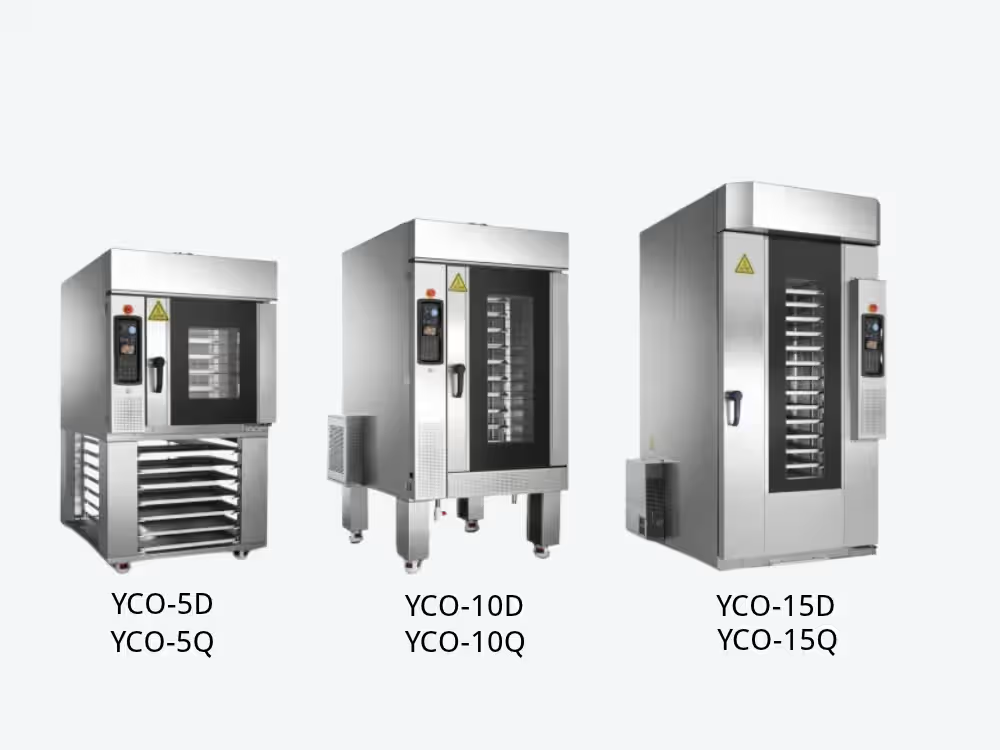
Rotary Rack Oven
Best for flexible high-volume batch baking
A strong match when you need uniform baking across many trays with one full trolley moving in and out as a unit.
View Details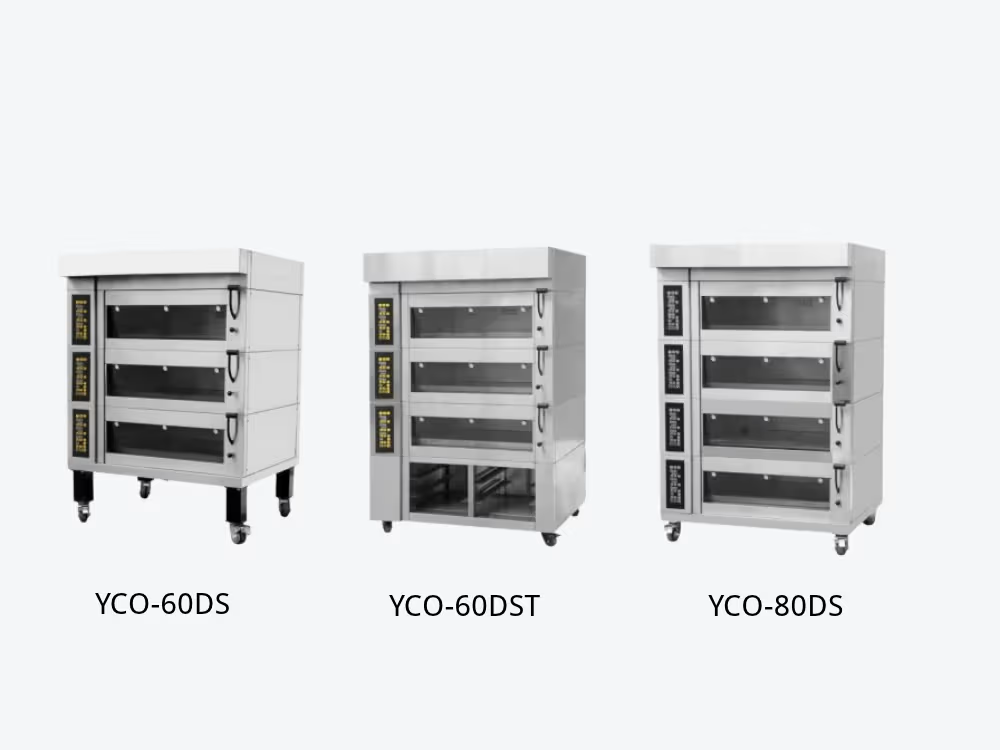
Deck Oven
Best for mixed-product bakeries that need independent deck control
A practical choice when bread, pastry, pizza, or cakes need different baking conditions in the same shift.
View Details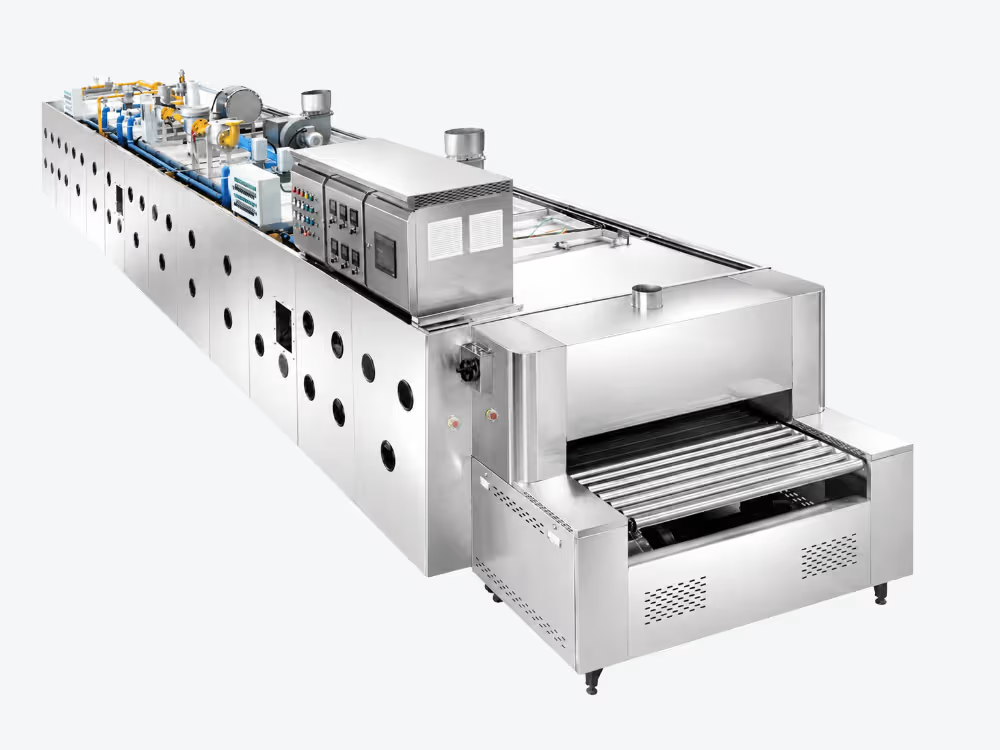
Tray Tunnel Oven
Best for continuous tray-based bread, cake, and pastry production
Built for steady tray movement, stage-by-stage heat control, and easier connection to continuous bakery lines.
View Details
Steel Belt Tunnel Oven
Best for belt-fed industrial baking lines
Well suited to biscuit, snack, and other belt-based production where conveyor speed and line rhythm matter.
View Details
Hot Air Radiant Tunnel Oven
Best for products that need strong surface color and even internal baking
A more targeted continuous option when product appearance and internal texture must finish in balance.
View DetailsA note on tunnel ovens
The tunnel oven page is a category, not a sixth pick. It is the right entry point if you already know you need continuous production. Confirm that direction first, then choose among picks 3, 4, and 5.
Here is a simple way to sort the three tunnel options. Products on trays point to the tray tunnel oven. Products on a belt point to the steel belt tunnel oven. Products that need color and internal texture to finish together point to the hot air radiant tunnel oven.
Before you compare any of these in detail, settle a few basic decisions about your own production.
What to Decide Before You Compare Commercial Bakery Ovens
Most oven mistakes happen before anyone looks at a spec sheet. A buyer gets excited about one feature, then finds out the oven doesn’t suit the product, the utilities, or the line.
I ask every buyer four questions first. Each answer removes some options. By the end, you should have a shortlist of two or three oven options instead of five.
1. What Are You Actually Baking?
Start with your product list. Bread, cakes, biscuits, pastries, pizza, and snacks each ask something different of a bakery oven.
The product decides three things:
- How it loads. Some products sit on trays. Some go on a belt. Some go straight into a deck chamber.
- How it takes heat. Some need circulating hot air. Others need radiant heat, or both together.
- What you need to control. Crust color, internal doneness, and moisture don’t all respond to the same settings.
Then ask a second question: do you bake many products, or one product all day?
A bakery that bakes baguettes in the morning and sponge cake in the afternoon needs flexibility. A plant that runs biscuits for an entire shift needs repeatability. These two operations should not buy the same oven.
Watch for this: If your product list keeps growing during the conversation, you probably need flexibility first and throughput second.
Write down your three to five core products before you go further. Everything else depends on that list.
2. Batch Baking or Continuous Production?
This split narrows the field faster than any other question.
Batch ovens work in cycles. You load, bake, unload, and repeat. That rhythm gives you room to switch products, adjust settings between rounds, and run different batch sizes.
Continuous ovens never stop moving product. Raw items enter one end and leave the other end fully baked. The oven sets the pace for the whole line.
These are two different ways to run a plant. You can’t swap one for the other later without rethinking your workflow.
Here is how the options sort:
- A rotary rack oven handles high-volume batches. The full trolley rolls in and out as one unit.
- A deck oven handles batches across separate chambers, each with its own temperature.
- A tunnel oven handles continuous, large-scale production.
A quick check: If your team plans production by “rounds,” you run a batch operation. If they plan by “hourly output,” you’re thinking continuous.
Settle this before you compare features. A great batch oven is still the wrong choice for a continuous line.
3. Which Heating Options Can Your Plant Support?
An oven can fit your product perfectly and still fail on site. Utilities often cause that failure.
Heating options vary by oven type:
|
Oven type |
Available heating |
|---|---|
|
Rotary rack oven |
Electric, gas, diesel |
|
Deck oven |
Electric |
|
Tray tunnel oven |
Electric, natural gas, diesel |
|
Steel belt tunnel oven |
Electric, natural gas, diesel |
|
Hot air radiant tunnel oven |
Natural gas, LPG, diesel |
This table changes shortlists quickly. A site without gas can’t run the hot air radiant tunnel oven, because it has no electric version. A plant that depends on diesel can drop the deck oven right away.
Check what your facility has now and what it can add. Confirm power supply, fuel access, and any local restrictions. Your heating choice also affects installation planning and running costs, so bring your facilities team in early.
Common pitfall: Some buyers settle on an oven first and check the utilities later. Reverse that order and you avoid painful redesigns.
4. Standalone Unit or Part of a Line?
Some buyers need one oven that works on its own. Operators load it, bake, and unload by hand or with trolleys. Others need an oven that sits in the middle of an automated process.
If you are building a line, the oven has to connect in both directions:
- Upstream: molding, forming, depositing, or filling equipment
- Downstream: cooling, conveying, or packaging systems
That changes what you evaluate. Speed matching, entry and exit heights, conveyor width, and floor layout start to matter as much as baking quality.
Tunnel ovens stand out here. Their continuous design lets products move straight from the depositor through the oven and into cooling. Rotary rack and deck ovens can sit alongside other equipment, but they work as baking stations, not as links in a moving line.
Example: A plant adds a cake depositor and a cooling conveyor. A deck oven would force staff to move trays by hand between steps. A tray tunnel oven lets the trays travel the whole route without stopping.
Sketch your product flow from mixing to packaging. If the oven sits in the middle of that sketch with arrows on both sides, put integration at the top of your list.
Once you answer these four questions, the oven types become much easier to read. Each structure handles product, heat, and flow differently, and those differences now map directly to your needs.
Main Types of Commercial Bakery Ovens Explained
Commercial bakery ovens differ in far more than size. They differ in how they handle product, deliver heat, and fit your production flow. Two ovens with similar capacity can behave completely differently on the plant floor.
When I walk a buyer through the options, I start with three core structures: rotary rack, deck, and tunnel. Once these are clear, every model name you see later becomes much easier to understand.
Rotary Rack Ovens: One Trolley, One Batch, Even Results
A rotary rack oven bakes an entire trolley at once. Your team loads trays onto a rack trolley, rolls the full trolley into the chamber, and closes the door. Nobody handles trays one by one at the oven mouth.
Inside, the rack turns a full 360° while forced hot air circulates through the chamber. That rotation matters. A static rack leaves some trays closer to the heat than others. A rotating rack carries every tray through the same airflow, so the top and bottom shelves bake far more evenly.
When the bake ends, the trolley rolls out as one unit. You push it toward cooling and roll the next loaded trolley in.
This design suits batch baking of bread, cakes, biscuits, and similar tray-based products. It works best when you need large batches but still want to switch products between loads. If your team already stages product on racks, a rotary rack oven fits naturally into that workflow.
Deck Ovens: Separate Chambers for Separate Jobs
A deck oven stacks several baking chambers on top of each other. Each deck works as its own oven with its own temperature setting.
That independence is the whole point. You can run one deck hot for crusty bread, another cooler for pastry, and a third for cookies, all at the same time. No product waits for another product’s bake to finish.
Deck ovens rely on radiant heat. Products sit on a hot deck surface, which builds crust, bottom color, and texture. Many bakers choose this structure for exactly that hearth-style result.
I usually point mixed-product bakeries in this direction. If one shift covers bread, pastry, pizza, cakes, and cookies, a deck oven lets you schedule them side by side. The trade-off is simple: staff load each deck directly, so output follows your team’s rhythm rather than a conveyor’s.
Tunnel Ovens: Continuous Baking, Built in Zones
A tunnel oven follows a different logic altogether. Product enters one end, travels through a long heated chamber, and leaves the other end fully baked. The flow never stops for loading or unloading.
The tunnel splits into multiple heating zones, each with its own temperature control. This lets you shape the bake stage by stage. For a cake, you might run a gentler entry zone for rise, a stronger middle zone to set structure, and a final zone to finish color.
Because product moves at a set pace, throughput stays steady hour after hour. The conveyor format also makes tunnel ovens easier to link with upstream depositing or forming equipment and downstream cooling or packaging. That is why large automatic lines usually build around a tunnel oven.
Keep in mind that “tunnel oven” names a category, not a single machine. Inside it, three routes matter:
- Tray-based tunnel ovens carry trays through the zones on a conveyor chain. They suit products that already bake in trays or pans, such as bread, sponge cake, and pastries. See the tray tunnel oven.
- Belt-based tunnel ovens move product on a stainless steel belt. They fit belt-fed lines for biscuits, cakes, pastries, and snacks. See the steel belt tunnel oven.
- Dual-heating tunnel ovens combine infrared radiant heat with forced hot air. They serve products that need strong surface color and an evenly baked interior. See the hot air radiant tunnel oven.
Choosing “tunnel” settles only half the question. How you carry the product and how you apply heat decide the rest.
Each of these three structures answers a different production question: rotary rack for even batch volume, deck for parallel product variety, and tunnel for continuous output. With that map in place, you can turn these differences into clear selection criteria for your own operation.
How to Choose the Right Commercial Bakery Oven
You now know the three oven structures. The harder part is turning that knowledge into a decision you can defend in a project meeting. When I help a buyer choose a commercial bakery oven, I run through five checks in a fixed order. Each one removes options. By the end, most buyers have a shortlist of one or two oven options, not five.
Use these checks as a working filter, not a reading list.
Let Your Product Format Pick the Oven Structure
Start with the product, and let it choose the structure. Many buyers do the opposite. They pick an oven type they like, then try to fit their products into it.
Every oven moves product in its own way, and that handling logic creates three clear paths:
- Deck-based baking places product directly on a hot surface. It suits hearth bread, baguettes, pizza, and items that need strong bottom color.
- Tray-fed baking keeps product in trays or pans from start to finish. It suits bread loaves, sponge cake, and pastries that already live on trays.
- Belt-fed baking carries product on a moving belt. It suits flat, repeatable items such as biscuits and snacks.
Your operating style matters too. A mixed-product bakery asks, “How many different products can I run today?” An industrial line asks, “How consistently can I run this one product all week?” Those two questions lead to different ovens.
If your products already sit on trays, a tray tunnel oven or rotary rack oven deserves a look. If they drop onto a belt from a depositor, a steel belt tunnel oven makes more sense. Narrow the bakery oven range first, then add features.
Weigh Flexibility Against Throughput
Every bakery trades some flexibility for throughput, or vice versa. The trick is choosing that balance on purpose.
Batch ovens give you room to change. A rotary rack oven lets you switch products between trolley loads while still baking large batches. A deck oven goes further. It lets you run different products at different temperatures at the same moment. Both support quick changeovers, but in different ways.
A tunnel oven works on continuous logic. Product flows at a set pace, and output stays steady shift after shift. You gain rhythm and predictability. You give up some freedom to switch recipes at short notice.
Neither model wins on its own. I have seen a bakery buy a tunnel line because “continuous” sounded more modern. Then the team spent half of each shift adjusting it for short product runs. A rotary rack setup would have served them better.
So ask yourself one honest question: do your days look like many short runs or a few long ones? Your answer points to your operating model, and your operating model should choose the oven.
Compare How the Oven Controls Heat, Not What It’s Called
“Deck,” “rack,” and “tunnel” tell you how an oven is built. They do not tell you how it manages your bake. Control method often shapes the final product more than the label does.
Look at three different control logics:
- Independent chamber control. Each deck in a deck oven holds its own temperature. You control products side by side, in parallel.
- Stage-by-stage zone control. A tunnel oven splits the bake into zones along its length. You control one product as it moves through each stage, from rise to set to color.
- Combined heating. A hot air radiant tunnel oven pairs infrared radiant heat with forced hot air circulation. The radiant heat builds surface color. The moving air bakes the inside evenly.
Heat transfer matters as much as the control layout. Forced convection gives even airflow around the product. Radiant heat drives crust and color. Combined heating aims to do both at once.
Here is the test I give buyers. Describe your ideal bake in plain words, such as “gentle start, firm middle, dark finish.” Then ask which control setup can actually deliver that sequence. The best match will rarely be the oven with the most impressive name.
Check Layout and Line Integration Before You Request a Quote
An oven that fits your product but not your building is still the wrong oven. Bring layout into the decision early, well before you ask suppliers for quotes.
Measure these points first:
- Available floor length and width for the oven body
- Passing height through doors, corridors, and loading areas
- Tray width or belt width your process needs
- Product flow from the previous step to the next one
Size references can change your configuration. The tray tunnel and hot air radiant tunnel ovens come in 2, 3, or 4 tray configurations. The steel belt tunnel oven offers 800, 1000, or 1200 mm belt widths. Each choice affects the exterior footprint and the equipment you can connect.
Line integration matters most with tunnel ovens. Their entry and exit points must line up with upstream depositing or forming machines and downstream cooling or packaging. A small mismatch in height or speed can stall a whole line.
Send your supplier a rough floor plan with your inquiry. It saves weeks of back-and-forth, and it often reveals fit problems before they turn expensive.
Buy for Next Year’s Production, Not Just Today’s
Today’s output matters. Still, an oven usually stays on your floor long after your product list and volume targets change. So don’t choose only for your narrowest current need.
Ask yourself three planning questions:
- Will your product mix grow, shrink, or stay the same?
- Do you expect volume to rise enough to push you toward continuous production?
- Do you plan to add upstream or downstream automation?
Your answers can shift the better long-term choice. Say a bakery runs one rotary rack oven today but plans an automated biscuit line in two years. That bakery should think about tunnel layout and floor space now. Similarly, a bakery growing its product range may gain more from extra deck capacity than from a bigger single-product system.
Choosing the right structure early protects you from buying twice. It also keeps your floor plan open for the next step.
Run your project through these five checks, and your shortlist will usually narrow to one clear direction. From there, comparing the five oven picks becomes a matter of fine-tuning, not guesswork.
Our Top 5 Picks for Commercial Bakery Ovens
These five picks follow the logic from the earlier sections. They are not five versions of the same machine. Each one solves a different production problem.
Picks 1 and 2 are batch ovens. Picks 3 to 5 are continuous tunnel ovens, each suited to a different way of carrying product and applying heat. Between the two groups, a quick tunnel-category check helps you confirm that continuous baking is the right move. For each pick, read the limitations as carefully as the strengths. The limits often settle the decision faster.
1. Rotary Rack Oven: Best for Flexible High-Volume Batch Baking
Best for: bakeries that bake large tray-based batches but still switch products between loads.
A rotary rack oven bakes a full trolley at once. Your team loads trays onto the rack away from the oven. They roll the whole trolley in, and later roll it out as one unit. Inside, the rack turns 360° while forced hot air circulates around it.
That design brings three practical gains:
- Less tray handling at the oven door. Staff skip loading trays one by one at the hot oven mouth. The trolley moves straight from proofing to baking to cooling.
- More even results across shelves. Rotation carries every tray through the same airflow. Top, middle, and bottom trays bake with more consistent results.
- Utility flexibility. You can choose electric, gas, or diesel heating. That helps when power capacity or fuel supply differs from site to site.
Tray configurations run from 5 to 64 trays. This lets you size the oven to your real batch volume instead of guessing.
Where it fits best: bread, cakes, biscuits, and roasted products. Picture a wholesale bakery that runs bread trolleys at dawn, cake trolleys at midday, and biscuits in the afternoon. A rotary rack oven handles that rhythm well.
Where another oven may serve you better: this is still a batch system. Each load must finish before the next one goes in. If you need steady, nonstop output linked to a depositor and a packaging line, look at the tunnel options below. If your products need direct contact with a hot deck for bottom crust, a deck oven fits better.
2. Deck Oven: Best for Bakeries Producing Multiple Product Types in One Shift
Best for: bakeries that bake many different products at the same time.
A deck oven stacks several baking chambers. Each deck holds its own temperature setting. In practice, you get several small ovens in one footprint.
That independence changes how you schedule a shift. Here is a typical morning:
- Top deck: hot setting for baguettes and crusty bread
- Middle deck: moderate setting for pastry
- Lower deck: gentler setting for cookies or cakes
No product waits for another product to finish baking. You plan around demand, not around one shared chamber temperature.
Deck ovens use radiant heat. Products sit on the heated deck, which builds crust, bottom color, and texture. That is why bread and pizza bakers often prefer this structure.
The body uses SUS304 stainless steel. This matters on a busy floor because flour, steam, and daily wipe-downs are hard on surfaces. Stainless steel stays easier to clean and holds up to that routine. Yucho offers three model references: YCO-60DS, YCO-80DS, and YCO-90DS. Compare each one against your floor space and daily batch plan.
Where it fits best: retail and mixed-product bakeries that produce bread, baguettes, pastry, pizza, cakes, and cookies in one shift.
Where another oven may serve you better: staff loads each deck by hand, so output follows your team’s pace. If you want continuous automated line output, a tunnel oven makes more sense. Deck ovens also run on electric heating only. Confirm your site’s power capacity before you shortlist one.
If You Need Continuous Baking, Start with Tunnel Ovens
Picks 1 and 2 cover batch production. If your answers point to nonstop flow instead, pause before you compare the three tunnel picks. First confirm that the tunnel oven category fits your plant at all.
Every tunnel oven shares the same core logic:
- Continuous automatic baking. Product enters one end and leaves the other end baked. Nobody stops the flow to load or unload.
- Multi-zone temperature control. You shape the bake stage by stage along the tunnel’s length.
- Stable throughput. A set conveyor pace gives you predictable output per hour and per shift.
- Easier line integration. The conveyor format links naturally with upstream forming or depositing machines and downstream cooling or packaging.
This category makes sense when one product, or a small product family, runs for hours at a time. It also fits when you want the oven to act as the center of an automatic line, not as a standalone unit.
If your days run on many short product changes, step back. A rotary rack or deck oven will likely serve you better than any tunnel.
If continuous baking does fit, three quick questions point you to the right tunnel pick:
- Does your product already move on trays? Look at the tray tunnel oven.
- Does it drop straight onto a conveyor from a depositor or cutter? Look at the steel belt tunnel oven.
- Does it need strong surface color and an evenly baked interior? Look at the hot air radiant tunnel oven.
3. Tray Tunnel Oven: Best for Continuous Tray-Based Bread, Cake, and Pastry Lines
Best for: continuous lines where products already bake in trays or pans.
A tray tunnel oven moves trays on a conveyor chain through independent heating zones. Each zone holds its own setting, and PID temperature control keeps it steady. Forced convection carries heat around every tray.
The chain deserves close attention. In a continuous oven, it runs through heat for hours at a time. This model uses a reinforced high-temperature chain with automatic lubrication. That setup supports long-hour operation and reduces manual greasing during production.
Zone control gives you real stage-by-stage control. Take a sponge cake line. You might run a gentler entry zone for even rise and a stronger middle zone to set the crumb. A final zone then finishes the color. Each zone handles one job.
Practical options include:
- Electric, natural gas, or diesel heating
- 2, 3, or 4 tray configurations to match line width and output goals
- Line integration support for linking upstream and downstream equipment
Where it fits best: bread, sponge cake, pastries, cookies, and biscuits on a continuous tray-based line. It also suits bakeries moving up from rotary rack ovens, since their products already live on trays.
Where another oven may serve you better: this oven works best when trays suit your process. If your depositor drops product straight onto a conveyor, trays add an extra handling step. A steel belt tunnel oven fits better there. If your product needs stronger surface color than convection alone provides, consider a hot air radiant tunnel oven.
4. Steel Belt Tunnel Oven: Best for Belt-Fed Industrial Baking Lines
Best for: industrial lines where product moves straight onto a conveyor belt, with no trays involved.
A steel belt tunnel oven carries product on a stainless steel conveyor belt. The belt passes through segmented temperature zones, and forced convection heats each one.
Two features do most of the work here:
- Variable belt speed. You adjust how long product stays in the oven by changing belt speed. That lets you match bake time to line throughput without rebuilding the zone setup.
- PLC intelligent control. Operators manage zones and belt speed from one control system. PLC control also makes it easier to sync the oven with upstream and downstream equipment.
You can choose belt widths of 800, 1000, or 1200 mm. Pick the width based on your product layout and the machines that feed the oven. Width affects the oven’s footprint, so settle it during layout planning. Heating options include electric, natural gas, and diesel.
If a product needs more air contact from below, ask about the mesh belt option. Customization lets you shape the belt to the product, not the other way around.
Where it fits best: biscuits, cakes, bread, pastries, and snacks on dedicated belt-fed lines. A biscuit plant with a rotary cutter feeding the oven offers a classic example.
Where another oven may serve you better: this is a specialized line oven. It does not suit bakeries that switch between many products in small batches. Belt width and line speed also lock in once the line goes live. A mixed-product bakery will get more from a deck or rotary rack oven.
5. Hot Air Radiant Tunnel Oven: Best for Products Requiring Surface Color and Even Internal Baking
Best for: products that need a rich surface color and an evenly baked interior at the same time.
Some products push a single heating method to its limit. Strong top heat colors the surface fast, but the inside may stay underbaked. Gentle airflow bakes the inside evenly, but the surface may stay pale. The hot air radiant tunnel oven solves this with two heat sources.
It combines infrared radiant heat with forced hot air circulation:
- Radiant heat drives surface color and crust.
- Forced hot air moves heat evenly into the product.
Independent zones, each with PID precision, let you balance the two along the tunnel. A PLC touchscreen gives operators one clear point of control. The oven runs on natural gas, LPG, or diesel. It comes in 2-, 3-, or 4-tray configurations for continuous tray-based production.
Caramel-coated desserts show why this matters. The coating needs deep, even color. The base needs to bake through without the top burning first. Dual heating lets you tune both results instead of trading one for the other.
Where it fits best: cakes, biscuits, pastries, and caramel-coated desserts on industrial tray-based lines.
Where another oven may serve you better: dual heating is the main reason to choose this oven. If your products don’t have demanding color needs, the tray tunnel oven offers a simpler path. This oven also runs on trays, so belt-fed lines belong with the steel belt tunnel oven. Finally, it lists no electric option. Check fuel access early if your site relies on electricity.
Line up these five picks against your answers from the earlier checks, and one or two options usually stand out. Knowing where buyers most often go wrong will help you confirm that choice before you commit.
Common Mistakes to Avoid When Choosing a Bakery Oven
Most oven problems don’t come from bad equipment. They come from good equipment bought for the wrong job. I see the same five mistakes in project after project, and each is easy to catch if you check early.
1. Choosing by Oven Name Instead of Product-Process Fit
The mistake: Treating “deck,” “rack,” and “tunnel” as quality levels. Some buyers assume a tunnel oven is simply the upgrade from a deck oven.
Why it happens: Bigger and more automated sounds better. Buyers also copy what a competitor or a larger plant uses.
Check instead: How your product is loaded, carried, and heated. A baguette that needs direct contact with a hot deck won’t improve on a conveyor. Start from your product list when you browse the bakery oven range, not from the oven label.
2. Treating Batch and Continuous Baking as Interchangeable
The mistake: Assuming a tunnel oven is just a faster rotary rack oven, or that several deck ovens can replace a line.
Why it happens: Both formats can bake the same products, so they look like points on one scale.
Check instead: Your daily schedule. Batch ovens run in load-bake-unload cycles and handle frequent changeovers well. Continuous ovens need steady feeding, matched machine speeds, and long runs. Pick the wrong format, and your staffing and floor flow will fight the oven every shift. Count your product changes per shift before you compare a rotary rack oven or deck oven against a tunnel oven.
3. Ignoring Utilities Until Late in the Project
The mistake: Choosing the oven first, then asking whether the site can power it.
Why it happens: Utilities feel like an installation detail, so they get pushed to the end.
Check instead: Your heating options before you build a shortlist. Rotary rack ovens run on electric, gas, or diesel. Deck ovens run on electric only. Tunnel ovens vary by type. The hot air radiant model, for example, uses natural gas, LPG, or diesel, with no electric option. A late surprise can force an electrical upgrade or restart the whole selection.
4. Overlooking Layout and Line Integration
The mistake: Approving an oven from its spec sheet without checking that it fits the building and the line.
Why it happens: Buyers focus on baking results. Layout feels like a problem for engineering to solve later.
Check instead:
- Floor length and width for the oven body
- Passing height through doors and corridors
- Tray configuration (2, 3, or 4 trays) or belt width (800, 1000, or 1200 mm)
- Entry and exit heights of upstream and downstream machines
With tunnel ovens, a small mismatch in height or speed can stall the entire line. Installation fit is part of equipment fit.
5. Selecting Only for Today’s Output
The mistake: Sizing the oven to your exact current volume and product mix.
Why it happens: Current orders feel concrete. Future plans feel uncertain, so buyers choose the smallest option that works now.
Check instead: Where your production will likely go next. Will volume grow enough to justify continuous baking? Are you adding new products or automation? If an automated line is on your roadmap, reserve floor space and utilities for a tunnel oven now. If your product range is expanding, extra deck capacity may serve you better than a larger single-product system.
Avoid these five mistakes, and the right oven direction usually becomes clear. Once it is, all that remains is to match it to your operation and gather the details a supplier needs to quote accurately.
Final Thoughts: Which Commercial Bakery Oven Is Right for You?
No oven wins on every floor. The right commercial bakery oven matches how you actually produce. Start with one decision: batch or continuous. Then let your product choose the pick.
- Rotary rack oven: choose this when batch volume and even results across trays matter most.
- Deck oven: choose this when you bake mixed products and need each chamber at its own temperature.
- Continuous production: confirm the tunnel oven direction first, then pick by handling format and heat profile:
-
- Tray tunnel oven for products that already bake on trays
- Steel belt tunnel oven for belt-fed industrial lines
- Hot air radiant tunnel oven for products that need strong surface color and an evenly baked interior
Before you request a quote, gather these details:
- Product types and your top sellers by volume
- Target capacity per hour or per shift
- Heating preference
- Available utilities on site
- Floor space, passing height, and a rough layout
- Upstream and downstream equipment the oven must connect to
Clear inputs get you a sharper recommendation. A supplier with this information can quickly rule out poor fits and size the right configuration instead of guessing.
Browse the full bakery oven range, then share your process details with the Yucho team. It is the quickest way to turn a shortlist into an oven that fits your plant.