A bakery line runs for 15 to 20 years. The supplier you choose today sets your output ceiling, your scrap rate, and your maintenance costs for that entire period. A bad decision rarely surfaces during the sales visit — it shows up in year three, when a divider drifts out of tolerance and the nearest service engineer is in a different time zone.
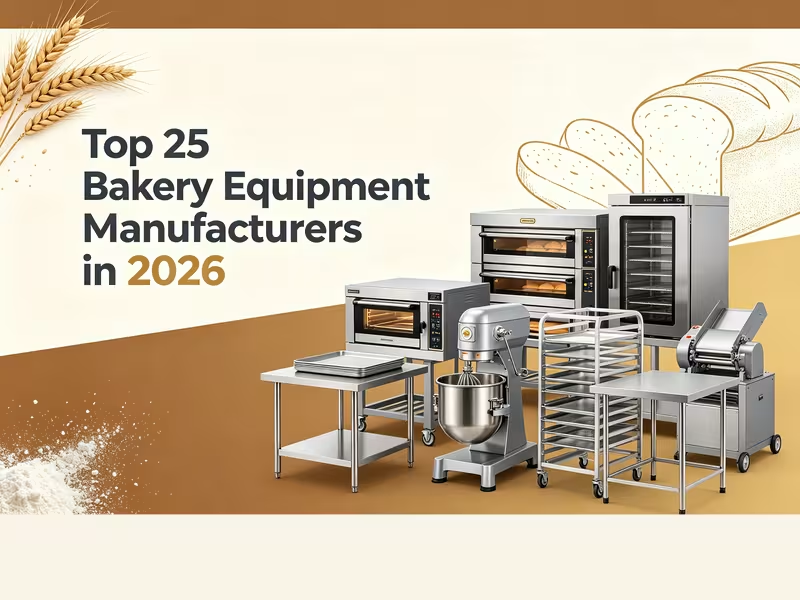
This guide is for industrial plants, bakery chains, and commercial bakeries building a credible shortlist in 2026. It covers 25 manufacturers across four groups:
- Full-line industrial systems
- Dough processing and mixing
- Ovens and thermal processing
- Depositing, forming, and decorating
The list is grouped by specialty, not ranked by score. A full-line systems supplier and a rack oven specialist do completely different jobs. A numbered leaderboard would just obscure the decision you actually need to make.
If you’re new to the category, start with [Types of Bakery Equipment Explained], then come back here to match supplier types to your operation.
Why Choosing the Right Bakery Equipment Manufacturer Matters
The cost of a poor supplier choice is mostly invisible at first. It accumulates in four places:
- Unplanned stoppages that take down an entire shift
- Scrap from dough weights that drift or bake color that varies tray to tray
- Spare parts with long lead times that turn a minor fault into days of lost production
- Retrofits when the line cannot handle a new product your sales team already promised
The machine is only part of the equation. Service coverage, parts availability, and the supplier’s ability to support upgrades five years from now matter just as much as whatever is on page one of their brochure.
Key Evaluation Criteria
Before you meet any sales team, nail down five questions you want answered:
- Accuracy and consistency: What dough scaling tolerance does the divider hold across a full run? How even is bake color from edge to center, across a rack or through a tunnel?
- Automation level: Manual, semi-automatic, or fully automated — that decision locks in your labor model and your output per shift.
- Versatility: How long does a changeover take between product types? Can the line handle lean doughs, enriched doughs, laminated doughs, and batters without major reconfiguration?
- Support and service: Are there technicians based in your region? What is the typical parts lead time? Is remote diagnostics available?
- Total cost of ownership: Get the five-year number — energy, labor, maintenance, and planned downtime — not just the purchase price.
Overview of the Top 25 Bakery Equipment Manufacturers in 2026
These companies were selected on three grounds: process coverage, international service reach, and depth of experience in industrial or commercial baking. The numbering follows the category groupings and does not indicate quality ranking.
Full-Line Industrial Bakery Systems
These suppliers build complete lines from mixing through cooling. They suit high-volume plants that want one partner accountable for the whole process — not a mix of vendors pointing at each other when something breaks.
1. Bühler Group – Integrated Processing from Grain to Finished Bake

Bühler’s 2018 acquisition of Haas gave it one of the strongest portfolios in wafer, biscuit, cookie, and cake production. Its milling background means it understands the flour entering the line, not just the machines processing it — a distinction that matters more than it sounds when you’re troubleshooting bake consistency. Best fit: large plants that want a single engineering partner across the full process.
Headquarters: Uzwil, Switzerland
Founded: 1860
Scale: Around 12,000 employees worldwide
Main Products: Wafer lines, biscuit and cookie lines, mixing systems, depositing systems, industrial ovens
Market Distribution: Global, with strong presence in Europe, Asia-Pacific, and the Americas
Website: www.buhlergroup.com
2. GEA Group – Hygienic, High-Capacity Bakery Processing

GEA builds mixing, depositing, forming, and baking systems for bread, pastry, cakes, and biscuits. Its hygienic design standards carry over from dairy and pharmaceutical work, which is a genuine structural advantage in plants where allergen and sanitation audits are routine rather than occasional. Best fit: high-volume plants with strict cleaning requirements and multi-allergen product ranges.
Headquarters: Düsseldorf, Germany
Founded: 1881
Scale: Around 18,000 employees worldwide
Main Products: Industrial mixers, depositors, forming systems, tunnel ovens, cake and pastry lines
Market Distribution: Global, strong in Europe, North America, and Asia
Website: www.gea.com
3. The Middleby Corporation – Multi-Brand Portfolio from Retail to Industrial
Middleby operates a family of bakery brands, including Auto-Bake Serpentine and Baker Thermal Solutions, covering everything from in-store baking to full industrial lines. The practical benefit for buyers is access to multiple engineering teams through one procurement relationship. Best fit: operators running different production scales who want one group to coordinate with.
Headquarters: Elgin, Illinois, USA
Founded: 1888
Scale: 10,000+ employees across multiple brands
Main Products: Industrial ovens, proofers, conveyors, automated bakery systems, commercial ovens
Market Distribution: North America, Europe, Asia-Pacific, Middle East, Latin America
Website: www.middleby.com
4. JBT Marel – Automation and Line Integration for Large Processors
Formed by the 2025 merger of JBT and Marel, this group covers spiral freezers, proofers, ovens, and plant automation. Bakery sits inside a broader food technology portfolio, which matters if your operation also handles proteins or prepared meals on adjacent lines. Best fit: processors adding frozen or par-baked bakery products to existing multi-category production.
Headquarters: Chicago, Illinois, USA
Founded: 2025 (JBT roots to 1884; Marel founded 1983)
Scale: Global food technology group with operations on six continents
Main Products: Spiral freezers, proofers, ovens, conveying systems, line automation software
Market Distribution: Global
Website: www.jbtmarel.com
5. AMF Bakery Systems – Turnkey Lines for Bread, Buns, and Tortillas
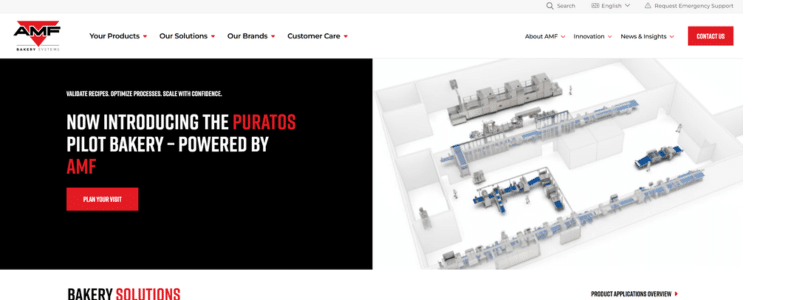
AMF is one of the few builders capable of delivering a complete bread or tortilla plant — mixing through packaging — and backing it with installations across more than 100 countries. It sits inside Markel Food Group alongside sister companies with complementary specialties. Best fit: high-volume pan bread, bun, and tortilla producers who need a single accountable line builder.
Headquarters: Richmond, Virginia, USA
Founded: Roots in American Machine & Foundry (1900)
Scale: Global line builder with installations in more than 100 countries
Main Products: Bread and bun lines, tortilla systems, horizontal mixers, proofers, tunnel ovens, cooling conveyors
Market Distribution: North America, Europe, Asia, Latin America, Middle East
Website: amfbakery.com
6. Mecatherm – Automated Lines for Crusty Bread and Pastry
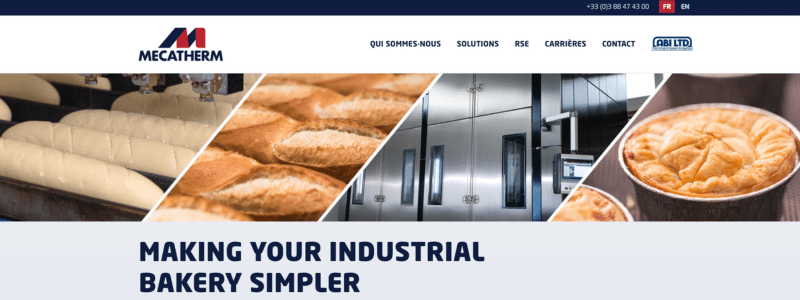
Mecatherm’s strength in baguette and crusty bread lines reflects its French origins — it understands those products from the inside, not just the machinery around them. Its thermal engineering is notably strong. Best fit: industrial producers of baguettes, crusty bread, and pastry who need high-speed automated lines built around the product rather than adapted from something else.
Headquarters: Barembach, France
Founded: 1964
Scale: International line builder with export projects worldwide
Main Products: Industrial ovens, proofers, baguette lines, bun lines, pastry lines
Market Distribution: Europe, North America, Asia, Middle East, Africa, Latin America
Website: www.mecatherm.fr
7. Kaak Group – Complete Lines Backed by Project Engineering
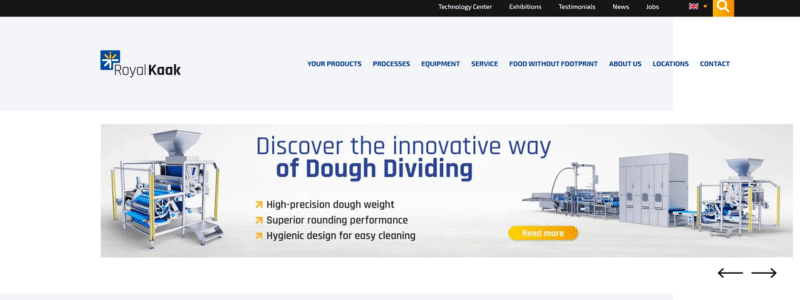
Kaak covers every stage from mixing to spiral cooling, and adds in-house plant design and project management. That combination is especially useful when you’re building a new facility and need one team responsible for layout, equipment integration, and commissioning — not just the hardware. Best fit: greenfield plants and full-factory automation projects.
Headquarters: Terborg, Netherlands
Founded: 1846
Scale: International bakery engineering group with multiple European sites
Main Products: Complete bread lines, dough processing systems, tunnel ovens, spiral coolers, pan handling
Market Distribution: Europe, Middle East, Asia, North America, Africa
Website: www.kaak.com
8. WP Bakery Group – Artisan Know-How Scaled to Industrial Lines
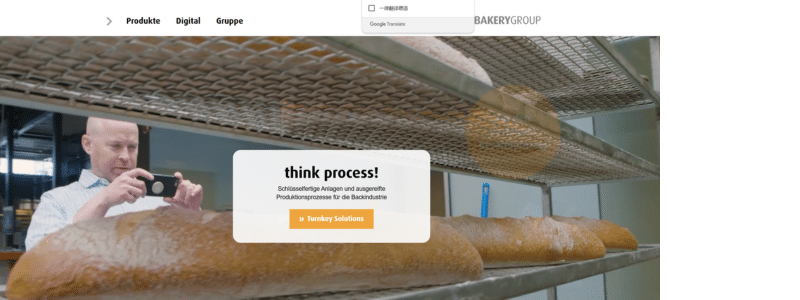
WP operates through brands including WP Kemper and WP Haton, covering mixing, dividing, moulding, ovens, and refrigeration. It is one of the few groups that serves both craft bakeries and industrial plants without treating one as a step toward the other. Best fit: bakeries growing from craft production toward semi-industrial scale who want one equipment family across the transition.
Headquarters: Dinkelsbühl, Germany
Founded: 1879 (as Werner & Pfleiderer)
Scale: Multi-brand bakery technology group
Main Products: Spiral mixers, dividers, moulders, deck and tunnel ovens, refrigeration systems
Market Distribution: Europe, North America, Asia, Middle East
Website: www.wp-bakerygroup.de
Dough Processing and Mixing Specialists
These companies concentrate on mixing, dividing, rounding, and sheeting. For products where the dough itself carries the quality — croissants, artisan breads, filled rolls — this group matters more than the oven downstream.
9. Rademaker – Sheeting and Laminating Lines for Industrial Pastry
Rademaker’s low-stress dough handling protects lamination layers at high line speeds, which is exactly where most laminated-product defects originate. Its systems run croissants, puff pastry, pizza, and sheeted bread. Best fit: high-capacity producers of laminated and sheeted dough who cannot afford layer damage once output scales up.
Headquarters: Culemborg, Netherlands
Founded: 1977
Scale: Specialist line builder with global installations
Main Products: Laminating lines, croissant lines, pizza lines, sheeted bread lines
Market Distribution: Europe, North America, Asia-Pacific, Middle East, Latin America
Website: www.rademaker.com
10. Rondo – Sheeters and Laminating from Craft to Industrial
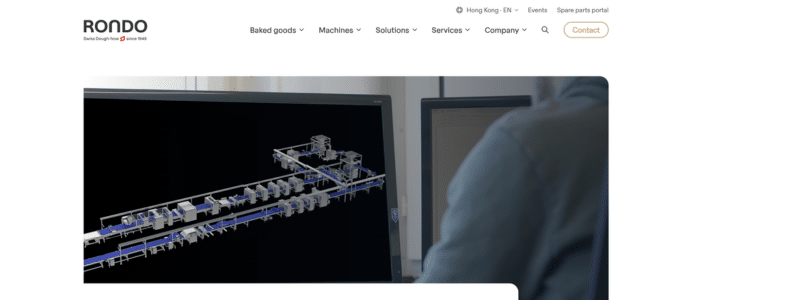
Rondo’s range runs from tabletop sheeters up to complete laminating and make-up lines. Because you can buy from the same supplier at every stage of growth, you do not have to retrain your team or rebuild your processes when you scale. That continuity has real operational value. Best fit: pastry producers scaling gradually who want one equipment partner across the journey.
Headquarters: Burgdorf, Switzerland
Founded: 1948
Scale: International specialist with subsidiaries in Europe, North America, and Asia
Main Products: Dough sheeters, laminating lines, make-up lines, cutting stations
Market Distribution: Europe, North America, Asia, Middle East, Latin America
Website: www.rondo-online.com
11. Koenig Group – Dividing and Rounding for Bread and Rolls
Koenig’s focus is precision portioning, particularly across high-count roll programs where weight variance accumulates quickly and quietly. Its dividers, rounders, and roll make-up systems are well established in European industrial and semi-industrial bakeries. Best fit: roll bakeries where portion consistency is a daily quality standard, not an occasional audit.
Headquarters: Graz, Austria
Founded: 1966
Scale: Mid-to-large international manufacturer
Main Products: Dough dividers, rounders, roll lines, bread make-up systems
Market Distribution: Europe, Asia, North America, Middle East, Africa
Website: www.koenig-rex.com
12. Sottoriva – Italian Dividers, Rounders, and Moulders
Sottoriva builds make-up machines for bread and pastry, from stand-alone units to compact integrated lines. It has a long track record with Italian and Mediterranean bread types. Best fit: mid-size bread bakeries looking to upgrade specific make-up stations without overhauling the entire line.
Headquarters: Marano Vicentino, Italy
Founded: 1944
Scale: Mid-size international manufacturer
Main Products: Volumetric dividers, rounders, moulders, sheeters, compact bread lines
Market Distribution: Europe, Middle East, Asia, Latin America, Africa
Website: www.sottoriva.com
13. Erika Record Baking Equipment – European Dough Systems with U.S. Support
Erika Record imports dividers, rounders, moulders, and mixers from European manufacturers and provides U.S.-based installation, parts, and ongoing service. That pairing gives North American buyers access to European dough-handling technology without the parts delays or timezone friction that typically comes with it. Best fit: North American bakeries that want European equipment with domestic support.
Headquarters: Clifton, New Jersey, USA
Founded: 1947
Scale: Specialist supplier and service provider
Main Products: Dough dividers, rounders, moulders, spiral mixers, bread make-up systems
Market Distribution: North America, Latin America
Website: www.erikarecord.com
14. Shaffer Mixers & Bakery Equipment – Industrial Horizontal Mixing Systems
Mixing is where dough consistency is either built or already compromised before the line starts moving. Shaffer’s horizontal and vertical mixers are built for the volume and scheduling demands of large pan bread and bun production. Now part of Bundy Baking Solutions. Best fit: large plants running continuous or near-continuous mixing schedules where batch-to-batch uniformity is non-negotiable.
Headquarters: Urbana, Ohio, USA
Founded: Mid-20th century; now a Bundy Baking Solutions brand
Scale: Specialist manufacturer within a larger baking group
Main Products: Horizontal bar mixers, vertical mixers, ingredient handling, mixer refurbishment
Market Distribution: North America, Latin America, Europe, Asia
Website: www.shaffermixers.com
Oven and Thermal Processing Specialists
Thermal processing is where energy costs, product quality, and throughput converge. These companies focus specifically on the bake — which makes them worth evaluating independently even if you plan to keep the rest of your line. For a closer look at how different oven types compare in industrial cake production, the bakery oven guide at topcakemachine.com covers rotary rack, deck, and tunnel configurations in useful detail.
15. Reading Bakery Systems – Cracker, Pretzel, and Baked Snack Lines
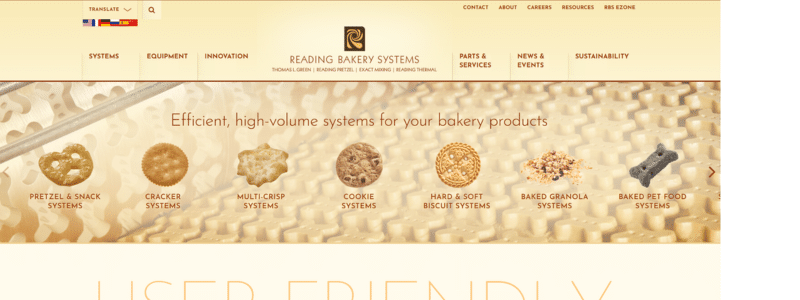
Reading builds snack and biscuit lines around its own continuous ovens. Its expertise in pretzels and crackers is genuinely rare — most general bakery suppliers treat those products as edge cases and engineer accordingly. Part of Markel Food Group. Best fit: manufacturers of crackers, pretzels, and baked snacks who need a builder that actually understands those products at process level.
Headquarters: Robesonia, Pennsylvania, USA
Founded: 1893
Scale: Specialist line builder within Markel Food Group
Main Products: Snack and cracker lines, pretzel systems, Thermatec ovens, sheeting and cutting systems
Market Distribution: North America, Europe, Asia, Latin America, Middle East
Website: www.readingbakery.com
16. Heat and Control – Continuous Thermal and Conveying Systems
Heat and Control’s core business is snack processing — tortilla chips, baked crisps, puffed products — with thermal, conveying, and packaging integrated end to end. It is not a bread equipment company, and presenting it as one would be misleading. Best fit: plants running continuous snack lines who want thermal, conveying, and seasoning from a single supplier that knows the product category.
Headquarters: Hayward, California, USA
Founded: 1950
Scale: Privately held, with manufacturing and service on several continents
Main Products: Continuous ovens and fryers, vibratory conveyors, seasoning systems, packaging integration
Market Distribution: Global
Website: www.heatandcontrol.com
17. Gemini Bakery Equipment Company – Ovens and Pan Handling for Bread Systems

Gemini fills gaps in existing bread and bun lines rather than replacing them entirely. If you need a new oven section, a pan handling upgrade, or a conveyor replacement without commissioning a full line build, Gemini is typically easier to work with than a full-line supplier whose minimum scope is the whole plant. Now part of Bundy Baking Solutions. Best fit: industrial bakeries replacing or adding single components in a live running line.
Headquarters: Philadelphia, Pennsylvania, USA
Founded: 1972; now a Bundy Baking Solutions brand
Scale: Specialist industrial supplier
Main Products: Tray and tunnel ovens, pan stackers and unstackers, conveyors, bread line components
Market Distribution: North America and export markets
Website: www.geminibe.com
18. MIWE – Deck Ovens and Process Climate Control
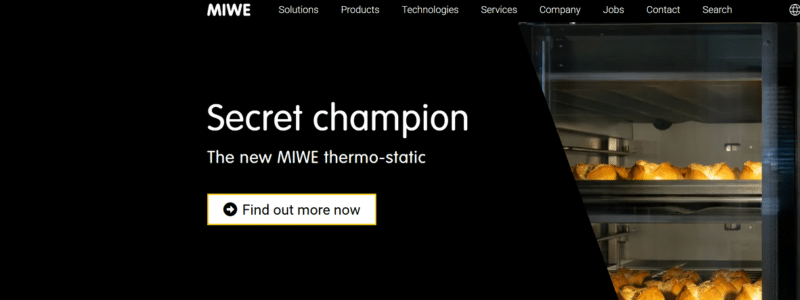
MIWE’s real differentiator is not the oven itself — it is the climate control during fermentation. Retarder proofing done well builds crumb structure and flavor that the oven simply cannot create on its own. MIWE makes deck ovens, rack ovens, retarder proofers, and blast freezers, and the systems are engineered to work as a coherent set rather than independent pieces. Best fit: premium craft bakeries and retail chains where fermentation control is part of the product identity.
Headquarters: Arnstein, Germany
Founded: 1919
Scale: Family-owned international manufacturer
Main Products: Deck ovens, rack ovens, in-store convection ovens, retarder proofers, blast freezers
Market Distribution: Europe, Asia, North America, Middle East, Africa
Website: www.miwe.com
19. Sveba Dahlen – Rack, Deck, and Tunnel Ovens
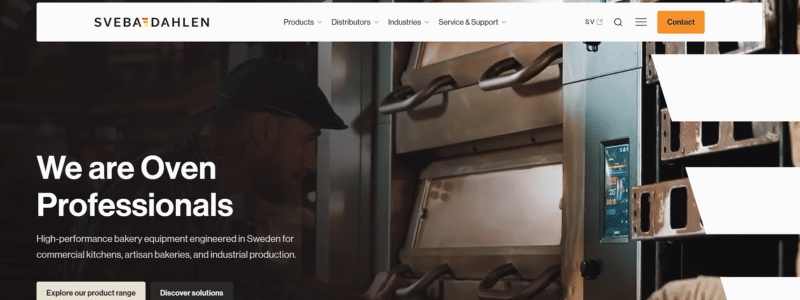
Sveba Dahlen covers the full oven range from artisan deck models through tunnel ovens, with energy efficiency built into the design rather than added as an afterthought. That consistency across the range makes it practical for retail chains running different formats under one procurement relationship. Best fit: retail chains and commercial bakeries that want one oven supplier across different store and production formats.
Headquarters: Fristad, Sweden
Founded: 1948
Scale: International oven specialist
Main Products: Rack ovens, deck ovens, tunnel ovens, proofers
Market Distribution: Europe, Middle East, Asia, North America
Website: www.sveba-dahlen.com
20. Revent – Rack Ovens Built Around Airflow

Revent’s focus is deliberately narrow: rack ovens, engineered specifically for even heat distribution from the top tray to the bottom. That solves a real and persistent problem — pale tops or overdone edges on a full rack load. If you’ve lived with that complaint and tried to manage it through airflow adjustments alone, you know how limited that approach is. Best fit: bakeries where consistent rack-to-rack color is a daily quality standard.
Headquarters: Upplands Väsby, Sweden
Founded: 1958
Scale: Specialist manufacturer with international subsidiaries
Main Products: Rack ovens, proofers, baking system accessories
Market Distribution: Europe, North America, Asia-Pacific, Middle East
Website: www.revent.com
21. Sinmag Equipment – Commercial Mixers, Ovens, and Sheeters from Asia

Sinmag makes spiral mixers, deck and rack ovens, proofers, and sheeters, with production in Taiwan and Wuxi, China. Its regional presence delivers shorter lead times and local service for buyers in Asia-Pacific — a practical advantage that European suppliers simply cannot match from that distance. Best fit: commercial and retail bakeries in Asia and the Middle East looking for reliable equipment without Western supply chain timelines.
Headquarters: Taiwan, with major production in Wuxi, China
Founded: 1983
Scale: Large regional manufacturer with global distribution
Main Products: Spiral mixers, deck ovens, rack ovens, proofers, dough sheeters
Market Distribution: Asia-Pacific, Middle East, Europe, Americas
Website: www.sinmag.com
22. Ali Group – Multi-Brand Foodservice Group with Bakery Ovens
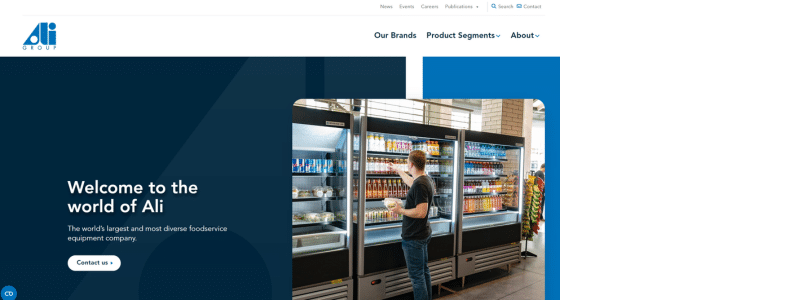
Ali Group is a large foodservice equipment conglomerate whose bakery-relevant brands include Moretti Forni and Belshaw Adamatic. It is not a dedicated bakery supplier, and you should not approach it as one. Its value is in consolidation. Best fit: chains that combine bakery and foodservice equipment purchasing through a single group relationship.
Headquarters: Milan, Italy
Founded: 1963
Scale: Multinational group with dozens of brands
Main Products: Deck and conveyor ovens, donut and fryer systems, refrigeration, food prep equipment
Market Distribution: Global
Website: www.aligroup.com
Depositing, Forming, and Decorating Specialists
For filled products, cookies, cakes, and finished pastries, portion accuracy and shape consistency are the quality standard. These companies build the equipment that makes those things repeatable at volume. Manufacturers building out complete cake lines — including depositing and forming alongside baking and cooling — can explore how these machines integrate into a full workflow via Yucho’s cake production line overview.
23. Rheon Automatic Machinery – Encrusting and Forming for Filled Products
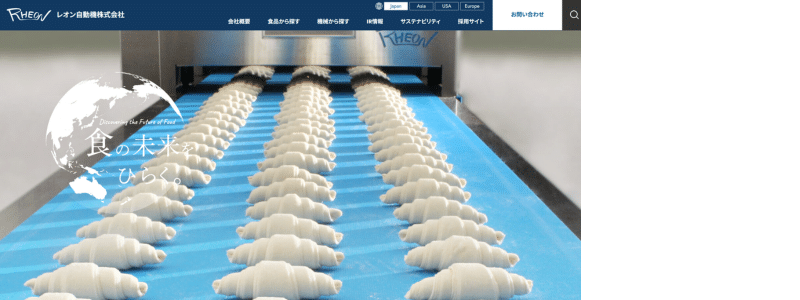
Rheon invented co-extrusion-style encrusting for filled baked goods and remains the benchmark in that category. Its systems wrap one material around another — filling inside dough, dough inside dough — with high accuracy across bun sizes and production speeds. Best fit: producers of filled buns, mochi, dim sum-adjacent pastries, and stuffed bakery items who need that precision at scale.
Headquarters: Utsunomiya, Japan
Founded: 1963
Scale: Publicly listed specialist with subsidiaries in the U.S. and Europe
Main Products: Encrusting machines, co-extrusion systems, stress-free dough lines, forming systems
Market Distribution: Asia-Pacific, Europe, North America, Middle East, Latin America
Website: www.rheon.com
24. Mimac Italia – Depositors for Cookies, Cakes, and Muffins
Mimac’s depositors use interchangeable nozzles and dies, which makes switching between product types faster than on most comparable machines. That matters most when you run small batches of different SKUs and cannot afford long changeover windows eating into your production schedule. Best fit: confectionery bakeries between artisan and industrial scale, where variety and fast changeover matter as much as raw throughput.
Headquarters: Italy
Founded: 1987
Scale: Mid-size international specialist
Main Products: Depositors, wire-cut cookie machines, cake and muffin depositing systems
Market Distribution: Europe, Asia, Middle East, Americas
Website: www.mimac.it
25. Bakon Food Equipment – Depositing, Spraying, and Glazing Machines
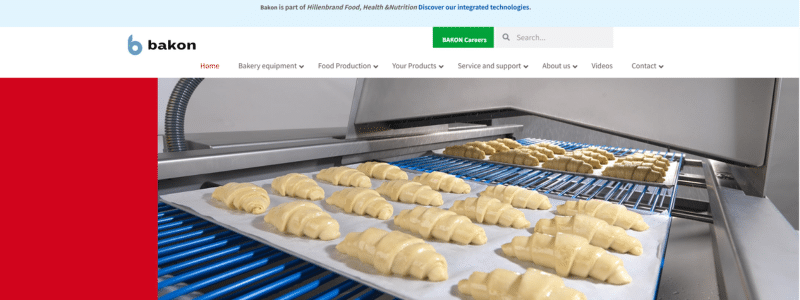
Bakon makes compact, repositionable depositing, spraying, glazing, and cutting equipment. Its machines are designed to move between workstations rather than anchor a fixed conveyor layout — a practical advantage in production environments where the product mix shifts regularly. If your finishing needs intersect with industrial cake manufacturing equipment, Bakon covers the depositing and decorating end of that spectrum. Best fit: cake and pastry producers adding decoration or finishing capacity without building a dedicated line.
Headquarters: Netherlands
Founded: 1961
Scale: Specialist manufacturer with dealers worldwide
Main Products: Depositors, spraying systems, glazing machines, cake cutters
Market Distribution: Europe, North America, Asia, Middle East
Website: www.bakon.com
Company details reflect publicly available information as of late 2026. Ownership structures and headcounts shift regularly in this sector — verify directly before you finalize any procurement decision.
How These Manufacturers Solve Real Bakery Production Problems
Bakery plants rarely shut down from a single catastrophic failure. They lose margin slowly, through the same small problems repeating every shift.
- Inconsistent output: Servo-driven dividers hold tighter weight tolerances than pneumatic or hydraulic systems. Multi-zone oven controls let you correct bake color zone by zone rather than accepting a line average. Koenig and MIWE address this from opposite ends of the same production flow.
- Unplanned downtime: Modular components and remote diagnostics shorten repairs from days to hours — but only if the supplier has parts stocked within reach of your facility. Confirm regional warehouse locations before you sign anything.
- Scaling limits: The best time to think about capacity expansion is before you need it. Rondo and Rademaker design their sheeting and make-up systems to accept additional modules, so you add capacity without rebuilding from scratch.
- Hygiene and allergen compliance: Open-frame, washdown-ready equipment cuts cleaning time between allergen runs. GEA and Bühler apply the same hygienic design principles they use in dairy and pharma — which sets a noticeably higher bar than what general bakery equipment standards typically require.
- Automation gaps: PLC and HMI recipe control, combined with data integration into your plant management system, closes the variance that opens up between operators across different shifts. That variance is not always machine error. Often it is undocumented manual adjustments that no spec sheet will warn you about.
Tips for Selecting the Right Bakery Equipment Manufacturer
Before you compare suppliers, decide which category of supplier fits your operation. The right manufacturer in the wrong category is still the wrong choice.
- Production scale: If your lines run across multiple shifts without stopping, start with full-line suppliers. Smaller or more varied operations usually get better fit from specialists.
- Product type: Laminated dough narrows the field to Rademaker or Rondo. Filled products point to Rheon. Crackers and pretzels lead to Reading Bakery Systems. Let your product decide first, then look at suppliers.
- Budget vs. ROI: A lower purchase price that comes with high energy consumption, frequent breakdowns, or slow parts supply will cost more over five years. Build the full ownership cost into your comparison — not just the invoice.
- After-sales support: Ask each supplier for the name and location of the nearest service technician, their typical response time, and their current lead time on the top ten most-replaced parts for your equipment class.
- Local vs. global supplier: Global suppliers usually carry deeper engineering capability. Local suppliers commission faster and introduce fewer logistics variables. The right answer depends on how complex your line is and how often you expect to need hands-on support.
Shortlist three to five suppliers from the right category, then ask each one for a trial run using your own dough and your own recipe. What happens in that trial tells you more than any specification sheet.
FAQ – Bakery Equipment Manufacturers
Q1: How much does industrial bakery equipment cost?
A standalone commercial mixer or deck oven typically starts in the five-figure range. Semi-automatic processing stations run considerably higher. Fully automated lines for bread or pastry production can reach several million dollars, depending on throughput, automation level, and customization. Always request itemized quotes so you can compare like for like rather than headline totals.
Q2: What is the difference between industrial and commercial bakery equipment?
Industrial equipment is built for continuous production integrated into a full line — mixing, makeup, proofing, baking, cooling, and packaging all connected and running together. Commercial equipment is designed for batch production at lower volumes, typically in standalone or loosely connected configurations. The full-line and snack-line groups in this article serve industrial operations. Sinmag, Revent, and MIWE are more commonly found in commercial and retail settings.
Q3: Should I buy bakery equipment from a global or a local manufacturer?
Think about commissioning and installation before you think about ongoing service. Global manufacturers often fly engineers in for commissioning, which adds cost and scheduling uncertainty. Local suppliers can mobilize faster and handle follow-up visits more easily. The trade-off is that local suppliers may not have the depth of experience needed for complex multi-stage lines. Match the supplier’s capability to the complexity of your project, not to your preference for familiarity.
Q4: What certifications should bakery equipment have?
CE marking covers the EU. For North America, look for UL or ETL electrical certification and NSF food-safety certification. ISO 9001 reflects manufacturing quality management. EHEDG certification applies specifically to hygienic equipment design and is relevant if your line handles allergens or runs multiple products through shared equipment. Confirm which certifications your target market actually requires before you specify equipment — not after.
Q5: Is used or refurbished bakery equipment worth buying?
For startups or backup capacity, refurbished equipment can make financial sense. The risks are concrete: control systems may be obsolete, spare parts may no longer be manufactured, and warranty terms vary widely between sellers. Before you buy, ask for full refurbishment records, written confirmation that parts are still available from the OEM or aftermarket, and warranty terms covering both parts and labor.