Aeration mistakes rarely show up at the mixer. They show up later. Sponge sheets bake short, chiffon shrinks as it cools, cream weeps in the display case, and deposit weights drift by the end of the shift. By the time anyone notices, the batter is already in the oven or the product is already packed.
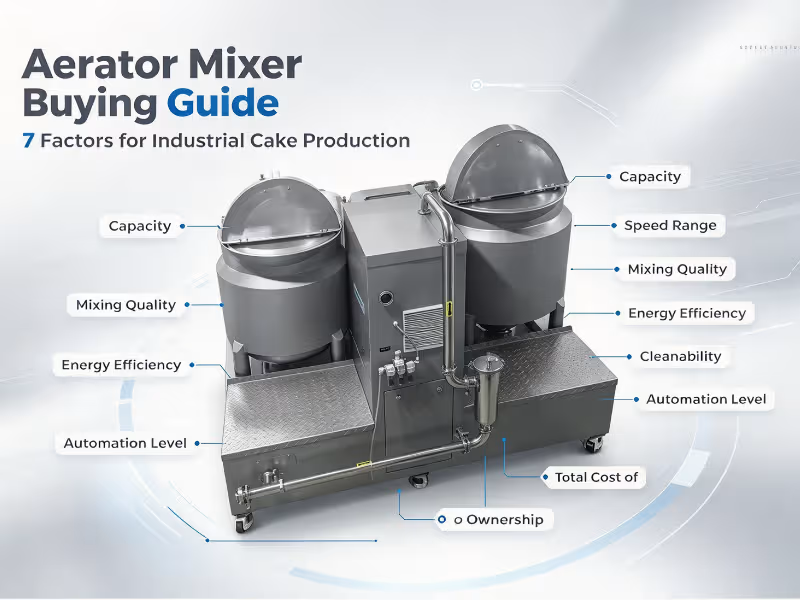
Choosing an aerator mixer is therefore a process decision, not just a mixer purchase. The right machine matches your product, your production pattern, and the line around it. This guide covers seven factors in the order a process engineer would check them: product type, batch vs. continuous production, density targets, throughput, changeover and sanitation, downstream integration, and future expansion.
What an Aerator Mixer Does in Industrial Cake Production
An aerator mixer has two jobs. First, it brings air into the product. Second, it breaks that air into small, even bubbles. The amount of air sets volume and density. Bubble size and distribution set crumb texture in cake and mouthfeel in cream or mousse.
These two jobs are separate, and buyers often treat them as one. A batter can hit the right density with coarse, uneven bubbles and still bake poorly. Keep “how much air” and “how fine the air is” apart as you read the factors below.
There are two ways to do the work. A batch mixer whips air in through the open surface of a bowl. The result depends on time, speed, and the operator’s judgment. A continuous aerator feeds premix and metered compressed air into a closed mixing head, usually a rotor and stator. The head breaks the air into fine bubbles under pressure, and the product leaves at a steady density as long as the inputs stay steady. Neither method is better in general. Factor 2 covers when each one fits.
On a continuous aerator mixer, operators control density mainly through three settings: airflow, mixing head speed, and back pressure. Product temperature often matters just as much, and it is managed through a jacketed head or a chilled feed. In the line, the aerator sits between preparation and forming:
Premix or cooking → aeration → depositing or filling → baking or chilling
Whatever the aerator produces goes straight to the next station. If the aerated product is wrong, the next station has no way to correct it.
1. Product Type and Formulation
Start with what you are aerating. Viscosity, fat content, temperature sensitivity, and foam fragility all change what the mixing head has to do. A machine tuned for egg-based sponge batter can damage cream or mousse, and a cream machine can struggle with sponge batter. List your products before you compare machines.
Each product fails in its own way. That failure mode tells you what to look for.
Sponge batter
Sponge batter is egg-based and highly aerated. Most of its structure comes from the foam. The main risk is coarse or uneven bubbles, which bake into an open, irregular crumb and uneven sheet height.
Look for fine dispersion and stable density across long runs. These matter most for layer cake sheets and Swiss rolls, where every tray has to match the next one. A dedicated Sponge Cake Aerator is built around this need.
Chiffon batter
Chiffon is harder. It contains oil, which tends to break down foam, yet it depends on a stable meringue structure for height. The main risk is volume loss between the aerator outlet and the oven.
For chiffon, gentle shear and short transfer time matter more than maximum air content. A machine that drives in as much air as possible can leave you with a batter that looks right at the outlet and has collapsed by the time it reaches the mold. A Chiffon Cake Aerator Mixer handles the oil-and-meringue balance directly.
Cream and toppings
Cream is very sensitive to temperature. If the product warms inside the mixing head, the fat structure weakens. Overrun becomes unstable, and the cream can weep hours later, often after the product has left the plant.
Look for temperature control at the head, not only a chilled feed tank. A Continuous Cream Aerating Machine is designed to hold overrun steady while keeping the product cold.
Mousse
Mousse is usually a two-step process. First, the base is cooked or heated, for example to dissolve gelatin or pasteurize dairy. Then it is cooled to the right window before aeration. The main risk is aerating the base at the wrong temperature. If it is too warm, it loses air. If it is too cold, it starts setting in the pipe.
Treat mousse as a linked pair of machines: a Mousse Cooking Mixer to prepare the base and a Mousse Aeration Machine to aerate it. Buying only the aeration step and improvising the cooking step is where most mousse lines go wrong.
The multi-product trap
If one machine has to run sponge in the morning and cream in the afternoon, ask the supplier to demonstrate it on your hardest product, not your easiest. A machine that handles sponge batter well proves very little about how it will handle a temperature-sensitive cream. If you ignore this factor, you get a machine that runs one product well and the rest at a compromise every day.
2. Batch vs. Continuous Production
Batch whipping is still the right answer for many bakeries. It works when runs are short, products change often, and small density differences between bowls do not show in the finished cake. A commercial planetary mixer also handles creams, fillings, and icings that a dedicated aerator may not.
That said, batch whipping has a ceiling, and most factories reach it before they notice. Look for these signs on your own floor:
- The depositor waits. The line pauses while the next bowl finishes whipping.
- Batter ages in the hopper. Product sits while the next batch is whipped and loses air before it is deposited.
- Cup weights vary by bowl. Density checks change from one batch to the next even with the same recipe.
- Results change by shift. Different operators produce different volumes from the same settings.
- Baked height varies by tray. The oven profile is stable, but the cakes are not.
If you see two or more of these, batch has become the bottleneck. Continuous aeration produces product at the rate the line uses it, so batter does not wait and degrade. Density depends on set parameters instead of timing and operator feel. For lines that feed a depositor at steady speed, a Cake Batter Aeration Machine is the usual next step.
That said, continuous is not always the upgrade it looks like. A continuous aerator needs a steady premix supply and runs long enough to justify startup, stabilization, and cleaning. On short runs with many products, a growing share of each run is lost to startup and flushing, and the advantage disappears. Buying continuous too early is one of the most expensive mistakes in this category.
3. Density Consistency and Stability Targets
“Consistent quality” is not a specification. A density target is.
Most factories track aeration with a cup-weight test, which weighs a fixed-volume cup of product, or as specific gravity. Set a target and an acceptable range for each product based on your own trials, not on a supplier’s brochure. Then ask each supplier how the machine holds that range over a full production run, not just in the first ten minutes.
Why density sets your deposit weight
Most depositors meter by volume. If density drifts, the depositor delivers the same volume at a different weight. Fill weights move, baked height changes, and operators start overfilling to stay safe. Over a year, that safety margin turns into a real ingredient cost.
Fixing density at the aerator is often cheaper than fixing fill weight at the depositor. The depositor can only measure volume, while the aerator controls what that volume weighs.
Stability matters as much as starting density
Initial density tells you only part of the story. You also need to know how long the foam holds between the aerator outlet and the oven or chiller. Fine, even bubbles hold longer than coarse ones at the same density.
Run this three-step test during trials:
- Measure cup weight at the aerator outlet.
- Measure it again after your real transfer and hopper time.
- Compare the baked height or set volume from both points.
The gap between steps 1 and 2 shows how much air you are losing before the product reaches the next station.
Check the premix first
An aerator cannot correct a premix that is lumpy, poorly emulsified, or uneven in temperature. If density swings while the machine settings stay the same, the cause is usually upstream. A Blade Homogenizer before aeration evens out the premix, so the aerator receives a uniform feed.
If you ignore this factor, you end up chasing density problems at the depositor, adjusting fill weights every shift while the real cause sits two stations upstream.
4. Throughput and Line Matching
Size the aerator from consumption, not from brochure capacity. Work backward from the station that uses the product. For batter, that is deposits per minute multiplied by weight per deposit. For cream, it is the filling or coating rate. Then add the product lost during startup and stabilization.
That figure is the steady output the aerator must hold at your target density. Rated capacity often assumes an ideal product, so ask suppliers for output data at your density and with your formulation.
Leave margin at both ends
A machine running at the top of its range has little room to absorb changes in product or temperature. Small disturbances can push density out of spec. A machine running far below its range may take longer to stabilize and lose more product at every startup.
Choose a size where normal output sits comfortably inside the working range. Ask suppliers about stable performance across that range, not peak output.
What each mismatch costs
An undersized aerator starves the depositor and forces stop-start running. Each restart shifts density, so the problem spreads to every tray that follows. An oversized aerator costs more to buy and loses more product at each startup and flush.
The two mistakes look opposite, but they end in the same place: uneven deposits and wasted product.
5. Changeover Frequency and Sanitation Demands
Count your changeovers before you compare machines. Every product switch on a closed aeration system means flushing, cleaning, and re-stabilizing. One change a day is routine. Five changes a shift can take a large share of production time, and on some lines that alone rules out a machine path before specs are even compared.
Product-specific hygiene risks
Not every product carries the same risk. Dairy cream and mousse support microbial growth if residue stays in dead zones. Allergen changeovers, such as moving to a dairy-free or nut-free run, need verified cleaning, not just a rinse. Lines running these products need stricter routines than lines running only batter.
What to inspect before you buy
Use this checklist during supplier visits or factory acceptance tests:
- CIP readiness. Is the machine CIP-ready, and does it fit your existing CIP system?
- Dead legs. Are there pipe sections that are hard to drain or reach?
- Head access. Can the mixing head be taken apart without special tools?
- Seals and gaskets. Are they easy to reach, inspect, and replace?
- Flush loss. How much product is lost when switching between products?
- Recipe recall. Can settings be stored and recalled after cleaning, so the restart does not depend on memory?
If you ignore this factor, a machine that performs well in trials can lose an hour or more each shift to cleaning once it runs your real product schedule.
6. Downstream Process Integration
The aerator has to suit the station after it, not only the product. Many lines get aeration right at the outlet and then lose it in the pipe.
Long pipe runs, tight bends, and pumps between the aerator and the depositor add shear and pressure changes. Bubbles merge, air escapes, and density rises before the product reaches the hopper. Ask suppliers where the aerator should sit relative to the depositor or filler. Measure density at the point of use, not only at the outlet.
Supply rhythm and hopper level
A depositor works best with a steady, matched supply. Large surges let batter sit in the hopper and lose air, while gaps starve the depositor. Continuous aeration matched to depositor speed keeps hopper residence time short and predictable. This is often a bigger quality gain than any setting change on the aerator itself.
What each downstream station needs
Different stations put different demands on the aerated product:
- Depositing and baking: Batter needs stable density and enough foam strength for good oven spring.
- Injection, filling, or coating: Cream needs stable overrun and the right temperature at the nozzle.
- Mold filling: Mousse needs to flow well enough to fill cleanly, then set on schedule.
If you ignore this factor, you buy a well-performing aerator and still get poor product, because the product changes between the aerator and the next machine.
7. Future Line Expansion and Flexibility
Check your product roadmap before you finalize the purchase. If mousse cakes or cream-filled lines are planned, find out now whether the aerator can handle them or whether a separate path will be needed. Adding mousse usually means adding a cooking step as well as aeration, which affects floor space, utilities, and budget.
Plan how capacity will grow
Ask suppliers how capacity scales: a larger head, a second unit, or a separate line. Check whether controls and recipes can move to a larger machine. Confirm that floor space, air supply, and chilled water leave room for the next step.
Do not buy for a future you have not planned
That said, flexibility is only worth paying for when the roadmap is real. A multi-purpose system bought for a product you may never launch often does each current job less well than a dedicated machine. Size for confirmed plans and leave physical room for possible ones.
If you ignore this factor, you face one of two problems: a machine that blocks next year’s product launch, or one that carries cost and compromise for a launch that never happens.
How to Match the 7 Factors to the Right Equipment Path
Use the factors in order. Product type narrows the machine family. Batch vs. continuous and throughput set the scale. Density, changeover, and downstream checks confirm the configuration. Expansion is the final check.
Buyers who start from capacity or price often end up with a machine that looks right on paper but does not suit the product. Use the table below to match common production scenarios to the equipment path worth evaluating first.
|
Production scenario |
Main risk |
Equipment path to evaluate |
|---|---|---|
|
Long sponge sheet runs for layer cakes or Swiss rolls |
Coarse crumb, density drift |
Sponge Cake Aerator |
|
Chiffon cakes in molds |
Volume loss before baking |
Chiffon Cake Aerator Mixer |
|
Several batter types feeding a depositor at line speed |
Fill-weight drift, air loss in the hopper |
|
|
Cream for filling, coating, or decorating |
Unstable overrun, weeping |
Continuous Cream Aerating Machine |
|
Mousse cakes from a cooked base |
Wrong base temperature, early setting |
Mousse Cooking Mixer + Mousse Aeration Machine |
|
Density swings with no change in settings |
Uneven premix |
Blade Homogenizer before aeration |
|
Short runs, many SKUs, moderate volume |
Startup and cleaning losses |
Batch mixing may still be the better fit |
Common mismatches to avoid
Three mistakes come up again and again. The first is buying a batter aerator and expecting it to run cream without temperature control at the head. The second is installing continuous aeration on a line that changes products every hour, where flushing losses outweigh the consistency gains. The third is sizing to peak output instead of steady demand, which leaves the machine running too far below its working range for most of the week.
What to prepare before requesting quotes
Prepare this information before you contact suppliers. It turns a general sales conversation into a real sizing discussion:
- Product list with formulations
- Target density or cup weight for each product
- Required output per hour at steady state
- Changeovers per shift and the allergen or dairy switches involved
- Downstream equipment and layout, including pipe run distances
- Planned products for the next two to three years
Send this list to Yucho, and our engineering team will recommend the aeration path that fits your line, whether that means one machine or a linked combination. You can review the full range of aerator mixer options before that conversation, so you arrive knowing which factors matter most for your products.